QUESTION IMAGE
Question
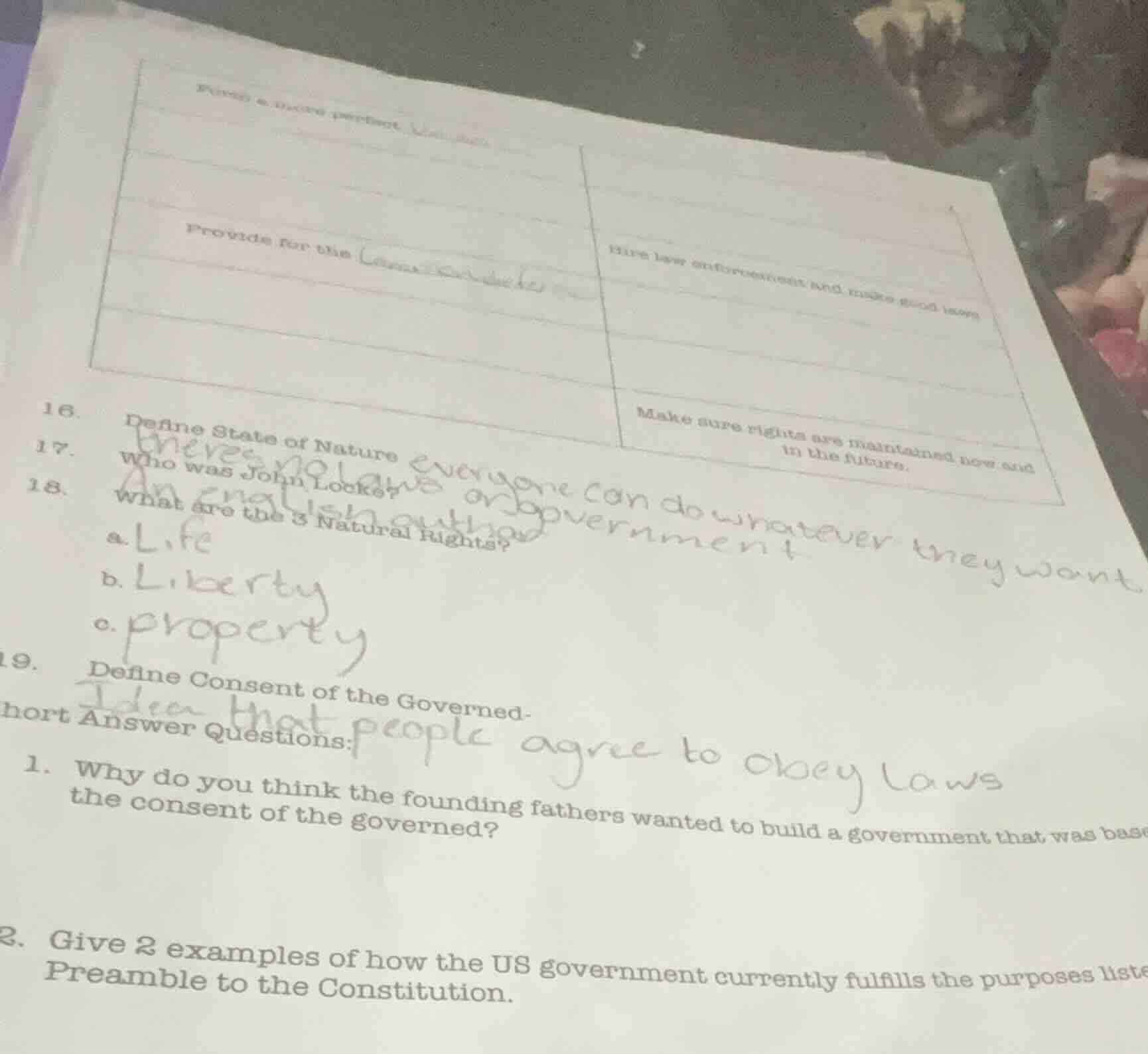
- define state of nature
- who was john locke?
- what are the 3 natural rights?
a. life
b. liberty
c. property
- define consent of the governed.
short answer questions:
- why do you think the founding fathers wanted to build a government that was based on the consent of the governed?
- give 2 examples of how the us government currently fulfills the purposes listed in the preamble to the constitution.
Question 16: Define State of Nature
The "State of Nature" is a philosophical and political concept (often associated with thinkers like John Locke, Thomas Hobbes). In this state, there is no established government or laws. Individuals exist in a condition where they have natural freedoms and can act as they see fit, but also face uncertainties (like conflict due to lack of order). Locke viewed it as a state of perfect freedom and equality, where people have natural rights but may form a government to better secure those rights.
John Locke was an English philosopher and political theorist. He is a key figure in the Enlightenment, known for his ideas on natural rights (life, liberty, property), the social contract (consent of the governed), and the idea that government’s purpose is to protect rights. His work influenced the American Revolution and the founding of the US (e.g., ideas in the Declaration of Independence).
From John Locke’s theory, natural rights are inherent rights people have in the state of nature (and retain in society). The three are: Life (the right to exist and be secure in one’s life), Liberty (the right to act freely within reason, without unjust restraint), and Property (the right to own or control one’s possessions, including one’s own labor/self).

Snap & solve any problem in the app
Get step-by-step solutions on Sovi AI
Photo-based solutions with guided steps
Explore more problems and detailed explanations
A theoretical condition where individuals exist without a formal government, laws, or social order; they have natural freedoms and rights but may face challenges like insecurity (interpretation based on political philosophy, e.g., Locke’s view: a state of perfect freedom, equality, and natural rights, leading people to form government to secure rights).