QUESTION IMAGE
Question
- directions
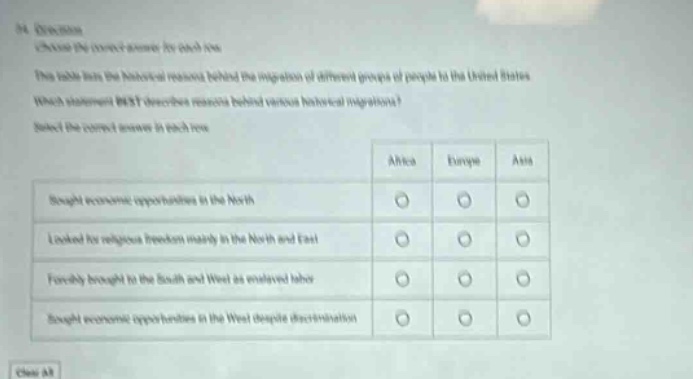
choose the correct answer for each row.
the table lists the historical reasons behind the migration of different groups of people to the united states.
which statement best describes reasons behind various historical migrations?
select the correct answer in each row.
| africa | europe | asia | |
|---|---|---|---|
| looked for religious freedoms mainly in the north and east | ∘ | ∘ | ∘ |
| forcibly brought to the south and west as enslaved labor | ∘ | ∘ | ∘ |
| sought economic opportunities in the west despite discrimination | ∘ | ∘ | ∘ |
class 1a
To solve this, we analyze each migration reason with the regions (Africa, Europe, Asia):
1. "Sought economic opportunities in the North"
- Europe: Many European immigrants (e.g., Irish, German) moved to Northern US for industrial jobs/economic opportunities.
- Africa: Enslaved Africans were forced to South/West, not voluntary for Northern economic opportunities.
- Asia: Asian immigrants (e.g., Chinese) focused on West (railroads, mining), not North.
Thus, this reason applies to Europe (mark the circle under Europe for this row).
2. "Looked for religious freedoms mainly in the North and East"
- Europe: Groups like Pilgrims, Quakers, Jews from Europe sought religious freedom in Northern/Eastern US (e.g., New England, Mid-Atlantic).
- Africa: Enslaved, no religious freedom seeking as voluntary migration.
- Asia: Religious freedom not a primary Asian migration driver to US.
Thus, this reason applies to Europe (mark the circle under Europe for this row).
3. "Forcibly brought to the South and West as enslaved labor"
- Africa: Enslaved Africans were forcibly transported to Southern/Western US for plantation labor.
- Europe: Voluntary migration, not forced labor.
- Asia: Voluntary (or contract labor, not enslaved in same way).
Thus, this reason applies to Africa (mark the circle under Africa for this row).
4. "Sought economic opportunities in the West despite discrimination"
- Asia: Chinese, Japanese immigrants went to Western US (West Coast) for gold rush, railroads, etc., facing discrimination (e.g., Chinese Exclusion Act).
- Europe: Focused on North/East, not West.
- Africa: Enslaved in South/West, not voluntary economic migration to West.
Thus, this reason applies to Asia (mark the circle under Asia for this row).
Final Selections (Row by Row):
- Row 1 ("Sought economic opportunities in the North"): Europe (circle under Europe).
- Row 2 ("Looked for religious freedoms..."): Europe (circle under Europe).
- Row 3 ("Forcibly brought... enslaved labor"): Africa (circle under Africa).
- Row 4 ("Sought economic opportunities in the West..."): Asia (circle under Asia).
(Note: The table requires marking the correct region for each row. The above explains which region matches each reason.)

Snap & solve any problem in the app
Get step-by-step solutions on Sovi AI
Photo-based solutions with guided steps
Explore more problems and detailed explanations
To solve this, we analyze each migration reason with the regions (Africa, Europe, Asia):
1. "Sought economic opportunities in the North"
- Europe: Many European immigrants (e.g., Irish, German) moved to Northern US for industrial jobs/economic opportunities.
- Africa: Enslaved Africans were forced to South/West, not voluntary for Northern economic opportunities.
- Asia: Asian immigrants (e.g., Chinese) focused on West (railroads, mining), not North.
Thus, this reason applies to Europe (mark the circle under Europe for this row).
2. "Looked for religious freedoms mainly in the North and East"
- Europe: Groups like Pilgrims, Quakers, Jews from Europe sought religious freedom in Northern/Eastern US (e.g., New England, Mid-Atlantic).
- Africa: Enslaved, no religious freedom seeking as voluntary migration.
- Asia: Religious freedom not a primary Asian migration driver to US.
Thus, this reason applies to Europe (mark the circle under Europe for this row).
3. "Forcibly brought to the South and West as enslaved labor"
- Africa: Enslaved Africans were forcibly transported to Southern/Western US for plantation labor.
- Europe: Voluntary migration, not forced labor.
- Asia: Voluntary (or contract labor, not enslaved in same way).
Thus, this reason applies to Africa (mark the circle under Africa for this row).
4. "Sought economic opportunities in the West despite discrimination"
- Asia: Chinese, Japanese immigrants went to Western US (West Coast) for gold rush, railroads, etc., facing discrimination (e.g., Chinese Exclusion Act).
- Europe: Focused on North/East, not West.
- Africa: Enslaved in South/West, not voluntary economic migration to West.
Thus, this reason applies to Asia (mark the circle under Asia for this row).
Final Selections (Row by Row):
- Row 1 ("Sought economic opportunities in the North"): Europe (circle under Europe).
- Row 2 ("Looked for religious freedoms..."): Europe (circle under Europe).
- Row 3 ("Forcibly brought... enslaved labor"): Africa (circle under Africa).
- Row 4 ("Sought economic opportunities in the West..."): Asia (circle under Asia).
(Note: The table requires marking the correct region for each row. The above explains which region matches each reason.)