QUESTION IMAGE
Question
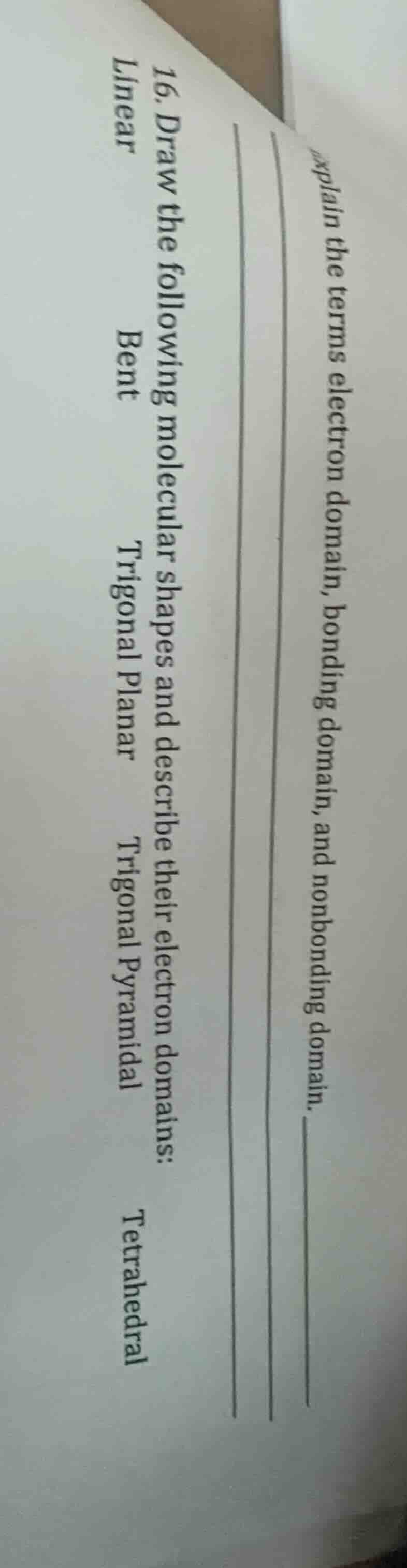
- draw the following molecular shapes and describe their electron domains: linear bent trigonal planar trigonal pyramidal tetrahedral
Brief Explanations
1. Linear:
- Electron Domains: 2 bonding domains, 0 non - bonding domains. The central atom has two regions of electron density (e.g., \(BeCl_2\), where \(Be\) is the central atom with two single bonds to \(Cl\) atoms).
- Shape Drawing: Represent the central atom (e.g., \(Be\)) in the middle. Draw two straight lines (bonds) extending from the central atom, 180° apart, to represent the two bonding domains (e.g., to two \(Cl\) atoms). The molecule is straight, like a line.
2. Bent:
- Electron Domains: 2 bonding domains, 1 or 2 non - bonding domains (e.g., \(H_2O\) has 2 bonding domains (to \(H\) atoms) and 2 non - bonding domains on the \(O\) atom; \(SO_2\) has 2 bonding domains and 1 non - bonding domain on the \(S\) atom).
- Shape Drawing: For a molecule like \(H_2O\), start with the central \(O\) atom. Draw two bonds (to \(H\) atoms) and represent the two non - bonding electron pairs (as pairs of dots or lines indicating electron density) around the \(O\). The two \(O - H\) bonds are bent at an angle (about 104.5° for \(H_2O\)). The overall shape is V - shaped.
3. Trigonal Planar:
- Electron Domains: 3 bonding domains, 0 non - bonding domains (e.g., \(BF_3\), where the central \(B\) atom has three single bonds to \(F\) atoms).
- Shape Drawing: Place the central \(B\) atom in the center. Draw three bonds extending from the central atom, each at 120° to the other two, forming a flat (planar) triangle. So the three \(F\) atoms are at the corners of an equilateral triangle with the \(B\) in the middle.
4. Trigonal Pyramidal:
- Electron Domains: 3 bonding domains, 1 non - bonding domain (e.g., \(NH_3\), where the central \(N\) atom has three single bonds to \(H\) atoms and one non - bonding electron pair).
- Shape Drawing: Start with the central \(N\) atom. Draw three bonds (to \(H\) atoms) and represent the non - bonding electron pair (as a pair of dots or a line) above or below the central atom. The three \(N - H\) bonds form a pyramid - like shape, with the \(N\) at the apex of the pyramid and the three \(H\) atoms at the base of the triangular pyramid. The bond angle is about 107°.
5. Tetrahedral:
- Electron Domains: 4 bonding domains, 0 non - bonding domains (e.g., \(CH_4\), where the central \(C\) atom has four single bonds to \(H\) atoms).
- Shape Drawing: Represent the central \(C\) atom. The four bonds (to \(H\) atoms) are directed towards the four corners of a regular tetrahedron. The bond angle between any two \(C - H\) bonds is about 109.5°. You can draw the central atom and then four bonds, with three in a sort of triangular base (but in 3D space, it's a tetrahedron) and one pointing up or down from the central atom.

Snap & solve any problem in the app
Get step-by-step solutions on Sovi AI
Photo-based solutions with guided steps
Explore more problems and detailed explanations
Linear:
- Electron Domains: 2 bonding, 0 non - bonding.
- Drawing: Central atom with two bonds at 180°.
Bent:
- Electron Domains: 2 bonding, 1 - 2 non - bonding.
- Drawing: V - shaped with bonding and non - bonding domains.
Trigonal Planar:
- Electron Domains: 3 bonding, 0 non - bonding.
- Drawing: Flat triangle (120° bond angles).
Trigonal Pyramidal:
- Electron Domains: 3 bonding, 1 non - bonding.
- Drawing: Pyramid - like with 3 bonds and 1 non - bonding domain.
Tetrahedral:
- Electron Domains: 4 bonding, 0 non - bonding.
- Drawing: Four - sided pyramid (tetrahedron) with 109.5° bond angles.