QUESTION IMAGE
Question
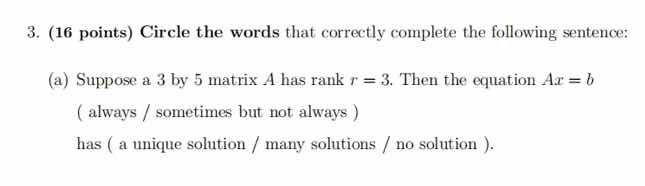
- (16 points) circle the words that correctly complete the following sentence: (a) suppose a 3 by 5 matrix ( a ) has rank ( r = 3 ). then the equation ( ax = b ) ( always / sometimes but not always ) has ( a unique solution / many solutions / no solution ).
To solve this, we use concepts from Linear Algebra (a subfield of Mathematics) about matrix rank, systems of linear equations, and the consistency and number of solutions.
Step 1: Recall the Rank-Nullity Theorem and Solution Conditions for \(Ax = b\)
For a matrix \(A\) of size \(m\times n\) (here \(m = 3\), \(n=5\)) and the equation \(Ax = b\):
- The rank of \(A\) is \(r=\text{rank}(A)\), and the rank of the augmented matrix \([A\mid b]\) is \(\text{rank}([A\mid b])\).
- The system \(Ax = b\) is consistent (has at least one solution) if and only if \(\text{rank}(A)=\text{rank}([A\mid b])\).
- If the system is consistent:
- If \(r = n\) (number of columns, which is the number of variables), then the system has a unique solution.
- If \(r < n\), then the system has infinitely many solutions (since there are free variables).
Step 2: Analyze the Given Matrix \(A\)
We have \(A\) as a \(3\times5\) matrix with \(\text{rank}(A)=r = 3\). The number of variables \(n = 5\) (since the number of columns of \(A\) is the number of variables in \(Ax = b\)). Here, \(r=3< n = 5\), so if the system is consistent, it will have many (infinitely many) solutions. But we also need to check when the system is consistent.
The rank of \(A\) is \(3\) (equal to the number of rows \(m = 3\)). The augmented matrix \([A\mid b]\) has size \(3\times6\). The rank of \([A\mid b]\) can be at most \(3\) (since it has \(3\) rows). Since \(\text{rank}(A)=3\), the rank of \([A\mid b]\) is either \(3\) (if \(b\) is in the column space of \(A\)) or greater than \(3\) (but it can't be, because it has only \(3\) rows). So \(\text{rank}(A)=\text{rank}([A\mid b]) = 3\) is always true? Wait, no. Wait, the column space of \(A\) is a subspace of \(\mathbb{R}^3\) (since \(A\) has \(3\) rows), and \(b\) is a vector in \(\mathbb{R}^3\). Since \(\text{rank}(A)=3\), the column space of \(A\) is \(\mathbb{R}^3\) (because the rank of \(A\) is equal to the number of rows, so the columns of \(A\) span \(\mathbb{R}^3\)). Therefore, for any \(b\in\mathbb{R}^3\), \(b\) is in the column space of \(A\), which means \(\text{rank}(A)=\text{rank}([A\mid b]) = 3\) always. Wait, is that correct?
Wait, a \(3\times5\) matrix with rank \(3\): the column space of \(A\) is \(\mathbb{R}^3\) (because the rank is equal to the number of rows, so the columns span \(\mathbb{R}^3\)). So for any \(b\in\mathbb{R}^3\), \(b\) is in the column space of \(A\), so the system \(Ax = b\) is always consistent. And since \(r = 3< n = 5\), the system has many (infinitely many) solutions.
Wait, let's re - express:
- The matrix \(A\) is \(3\times5\), \(\text{rank}(A)=3\) (so the column space of \(A\) is \(\mathbb{R}^3\), because the dimension of the column space is the rank, and if the rank is equal to the number of rows, the column space is the entire \(\mathbb{R}^m\) where \(m\) is the number of rows). So for any \(b\in\mathbb{R}^3\), \(b\) is in the column space of \(A\), which means \(\text{rank}(A)=\text{rank}([A\mid b])\) always. So the system \(Ax = b\) is always consistent. And since \(r = 3< n = 5\), the system has many (infinitely many) solutions.
So the first blank: "always" (because the system is always consistent, as \(b\) is always in the column space of \(A\) since \(\text{rank}(A) = 3=\) number of rows, so column space is \(\mathbb{R}^3\)), and the second blank: "many solutions" (because \(r = 3< n = 5\), so there are free variables, leading to infinitely many solutions).

Snap & solve any problem in the app
Get step-by-step solutions on Sovi AI
Photo-based solutions with guided steps
Explore more problems and detailed explanations
(a) Suppose a 3 by 5 matrix \(A\) has rank \(r = 3\). Then the equation \(Ax = b\) \(\boldsymbol{\text{always}}\) has \(\boldsymbol{\text{many solutions}}\).