QUESTION IMAGE
Question
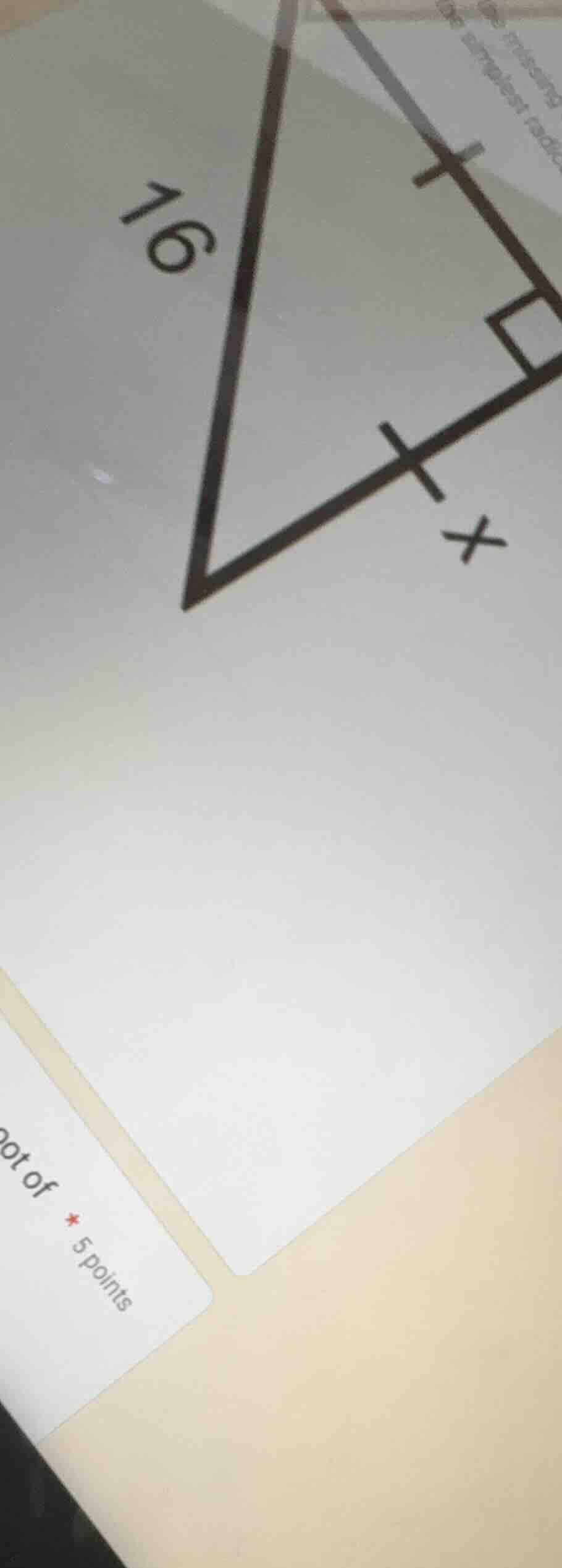
16, x (in a right isosceles triangle context, likely finding x)
Step1: Identify the triangle type
The triangle is an isosceles right triangle? Wait, no, the legs are equal (marked with same tick marks) and it's a right triangle? Wait, the hypotenuse is 16, and the legs are equal (let each leg be \( x \))? Wait, no, in a right isosceles triangle, hypotenuse \( h = x\sqrt{2} \), but wait, maybe it's a right triangle with two equal legs (isosceles right triangle) or maybe the hypotenuse is 16 and we need to find the leg? Wait, no, the marks: the two legs (the ones with right angle) have same tick marks, so they are equal, length \( x \), and the hypotenuse is 16? Wait, no, the side with 16 is the hypotenuse? Wait, the right angle is between the two legs (marked with tick marks), so the hypotenuse is the side with length 16? Wait, no, the side labeled 16 is one of the legs? Wait, no, the right angle is at the intersection of the two legs (with tick marks), so the hypotenuse is the side opposite the right angle, which is the side with length 16? Wait, no, the side with 16 is the hypotenuse, and the two legs are equal (length \( x \)). Then by Pythagorean theorem: \( x^2 + x^2 = 16^2 \)
Step2: Solve for \( x \)
\( 2x^2 = 256 \)
Divide both sides by 2: \( x^2 = 128 \)
Take square root: \( x = \sqrt{128} = 8\sqrt{2} \)? Wait, no, wait maybe I got the sides wrong. Wait, maybe the side with 16 is a leg, and the hypotenuse is \( x \)? No, the right angle is at the bottom right, so the legs are the vertical and horizontal with tick marks, and the hypotenuse is the left side with 16. So legs are equal (length \( x \)), hypotenuse 16. Then Pythagorean theorem: \( x^2 + x^2 = 16^2 \)
\( 2x^2 = 256 \)
\( x^2 = 128 \)
\( x = \sqrt{128} = 8\sqrt{2} \approx 11.31 \)? Wait, no, maybe I mixed up. Wait, maybe the triangle is an isosceles triangle with two equal sides (the legs) and right angle, so hypotenuse is \( x\sqrt{2} \), but if hypotenuse is 16, then \( x = 16/\sqrt{2} = 8\sqrt{2} \). But maybe the side with 16 is a leg? Wait, the marks: the two legs (the ones forming the right angle) have same tick marks, so they are equal, length \( x \), and the hypotenuse is 16. So:
\( x^2 + x^2 = 16^2 \)
\( 2x^2 = 256 \)
\( x^2 = 128 \)
\( x = \sqrt{128} = 8\sqrt{2} \) or simplified as \( 8\sqrt{2} \) or decimal \( \approx 11.31 \). But maybe the problem is that the triangle is a right triangle with two equal legs (isosceles right triangle) and the hypotenuse is 16, find the leg. So the calculation is as above.
Wait, maybe I made a mistake. Wait, the side labeled 16 is a leg, not the hypotenuse? Let's re-examine the diagram. The right angle is at the bottom right, the two legs (vertical and horizontal) have tick marks, so they are equal (length \( x \)), and the hypotenuse is the left side with 16. So yes, hypotenuse is 16, legs \( x \). So Pythagorean theorem: \( x^2 + x^2 = 16^2 \)
So solving:
- \( 2x^2 = 256 \)
- \( x^2 = 128 \)
- \( x = \sqrt{128} = 8\sqrt{2} \) (simplified radical form) or \( x \approx 11.31 \) (decimal). But maybe the problem is that the side with 16 is a leg, and we need to find the hypotenuse? Wait, no, the tick marks are on the legs (the ones with right angle), so they are equal, so legs are \( x \), hypotenuse 16. So the answer is \( 8\sqrt{2} \) or \( \approx 11.31 \). But let's check again.
Wait, maybe the triangle is not a right triangle? No, there's a right angle symbol. So it's a right isosceles triangle, hypotenuse 16, find leg length \( x \). So formula: hypotenuse \( = x\sqrt{2} \), so \( x = \) hypotenuse \( / \sqrt{2} = 16 / \sqrt{2} = 8\sqrt{2} \), which matches the ea…

Snap & solve any problem in the app
Get step-by-step solutions on Sovi AI
Photo-based solutions with guided steps
Explore more problems and detailed explanations
\( 8\sqrt{2} \) (or approximately \( 11.31 \))