QUESTION IMAGE
Question
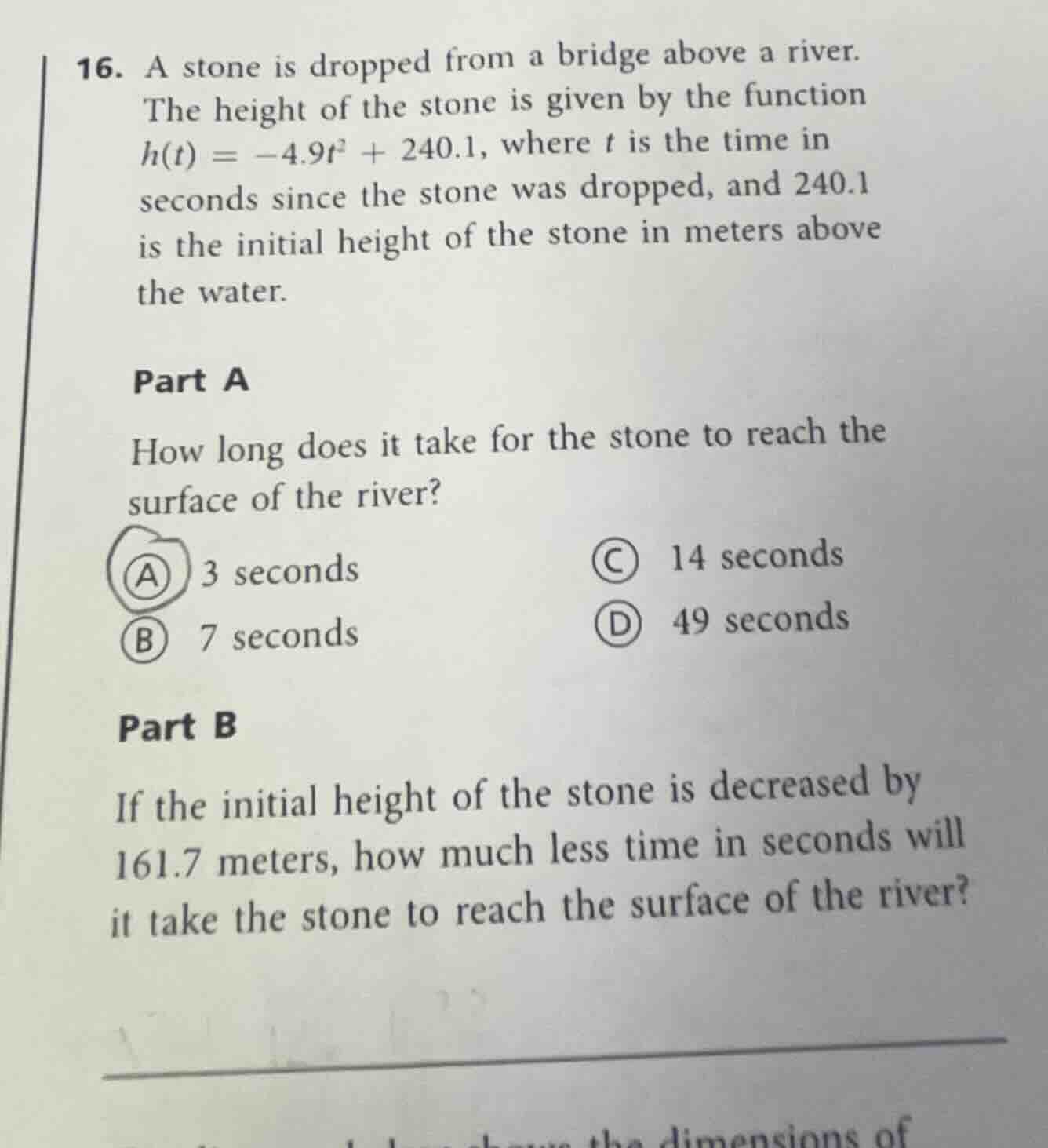
- a stone is dropped from a bridge above a river. the height of the stone is given by the function $h(t) = -4.9t^2 + 240.1$, where $t$ is the time in seconds since the stone was dropped, and 240.1 is the initial height of the stone in meters above the water.
part a
how long does it take for the stone to reach the surface of the river?
a 3 seconds
c 14 seconds
b 7 seconds
d 49 seconds
part b
if the initial height of the stone is decreased by 161.7 meters, how much less time in seconds will it take the stone to reach the surface of the river?
Part A
Step1: Set height to 0
When the stone reaches the river, \( h(t) = 0 \). So we set up the equation \( 0=-4.9t^{2}+240.1 \).
Step2: Solve for \( t^2 \)
First, add \( 4.9t^{2} \) to both sides: \( 4.9t^{2}=240.1 \). Then divide both sides by \( 4.9 \): \( t^{2}=\frac{240.1}{4.9} = 49 \).
Step3: Solve for \( t \)
Take the square root of both sides. Since time can't be negative, \( t=\sqrt{49}=7 \) seconds.
Step1: Find new initial height
The original initial height is \( 240.1 \) meters. Decrease it by \( 161.7 \) meters: \( 240.1 - 161.7 = 78.4 \) meters. So the new height function is \( h(t)=-4.9t^{2}+78.4 \).
Step2: Set new height to 0 and solve for \( t \)
Set \( 0=-4.9t^{2}+78.4 \). Add \( 4.9t^{2} \) to both sides: \( 4.9t^{2}=78.4 \). Divide by \( 4.9 \): \( t^{2}=\frac{78.4}{4.9}=16 \). Take the square root: \( t = 4 \) seconds (since time is positive).
Step3: Find the difference in time
Original time was \( 7 \) seconds, new time is \( 4 \) seconds. The difference is \( 7 - 4 = 3 \) seconds.

Snap & solve any problem in the app
Get step-by-step solutions on Sovi AI
Photo-based solutions with guided steps
Explore more problems and detailed explanations
B. 7 seconds