QUESTION IMAGE
Question
- use the following terms to fill in the blanks in this description of the central dogma. terms: transcription, translation, ribosome, amino acids, mrna, dna, trna, polypeptide, nucleus, cytoplasm, protein and rna polymerase. 6 pts
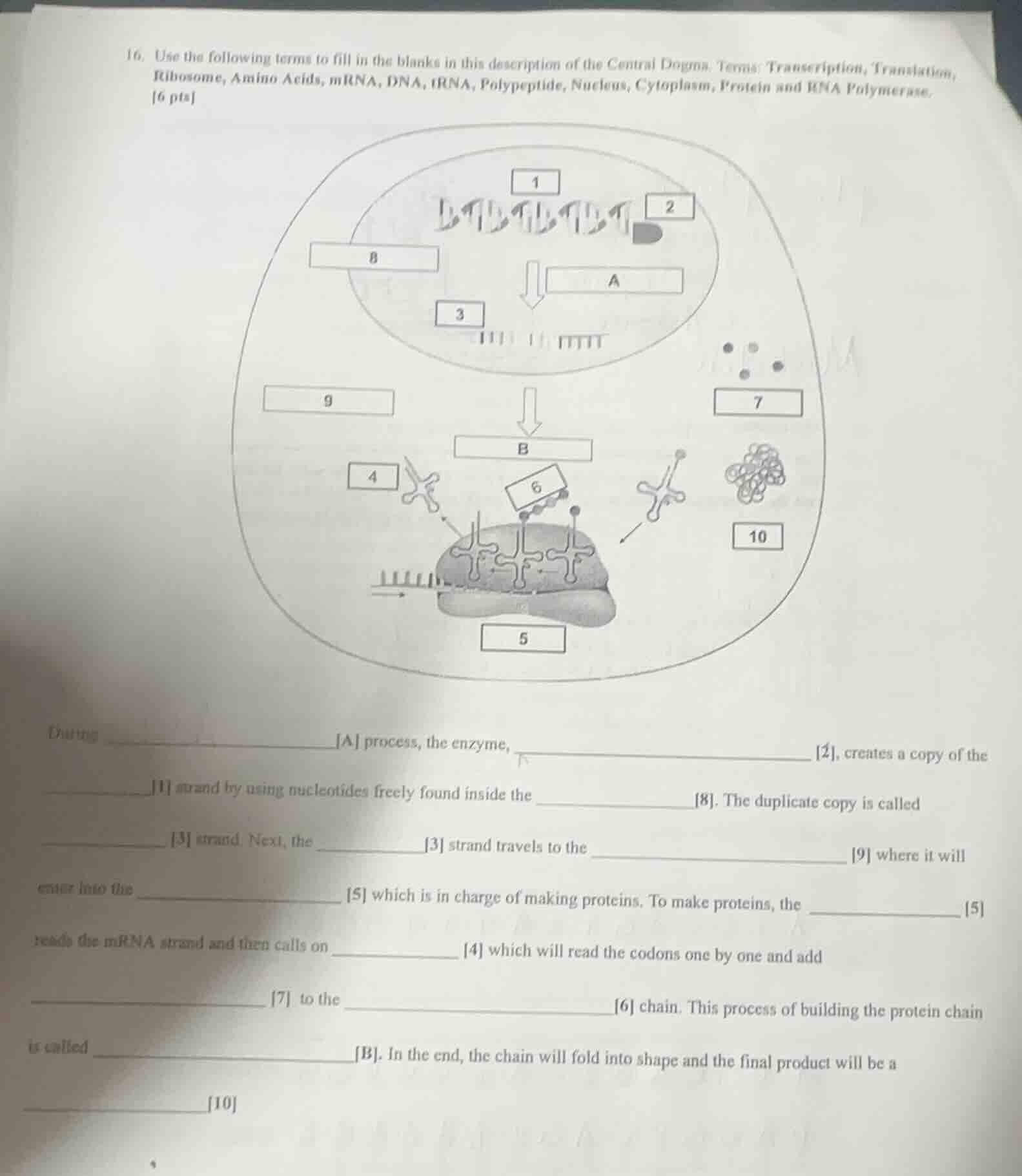
during a process, the enzyme, 2, creates a copy of the 1 strand by using nucleotides freely found inside the 8. the duplicate copy is called 3 strand. next, the 3 strand travels to the 9 where it will enter into the 5 which is in charge of making proteins. to make proteins, the 5 reads the mrna strand and then calls on 4 which will read the codons one by one and add 7 to the 6 chain. this process of building the protein chain is called b. in the end, the chain will fold into shape and the final product will be a 10
- [1] is the original genetic material in the nucleus, so DNA.
- [2] is the enzyme that synthesizes RNA from DNA, so RNA Polymerase.
- [3] is the RNA copy of DNA made in transcription, so mRNA.
- [4] is the molecule that carries amino acids to the ribosome, so tRNA.
- [5] is the cellular structure where protein synthesis occurs, so Ribosome.
- [6] is the growing chain of amino acids before folding, so Polypeptide.
- [7] are the building blocks of proteins, so Amino Acids.
- [8] is the organelle where transcription takes place, so Nucleus.
- [9] is the cellular space outside the nucleus where translation occurs, so Cytoplasm.
- [10] is the final folded, functional product, so Protein.
[A] The process of making mRNA from DNA is Transcription.
[B] The process of building a polypeptide from mRNA is Translation.

Snap & solve any problem in the app
Get step-by-step solutions on Sovi AI
Photo-based solutions with guided steps
Explore more problems and detailed explanations
- DNA
- RNA Polymerase
- mRNA
- tRNA
- Ribosome
- Polypeptide
- Amino Acids
- Nucleus
- Cytoplasm
- Protein
[A] Transcription
[B] Translation