QUESTION IMAGE
Question
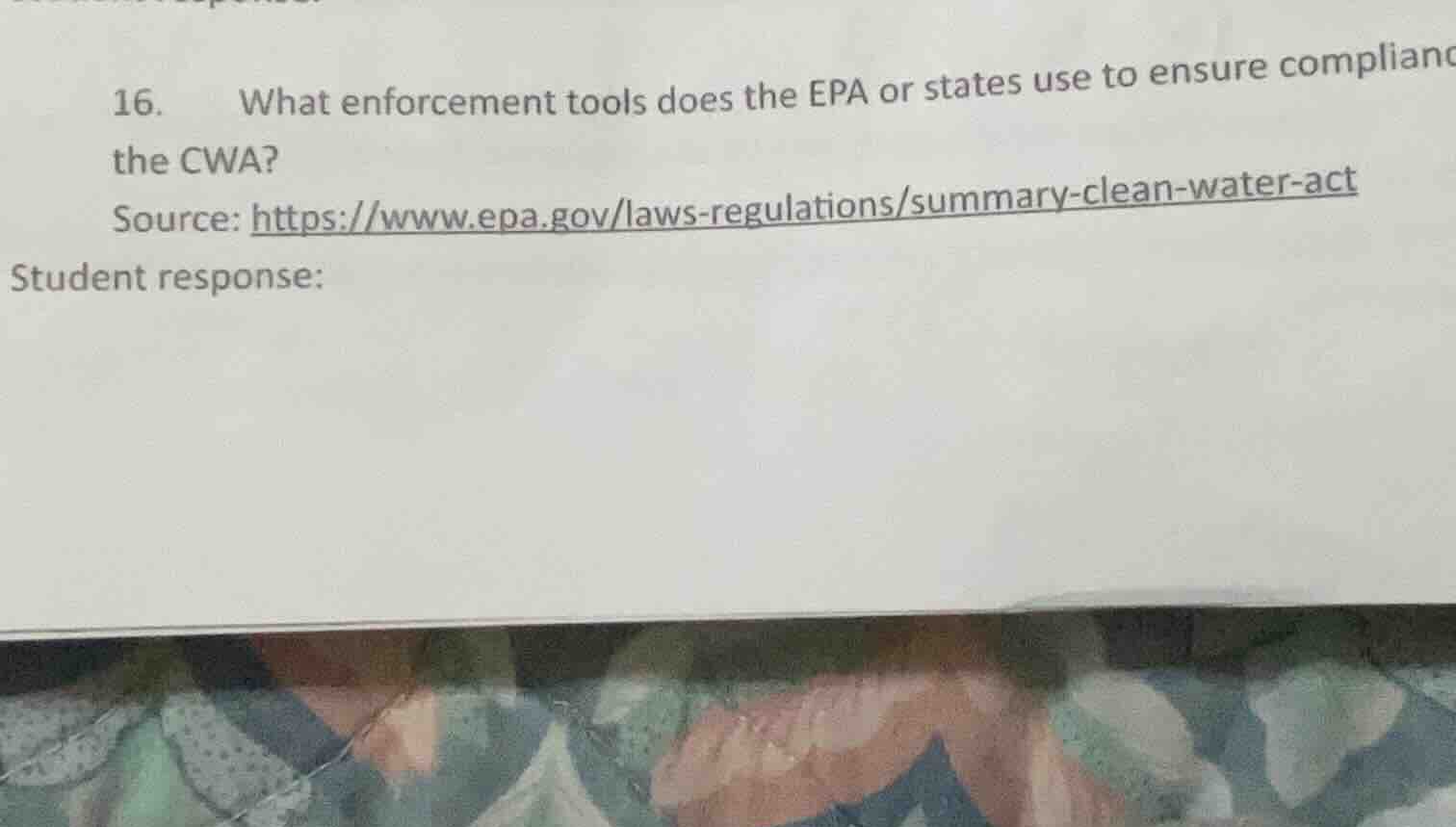
- what enforcement tools does the epa or states use to ensure complianc the cwa? source: https://www.epa.gov/laws-regulations/summary-clean-water-act student response:
To answer this, we refer to the EPA's summary of the Clean Water Act (CWA). The EPA and states use several enforcement tools:
1. Administrative Orders
These are legal directives requiring non - compliant parties to take corrective actions (e.g., stop illegal discharges, implement pollution controls).
2. Civil Penalties
Monetary fines imposed on entities that violate CWA regulations. The amount depends on the severity of the violation, the entity’s compliance history, and the environmental harm caused.
3. Criminal Prosecution
For intentional or egregious violations (e.g., falsifying reports, knowingly discharging pollutants illegally), the EPA can refer cases to the Department of Justice for criminal charges, which may result in fines and imprisonment for responsible parties.
4. Compliance Assistance and Monitoring
The EPA and states conduct regular inspections (e.g., of industrial facilities, wastewater treatment plants) to check for compliance. They also offer guidance and resources to help entities understand and meet CWA requirements, which encourages voluntary compliance.
5. Permitting and NPDES (National Pollutant Discharge Elimination System)
The EPA and states issue permits that regulate pollutant discharges into waters of the U.S. Facilities must obtain an NPDES permit (for point - source discharges) and comply with permit conditions (e.g., discharge limits, monitoring requirements). If a facility violates permit terms, enforcement actions follow.

Snap & solve any problem in the app
Get step-by-step solutions on Sovi AI
Photo-based solutions with guided steps
Explore more problems and detailed explanations
The EPA or states use enforcement tools like administrative orders, civil penalties, criminal prosecution, compliance monitoring/assistance, and NPDES permitting to ensure CWA compliance.