QUESTION IMAGE
Question
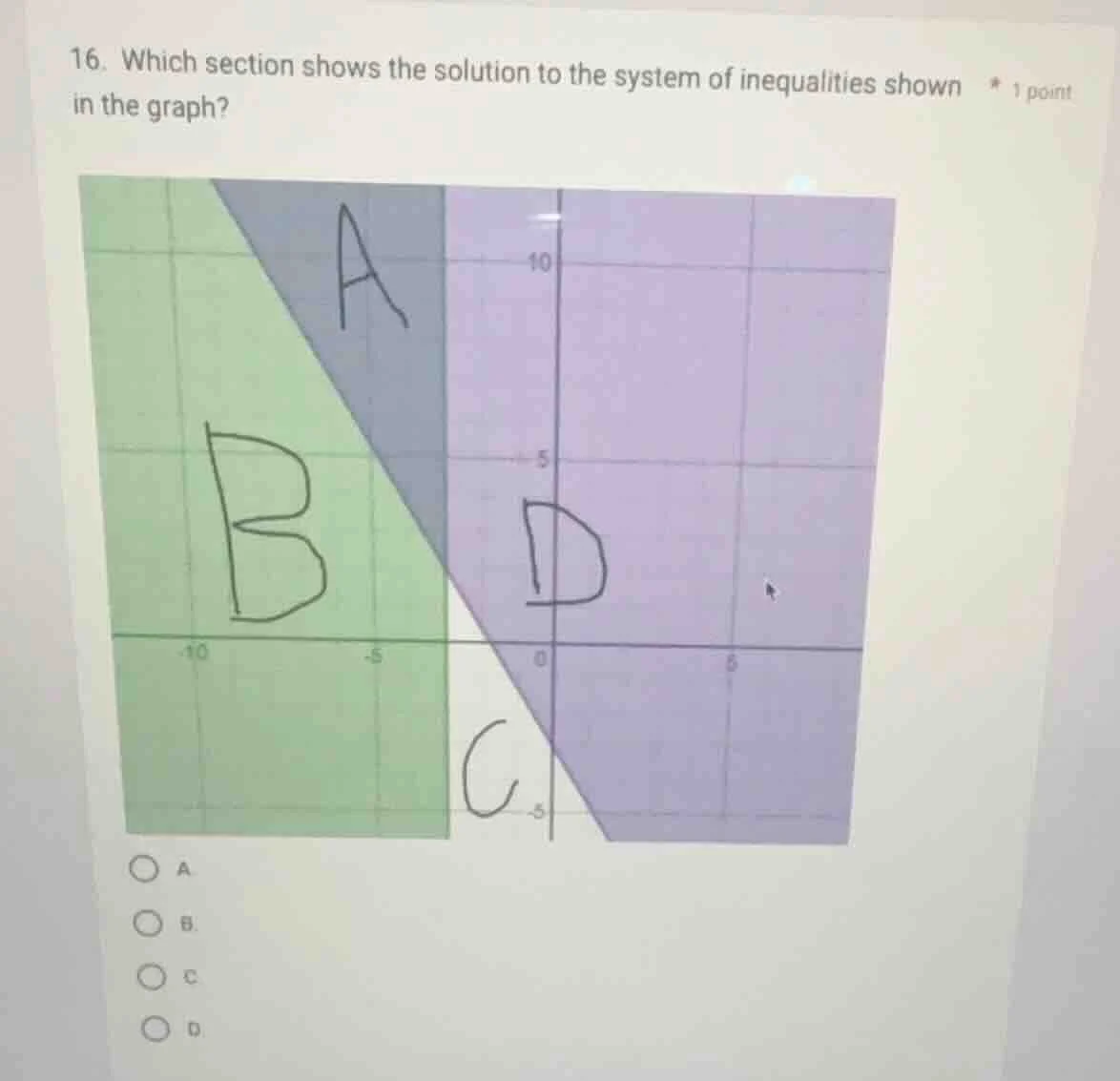
- which section shows the solution to the system of inequalities shown in the graph? * 1 point graph with sections a, b, c, d and coordinate grid options: a, b, c, d
Step1: Recall System of Inequalities Solution
The solution to a system of inequalities is the region that satisfies all inequalities. For a graph with multiple shaded regions (from different inequalities), the solution is the intersection (overlap) of all shaded areas.
Step2: Analyze the Graph Sections
- Section A: Overlap of the slanted (e.g., linear inequality) and vertical (e.g., another inequality) shaded regions? Wait, looking at the graph: the green region (B) and purple region (D) with a slanted line. The solution is where both shadings overlap. Wait, the slanted line divides, and the vertical line (maybe \( x \leq -5 \) or \( x \geq -5 \)? Wait, no, the graph has a vertical boundary (maybe \( x = -5 \) or similar) and a slanted line. The solution to the system is the area that is shaded by both inequalities. Looking at the labels: A is the overlap of the slanted (e.g., above the line) and the vertical (e.g., right of \( x=-5 \) or left? Wait, no—wait, the green region (B) is left of a vertical line (maybe \( x = -5 \)), purple (D) is right of a vertical line? Wait, no, the graph: the vertical line (maybe \( x = -5 \)) and the slanted line. The solution is where both inequalities' shadings overlap. So if one inequality shades left (green, B) and another shades above the slanted line (A's area), but wait, no—wait, the system's solution is the intersection. Wait, the options: A is the area that is shaded by both the slanted inequality (e.g., \( y \geq mx + b \)) and the vertical inequality (e.g., \( x \geq -5 \))? Wait, no, maybe the vertical line is \( x = -5 \), and the slanted line is a linear inequality. The solution to the system is the region that satisfies both inequalities. So if one inequality is, say, \( x \geq -5 \) (purple region D is right of \( x=-5 \)) and another is \( y \geq mx + b \) (slanted line, shading above). Then the intersection is A? Wait, no, looking at the graph: A is the overlap of the slanted (gray) and purple (D) regions? Wait, no, the labels: A is gray, B is green, C is below, D is purple. The solution to the system is the region that is shaded by all inequalities. So if there are two inequalities: one shading the area (e.g., green B) and another (purple D) and the slanted line. Wait, maybe the two inequalities are: one is a vertical inequality (e.g., \( x \leq -5 \) for green B, and \( x \geq -5 \) for purple D) and a slanted inequality (e.g., \( y \geq mx + b \) shading above the line). Then the solution is where \( x \geq -5 \) (purple D's side) and \( y \geq mx + b \) (A's area). So A is the intersection. Wait, but maybe I got it wrong. Wait, the key is: the solution to a system of inequalities is the set of points that satisfy all inequalities, so it's the intersection of their solution regions. So if one inequality shades, say, the region above the slanted line, and another shades the region to the right of a vertical line (or left), the intersection is A. Wait, the correct answer is A? Wait, no—wait, maybe the vertical line is \( x = -5 \), and the slanted line is, say, \( y = -x - 2 \) or something. Wait, maybe the two inequalities are: \( x \geq -5 \) (so right of \( x=-5 \), which is the purple D region) and \( y \geq -x - 2 \) (shading above the slanted line). Then the intersection is A (the gray area), which is in both \( x \geq -5 \) (right of \( x=-5 \)) and above the slanted line. So the solution is A.
Wait, but maybe I made a mistake. Alternatively, maybe the vertical line is \( x = -5 \), and one inequality is \( x \leq -5 \) (green B) and another is \( y \geq mx + b \) (s…

Snap & solve any problem in the app
Get step-by-step solutions on Sovi AI
Photo-based solutions with guided steps
Explore more problems and detailed explanations
A. A