QUESTION IMAGE
Question
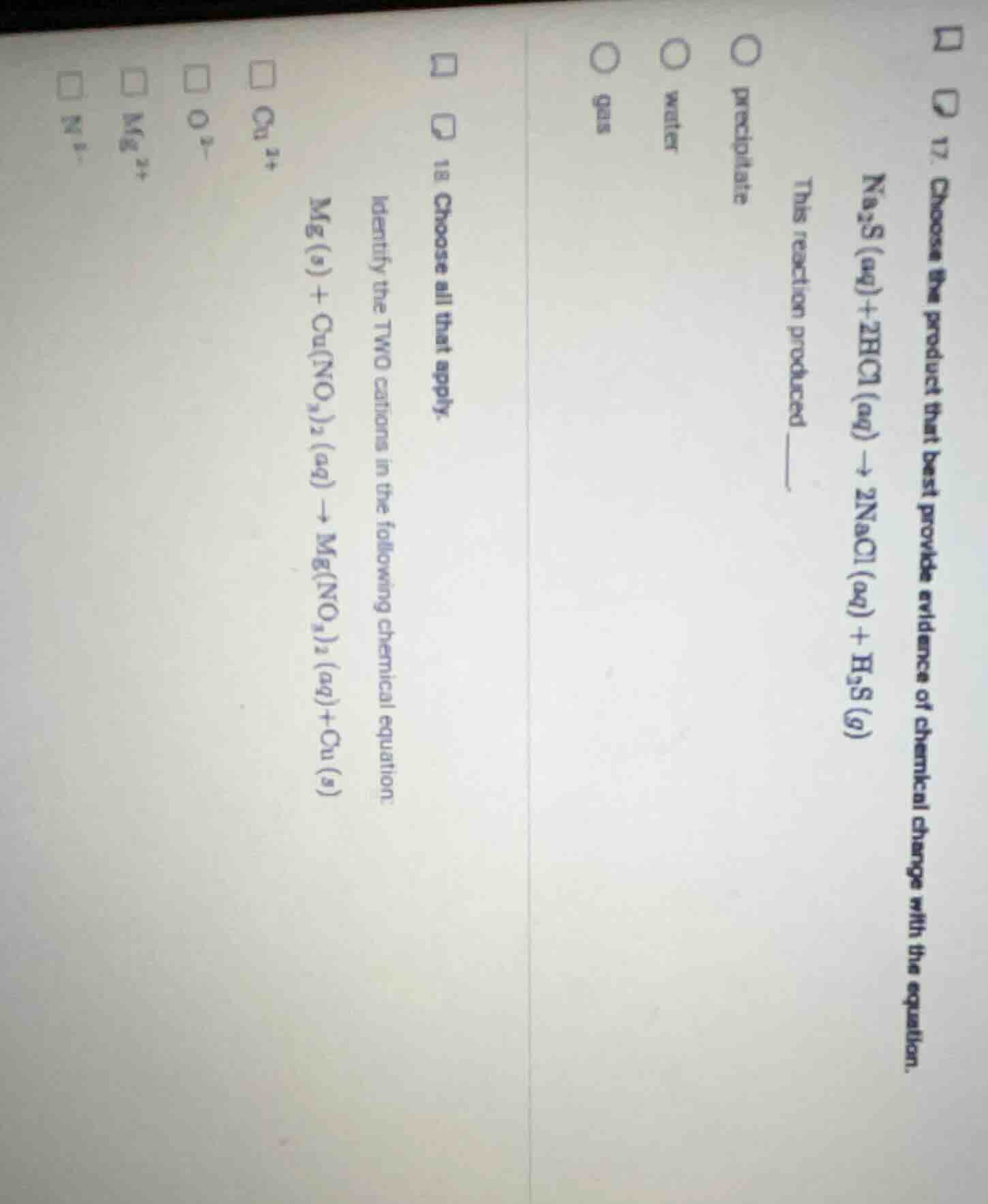
- choose the product that best provides evidence of chemical change with the equation. \\(\ce{na_{2}s(aq) + 2hcl(aq) -> 2nacl(aq) + h_{2}s(g)}\\) this reaction produced ______. \\(\circ\\) precipitate \\(\circ\\) water \\(\circ\\) gas \\(\\) 18 choose all that apply. identify the two cations in the following chemical equation: \\(\ce{mg(s) + cu(no_{3})_{2}(aq) -> mg(no_{3})_{2}(aq) + cu(s)}\\) \\(\square\\) \\(\ce{cu^{2+}}\\) \\(\square\\) \\(\ce{o^{2-}}\\) \\(\square\\) \\(\ce{mg^{2+}}\\) \\(\square\\) \\(\ce{n^{3-}}\\)
Step1: Analyze reaction 17
The reaction $\text{Na}_2\text{S}(aq) + 2\text{HCl}(aq)
ightarrow 2\text{NaCl}(aq) + \text{H}_2\text{S}(g)$ produces $\text{H}_2\text{S}$, a gas. Formation of gas is evidence of chemical change.
Step2: Analyze reaction 18
The reaction $\text{Mg}(s) + \text{Cu(NO}_3\text{)}_2(aq)
ightarrow \text{Mg(NO}_3\text{)}_2(aq) + \text{Cu}(s)$ has aqueous ionic compounds. $\text{Cu(NO}_3\text{)}_2$ dissociates into $\text{Cu}^{2+}$, $\text{Mg(NO}_3\text{)}_2$ dissociates into $\text{Mg}^{2+}$. These are the cations.

Snap & solve any problem in the app
Get step-by-step solutions on Sovi AI
Photo-based solutions with guided steps
Explore more problems and detailed explanations
- gas
- $\text{Cu}^{2+}$, $\text{Mg}^{2+}$