QUESTION IMAGE
Question
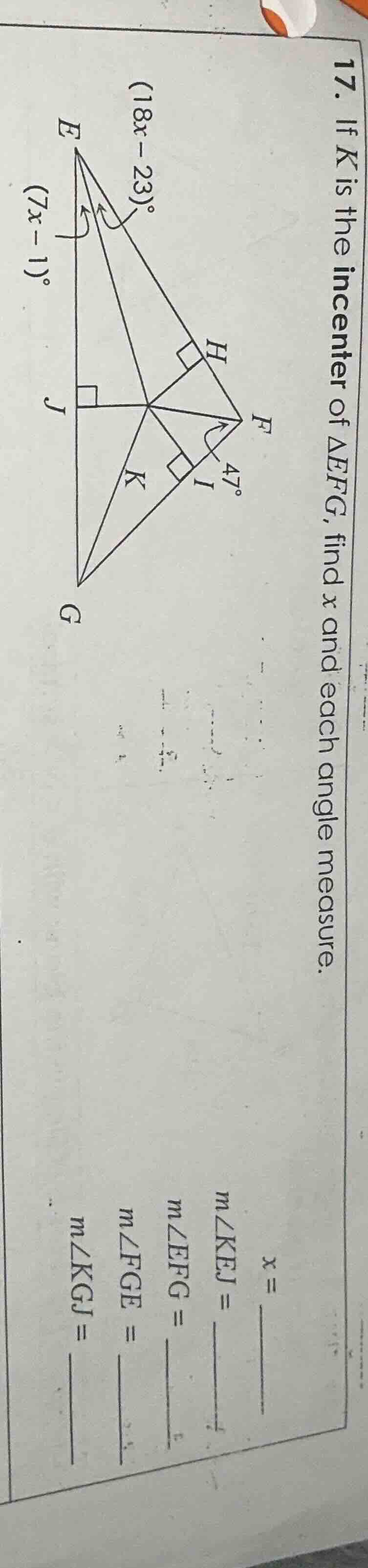
- if k is the incenter of \\(\triangle efg\\), find \\(x\\) and each angle measure.\\(x = \underline{\quad\quad}\\)\\(m\angle kej = \underline{\quad\quad}\\)\\(m\angle efg = \underline{\quad\quad}\\)\\(m\angle fge = \underline{\quad\quad}\\)\\(m\angle kgj = \underline{\quad\quad}\\)
Step1: Recall Incenter Properties
The incenter \( K \) of a triangle is the intersection of angle bisectors. So, \( \angle FEK = \angle GEK \) and \( \angle EFK=\angle GFK = 47^\circ \), \( \angle EGK=\angle FGK \). Also, in \( \triangle EKJ \) and \( \triangle EKI \) (right triangles), but here we use angle bisector: \( \angle FEK=(7x - 1)^\circ \) and \( \angle GEK=(18x - 23)^\circ \)? Wait, no—wait, the incenter bisects the angles. Wait, actually, the two angles at \( E \): \( (7x - 1)^\circ \) and \( (18x - 23)^\circ \)? Wait, no, maybe \( \angle FEK=(7x - 1)^\circ \) and \( \angle GEK=(18x - 23)^\circ \)? No, wait, the incenter bisects \( \angle FEG \), so \( \angle FEK=\angle GEK \). Wait, maybe I misread. Wait, the diagram: \( \angle at\ E \): one part is \( (7x - 1)^\circ \), another part is \( (18x - 23)^\circ \)? No, wait, the incenter \( K \), so \( EK \) bisects \( \angle FEG \), \( FK \) bisects \( \angle EFG \), \( GK \) bisects \( \angle EGF \). Given \( \angle EFK = 47^\circ \), so \( \angle EFG=2\times47^\circ = 94^\circ \). Now, for \( \angle FEG \): the two parts at \( E \) are \( (7x - 1)^\circ \) and \( (18x - 23)^\circ \)? Wait, no—wait, maybe \( \angle KEJ=(7x - 1)^\circ \) and \( \angle KEI=(18x - 23)^\circ \)? No, the incenter bisects \( \angle FEG \), so \( \angle FEK=\angle GEK \). Wait, perhaps the problem is that \( EK \) bisects \( \angle FEG \), so \( (7x - 1)^\circ=(18x - 23)^\circ \)? Wait, that would be if they are the two equal parts. Wait, let's set \( 7x - 1=18x - 23 \).
Step2: Solve for \( x \)
Set \( 7x - 1 = 18x - 23 \) (since \( EK \) bisects \( \angle FEG \), so the two angles at \( E \) formed by \( EK \) are equal).
\( -1 + 23=18x - 7x \)
\( 22 = 11x \)
\( x = 2 \)
Step3: Find \( m\angle KEJ \)
Substitute \( x = 2 \) into \( 7x - 1 \):
\( 7(2)-1=14 - 1 = 13^\circ \)
Step4: Find \( m\angle EFG \)
Since \( FK \) bisects \( \angle EFG \) and \( \angle EFK = 47^\circ \), so \( m\angle EFG=2\times47^\circ = 94^\circ \)
Step5: Find \( m\angle FGE \)
First, in \( \triangle EFG \), sum of angles is \( 180^\circ \). We know \( m\angle EFG = 94^\circ \), \( m\angle FEG=2\times13^\circ = 26^\circ \) (since \( EK \) bisects \( \angle FEG \), so \( \angle FEG = 2\times(7x - 1)=2\times13 = 26^\circ \)). Then \( m\angle FGE=180^\circ - 94^\circ - 26^\circ = 60^\circ \). Wait, but \( GK \) bisects \( \angle FGE \), so \( m\angle KFGJ=\frac{60^\circ}{2}=30^\circ \)? Wait, no, \( m\angle KFGJ \) (wait, \( m\angle K G J \)): \( GK \) bisects \( \angle FGE \), so \( m\angle K G J=\frac{m\angle FGE}{2} \). Wait, let's recalculate \( \angle FGE \):
Wait, \( \angle FEG = 2\times(7x - 1)=2\times13 = 26^\circ \), \( \angle EFG = 94^\circ \), so \( \angle FGE=180 - 26 - 94 = 60^\circ \). Then \( GK \) bisects \( \angle FGE \), so \( m\angle K G J=\frac{60^\circ}{2}=30^\circ \), and \( m\angle FGE = 60^\circ \).
Wait, let's check \( x = 2 \):
\( 7x - 1 = 13 \), \( 18x - 23 = 36 - 23 = 13 \). Yes! So \( EK \) bisects \( \angle FEG \), so \( \angle FEK=\angle GEK = 13^\circ \), so \( \angle FEG = 26^\circ \).
Step6: Verify \( \triangle EFG \) angles
Sum: \( 26^\circ + 94^\circ + 60^\circ = 180^\circ \), which works.
Step7: Find \( m\angle K G J \)
Since \( GK \) bisects \( \angle FGE = 60^\circ \), so \( m\angle K G J=\frac{60^\circ}{2}=30^\circ \)

Snap & solve any problem in the app
Get step-by-step solutions on Sovi AI
Photo-based solutions with guided steps
Explore more problems and detailed explanations
\( x = 2 \)
\( m\angle KEJ = 13^\circ \)
\( m\angle EFG = 94^\circ \)
\( m\angle FGE = 60^\circ \)
\( m\angle K G J = 30^\circ \)