QUESTION IMAGE
Question
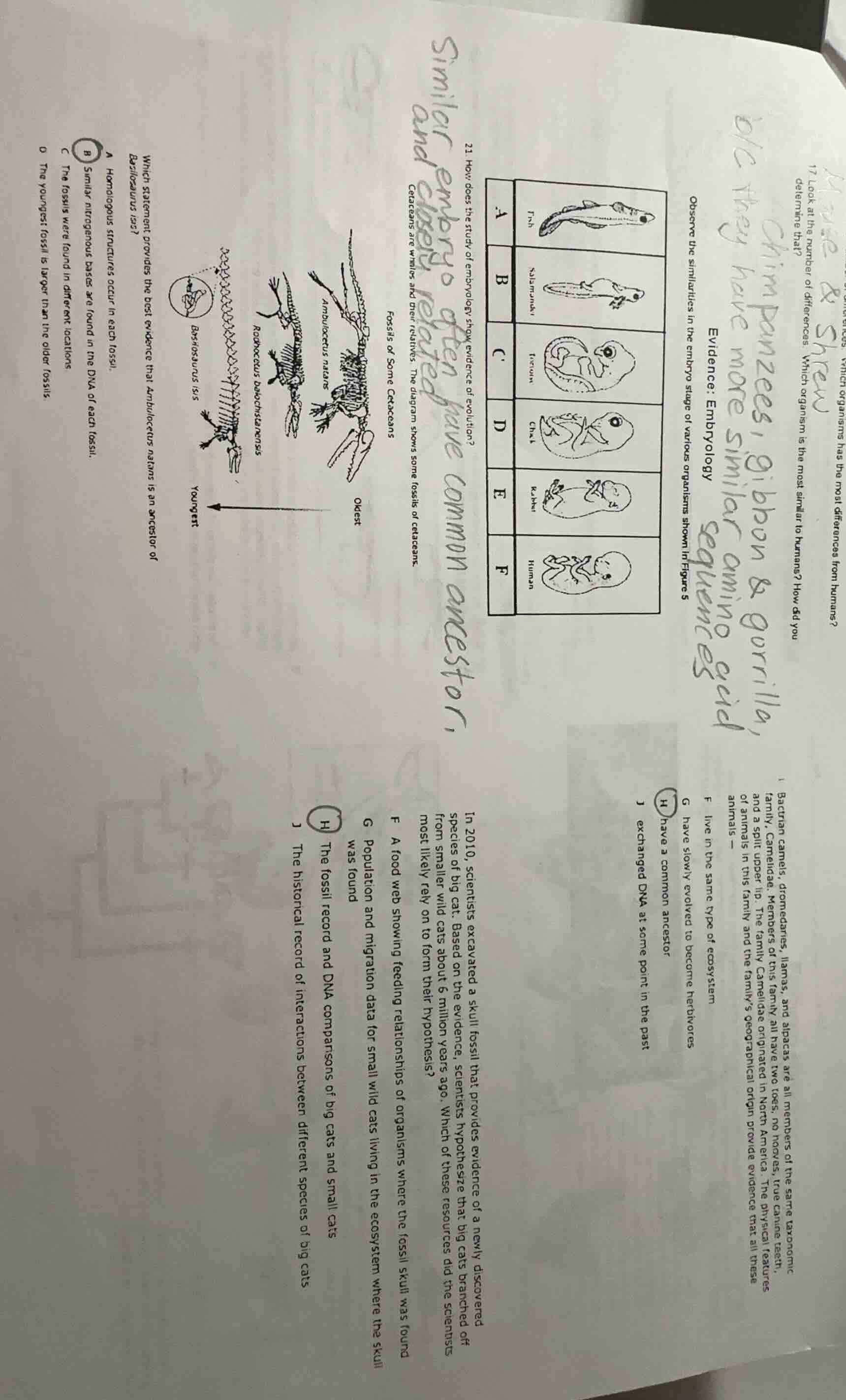
- look at the number of differences. which organisms has the most differences from humans? determine that? chimpanzees, gibbon & gorilla, they have more similar amino acid sequences evidence: embryology observe the similarities in the embryo stage of various organisms shown in figure 5 21. how does the study of embryology show evidence of evolution? similar and embryo... related have common ancestor. cetaceans are whales and their relatives. the diagram shows some fossils of cetaceans. fossils of some cetaceans which statement provides the best evidence that ambulocetus natans is an ancestor of basilosaurus isis? a homologous structures occur in each fossil. b similar nitrogenous bases are found in the dna of each fossil. c the fossils were found in different locations. d the youngest fossil is larger than the older fossils. bactrian camels, dromedaries, llamas, and alpacas are all members of the same taxonomic family, camelidae. members of this family all have two toes, no hooves, true canine teeth, and a split upper lip. the family camelidae originated in north america. the physical features of animals in this family and the family’s geographical origin provide evidence that all these animals — f live in the same type of ecosystem g have slowly evolved to become herbivores h have a common ancestor j exchanged dna at some point in the past in 2010, scientists excavated a skull fossil that provides evidence of a newly discovered species of big cat. based on the evidence, scientists hypothesize that big cats branched off from smaller wild cats about 6 million years ago. which of these resources did the scientists most likely rely on to form their hypothesis? a a food web showing feeding relationships of organisms where the fossil skull was found g population and migration data for small wild cats living in the ecosystem where the skull was found h the fossil record and dna comparisons of big cats and small cats j the historical record of interactions between different species of big cats
Question 21 (Embryology and Evolution)
To determine how embryology shows evolutionary evidence, we analyze the options. Embryology studies the development of embryos. Similarities in early - stage embryos of different species (like the ones in the table: fish, salamander, frog, chick, rabbit, human) indicate a common ancestor. This is because shared embryonic structures suggest evolutionary relationships. The study of embryology reveals that different species have similar embryonic development patterns, implying they evolved from a common ancestor.
To find the best evidence that Ambuloectus natans is an ancestor of Basilosaurus isis, we analyze the options. Homologous structures (option A) are structures with a common evolutionary origin. If Ambuloectus natans and Basilosaurus isis have homologous structures, it suggests a common ancestor. Option B (similar nitrogenous bases in DNA) would be for more recent or closely related species at a molecular level, and the fossil - related options (C and D) don't directly show ancestry as well as homologous structures.
To form a hypothesis about big cats branching off from small wild cats, scientists would rely on evidence that connects big cats and small cats. Fossil record and DNA comparisons (option H) provide both structural (from fossils) and molecular (from DNA) evidence to show the evolutionary relationship. Option F (food web) shows feeding relationships, option G (population and migration data) shows current population dynamics, and option J (historical interactions) shows behavioral interactions, none of which directly relate to evolutionary ancestry as well as fossil and DNA evidence.

Snap & solve any problem in the app
Get step-by-step solutions on Sovi AI
Photo-based solutions with guided steps
Explore more problems and detailed explanations
The study of embryology shows evidence of evolution by revealing that different species have similar embryonic development patterns, indicating a common ancestor (the specific answer related to the options would be based on the option that states this idea, for example, if there was an option saying "Similarities in embryonic development suggest a common ancestor", that would be the answer. From the hand - written note in the image, it seems the intended answer is related to common ancestry shown by embryonic similarities).