QUESTION IMAGE
Question
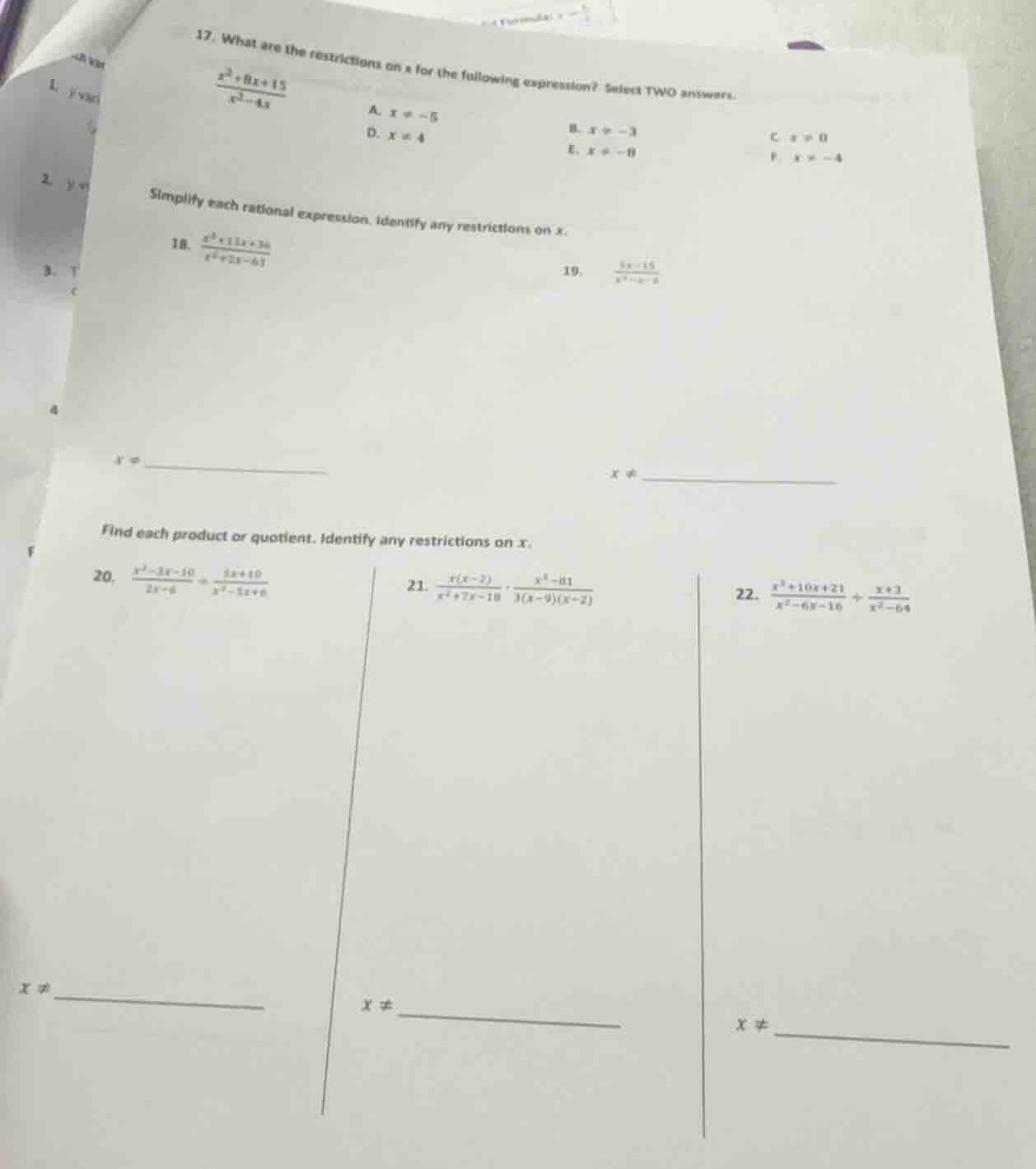
- what are the restrictions on x for the following expression? select two answers.
\\(\frac{x^2 + 8x + 15}{x^2 - 4x}\\)
a. \\(x \
eq -5\\) b. \\(x \
eq -3\\) c. \\(x \
eq 0\\)
d. \\(x \
eq 4\\) e. \\(x \
eq -8\\) f. \\(x \
eq -4\\)
simplify each rational expression. identify any restrictions on x.
- \\(\frac{x^2 + 13x + 36}{x^2 + 23 - 63}\\) 19. \\(\frac{5x - 15}{x^2 - x - 6}\\)
find each product or quotient. identify any restrictions on x.
- \\(\frac{x^2 - 3x - 10}{2x - 6} \cdot \frac{8x + 10}{x^2 - 5x + 6}\\) 21. \\(\frac{x(x - 2)}{x^2 + 7x - 18} \cdot \frac{x^2 - 81}{3(x - 9)(x - 2)}\\) 22. \\(\frac{x^2 + 10x + 21}{x^2 - 68 - 16} \div \frac{x + 3}{x^2 - 64}\\)
Question 17
Step 1: Factor numerator and denominator
Factor \(x^2 + 8x + 15\): \(x^2 + 8x + 15=(x + 3)(x + 5)\)
Factor \(x^2 - 4x\): \(x^2 - 4x=x(x - 4)\)
Step 2: Find restrictions (denominator ≠ 0)
For \(x(x - 4)
eq0\), we have \(x
eq0\) (from \(x = 0\)) and \(x
eq4\) (from \(x - 4=0\)). Also, the numerator's factors don't affect restrictions here, but we check if any of the numerator's roots make denominator zero (they don't here). So restrictions are \(x
eq0\) and \(x
eq4\), and also, wait, no—wait, the original expression is \(\frac{x^2 + 8x + 15}{x^2 - 4x}\), so denominator is \(x(x - 4)\), so \(x
eq0\) and \(x
eq4\). But also, when simplifying, but the question is about restrictions on \(x\) for the expression, so denominator can't be zero. So the restrictions are \(x
eq0\) (option C) and \(x
eq4\) (option D), and also, wait, the numerator is \((x + 3)(x + 5)\), so no conflict. Wait, but the options: A. \(x
eq - 5\), B. \(x
eq - 3\), C. \(x
eq0\), D. \(x
eq4\), E. \(x
eq - 8\), F. \(x
eq - 4\). So the denominator is \(x(x - 4)\), so \(x
eq0\) (C) and \(x
eq4\) (D). So the two answers are C and D.
Step 1: Factor numerator and denominator
Factor \(x^2 + 13x + 36\): \(x^2 + 13x + 36=(x + 4)(x + 9)\)
Factor \(x^2 + 2x - 63\): \(x^2 + 2x - 63=(x + 9)(x - 7)\)
Step 2: Simplify the expression
\(\frac{(x + 4)(x + 9)}{(x + 9)(x - 7)}=\frac{x + 4}{x - 7}\) (cancel \(x + 9\), \(x
eq - 9\))
Step 3: Find restrictions (denominator ≠ 0)
Original denominator: \((x + 9)(x - 7)
eq0\) ⇒ \(x
eq - 9\) and \(x
eq7\)
Step 1: Factor numerator and denominator
Factor \(5x - 15\): \(5x - 15 = 5(x - 3)\)
Factor \(x^2 - x - 6\): \(x^2 - x - 6=(x - 3)(x + 2)\)
Step 2: Simplify the expression
\(\frac{5(x - 3)}{(x - 3)(x + 2)}=\frac{5}{x + 2}\) (cancel \(x - 3\), \(x
eq3\))
Step 3: Find restrictions (denominator ≠ 0)
Original denominator: \((x - 3)(x + 2)
eq0\) ⇒ \(x
eq3\) and \(x
eq - 2\)

Snap & solve any problem in the app
Get step-by-step solutions on Sovi AI
Photo-based solutions with guided steps
Explore more problems and detailed explanations
C. \(x
eq 0\), D. \(x
eq 4\)