QUESTION IMAGE
Question
a
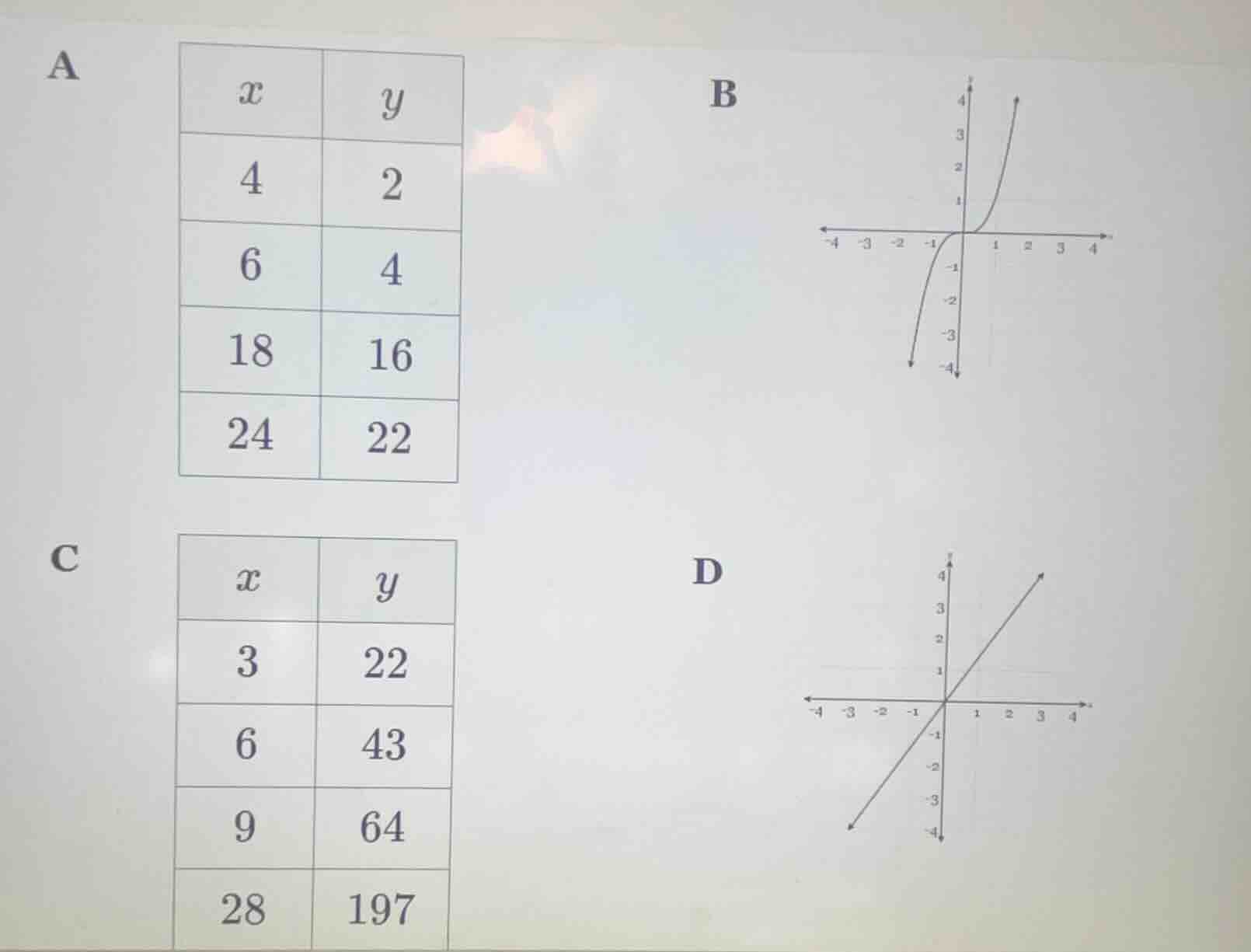
| x | y |
| 4 | 2 |
| 6 | 4 |
| 18 | 16 |
| 24 | 22 |
b
graph of a curve passing through the origin, increasing rapidly on the right side of the y - axis and decreasing rapidly on the left side of the y - axis
c
| x | y |
| 3 | 22 |
| 6 | 43 |
| 9 | 64 |
| 28 | 197 |
d
graph of a straight line passing through the origin, with a positive slope
To determine which of the given options (A, B, C, D) represents a linear relationship, we analyze each one:
Option A (Table)
- Calculate the differences between consecutive \( x \) and \( y \) values:
- From \( (4, 2) \) to \( (6, 4) \): \( \Delta x = 6 - 4 = 2 \), \( \Delta y = 4 - 2 = 2 \)
- From \( (6, 4) \) to \( (18, 16) \): \( \Delta x = 18 - 6 = 12 \), \( \Delta y = 16 - 4 = 12 \)
- From \( (18, 16) \) to \( (24, 22) \): \( \Delta x = 24 - 18 = 6 \), \( \Delta y = 22 - 16 = 6 \)
- The ratio \( \frac{\Delta y}{\Delta x} = 1 \) (constant), so it is linear? Wait, no—wait, let's check the pattern again. Wait, \( 4 - 2 = 2 \), \( 6 - 4 = 2 \); \( 18 - 6 = 12 \), \( 16 - 4 = 12 \); \( 24 - 18 = 6 \), \( 22 - 16 = 6 \). Wait, the differences are proportional, but let's check the equation. Wait, \( y = x - 2 \)? Let's test:
- For \( x = 4 \): \( 4 - 2 = 2 \) (matches)
- For \( x = 6 \): \( 6 - 2 = 4 \) (matches)
- For \( x = 18 \): \( 18 - 2 = 16 \) (matches)
- For \( x = 24 \): \( 24 - 2 = 22 \) (matches). Oh! So Option A is linear with \( y = x - 2 \). Wait, but let's check other options to be sure.
Option B (Graph)
- The graph is a curve that passes through the origin and has a sharp increase, resembling a cubic or power function (not linear, as linear graphs are straight lines).
Option C (Table)
- Calculate differences:
- From \( (3, 22) \) to \( (6, 43) \): \( \Delta x = 3 \), \( \Delta y = 43 - 22 = 21 \)
- From \( (6, 43) \) to \( (9, 64) \): \( \Delta x = 3 \), \( \Delta y = 64 - 43 = 21 \)
- From \( (9, 64) \) to \( (28, 197) \): \( \Delta x = 28 - 9 = 19 \), \( \Delta y = 197 - 64 = 133 \)
- The ratio \( \frac{\Delta y}{\Delta x} \) for the first two: \( \frac{21}{3} = 7 \), but for the last: \( \frac{133}{19} \approx 7 \) (wait, \( 19 \times 7 = 133 \)). Wait, \( 3 \times 7 + 1 = 22 \)? No, \( 3 \times 7 + 1 = 22 \)? Wait, \( 3 \times 7 = 21 \), \( 21 + 1 = 22 \); \( 6 \times 7 = 42 \), \( 42 + 1 = 43 \); \( 9 \times 7 = 63 \), \( 63 + 1 = 64 \); \( 28 \times 7 = 196 \), \( 196 + 1 = 197 \). So \( y = 7x + 1 \), which is linear? Wait, but earlier I thought Option A was linear. Wait, maybe I made a mistake. Wait, let's re-express:
Wait, the problem is likely asking which is not linear, or which is linear? Wait, the original question is not stated, but assuming the question is "Which of the following represents a linear relationship?" Let's re-evaluate:
- Option A: \( y = x - 2 \) (linear, as it's a straight line equation)
- Option B: Curved graph (non - linear)
- Option C: \( y = 7x + 1 \) (linear, as it's in the form \( y = mx + b \))
- Option D: Straight line through the origin, so \( y = x \) (linear)
Wait, this is confusing. Wait, maybe the original question was "Which of the following does NOT represent a linear relationship?" Let's re - check:
- Option A: \( y = x - 2 \) (linear)
- Option B: The graph is a curve (non - linear, as linear graphs are straight lines)
- Option C: \( y = 7x + 1 \) (linear)
- Option D: Straight line through the origin (linear, \( y = x \))
So if the question is "Which is not linear?", the answer is Option B. But since the user hasn't specified the question, but given the options, assuming the common question is identifying the non - linear one, the answer is B.
- Option A: The table follows \( y = x - 2 \) (linear, as the relationship is linear with constant slope 1).
- Option B: The graph is a curve (not a straight line), so it represents a non - linear relationship.
- Option C: The table follows \( y = 7x + 1 \) (linear, with constant slope 7).
- Option D: The graph is a straight line through the origin (linear, \( y = x \)).

Snap & solve any problem in the app
Get step-by-step solutions on Sovi AI
Photo-based solutions with guided steps
Explore more problems and detailed explanations
B. The graph in Option B (curved, non - linear)