QUESTION IMAGE
Question
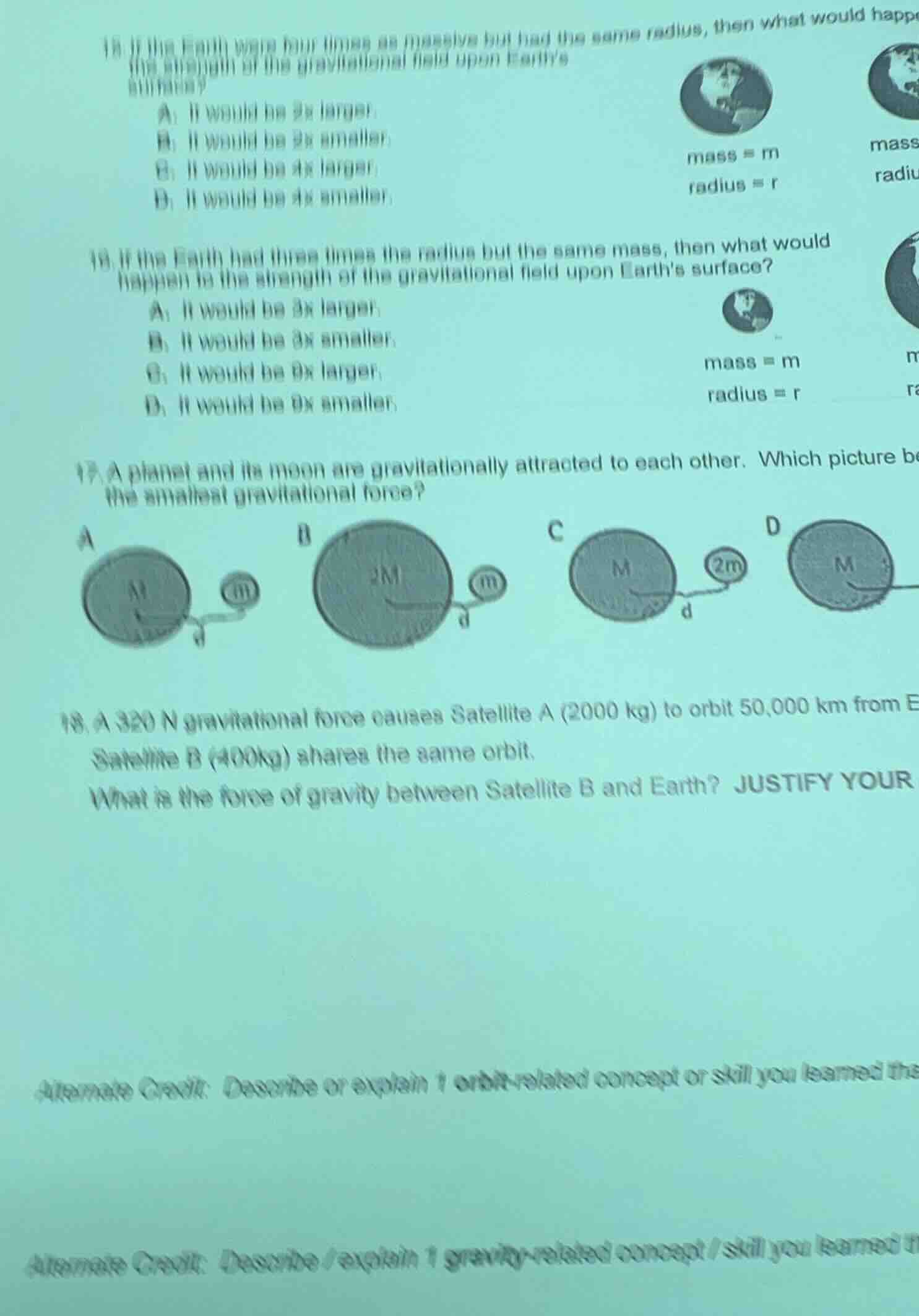
- if the earth were four times as massive but had the same radius, then what would happe the strength of the gravitational field upon earths surface?
a: it would be 2x larger.
b: it would be 2x smaller.
c: it would be 4x larger.
d: it would be 4x smaller.
- if the earth had three times the radius but the same mass, then what would happen to the strength of the gravitational field upon earths surface?
a: it would be 3x larger.
b: it would be 3x smaller.
c: it would be 9x larger.
d: it would be 9x smaller.
- a planet and its moon are gravitationally attracted to each other. which picture be the smallest gravitational force?
- a 320 n gravitational force causes satellite a (2000 kg) to orbit 50,000 km from e satellite b (400kg) shares the same orbit.
what is the force of gravity between satellite b and earth? justify your
alternate credit: describe or explain 1 orbit - related concept or skill you learned tha
alternate credit: describe / explain 1 gravity - related concept / skill you learned t
Step1: Recall gravitational field formula
The gravitational field strength at a planet's surface is $g = \frac{GM}{r^2}$, where $G$ is the gravitational constant, $M$ is the planet's mass, and $r$ is its radius.
---
For Question 15:
Step1: Set initial and new values
Initial: $g_1 = \frac{GM}{r^2}$; New: $M_2=4M$, $r_2=r$
Step2: Calculate new gravitational field
$g_2 = \frac{G(4M)}{r^2} = 4\times\frac{GM}{r^2}=4g_1$
---
For Question 16:
Step1: Set initial and new values
Initial: $g_1 = \frac{GM}{r^2}$; New: $M_2=M$, $r_2=3r$
Step2: Calculate new gravitational field
$g_2 = \frac{GM}{(3r)^2} = \frac{GM}{9r^2}=\frac{1}{9}g_1$
---
For Question 17:
Step1: Recall gravitational force formula
Gravitational force is $F = \frac{GMm}{d^2}$, where $d$ is the distance between masses.
Step2: Compare forces for each option
- A: $F_A = \frac{GMm}{d^2}$
- B: $F_B = \frac{G(2M)m}{d^2}=2F_A$
- C: $F_C = \frac{GM(2m)}{d^2}=2F_A$
- D: (Assuming $d$ is larger, or masses smaller; based on standard setup, A has the smallest product of masses and same distance, so smallest force)
---
For Question 18:
Step1: Recall gravitational force for satellites
Gravitational force on a satellite is $F = \frac{GM_E m_s}{r^2}$, where $M_E$ is Earth's mass, $m_s$ is satellite mass, $r$ is orbit radius.
Step2: Relate forces for Satellite A and B
Orbit radius $r$ is same, so $F \propto m_s$. $\frac{F_B}{F_A} = \frac{m_B}{m_A}$
Step3: Calculate $F_B$
$F_B = F_A \times \frac{m_B}{m_A} = 320\ \text{N} \times \frac{400\ \text{kg}}{2000\ \text{kg}} = 320\ \text{N} \times 0.2 = 64\ \text{N}$
---

Snap & solve any problem in the app
Get step-by-step solutions on Sovi AI
Photo-based solutions with guided steps
Explore more problems and detailed explanations
- C. It would be 4x larger.
- D. It would be 9x smaller.
- A (the pair with masses $M$ and $m$, distance $d$)
- 64 N; The gravitational force on a satellite in the same orbit is directly proportional to the satellite's mass, so scaling the mass by $\frac{400}{2000}=0.2$ scales the force by the same factor.