QUESTION IMAGE
Question
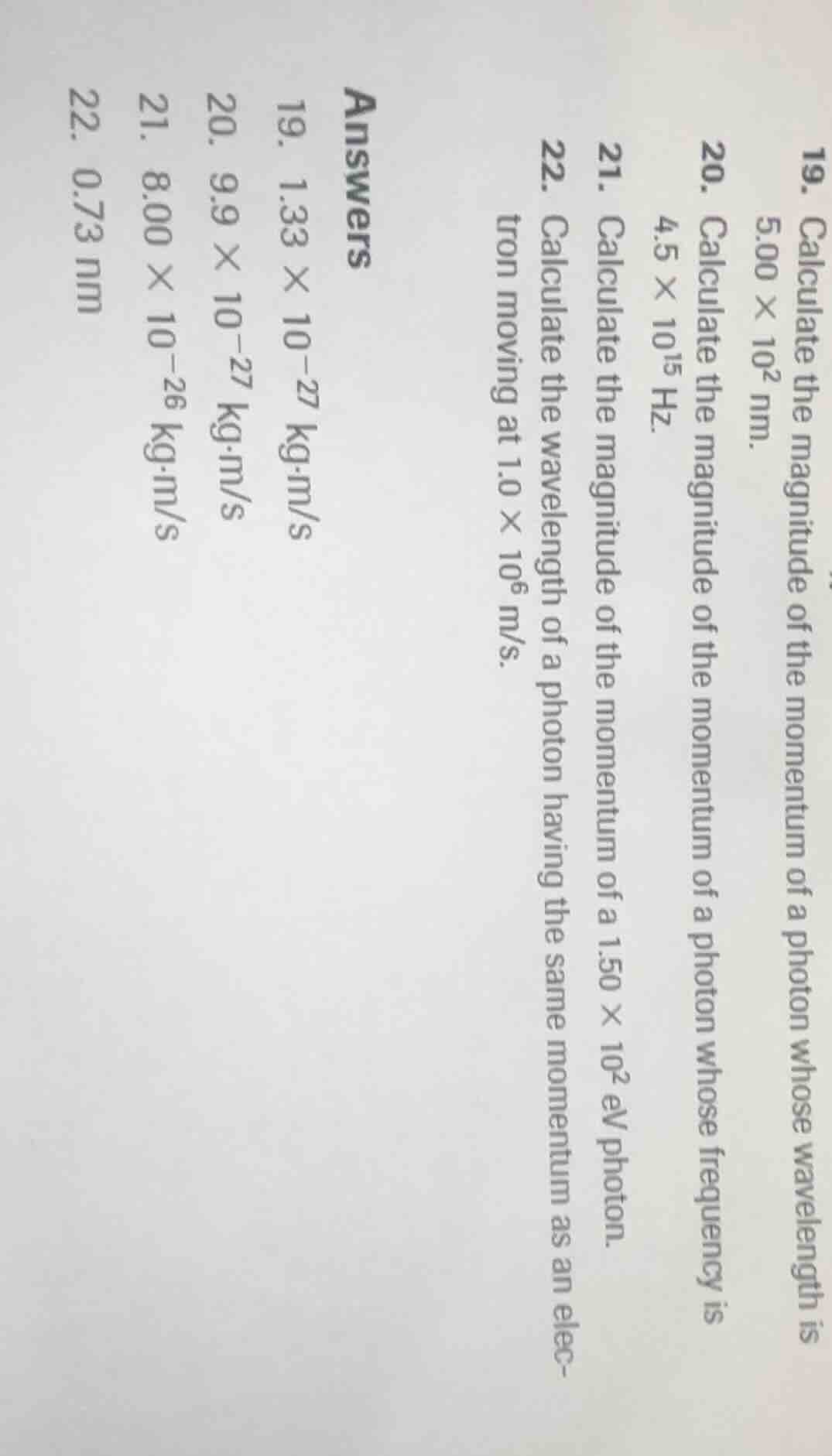
- calculate the magnitude of the momentum of a photon whose wavelength is 5.00 × 10² nm.
- calculate the magnitude of the momentum of a photon whose frequency is 4.5 × 10¹⁵ hz.
- calculate the magnitude of the momentum of a 1.50 × 10² ev photon.
- calculate the wavelength of a photon having the same momentum as an electron moving at 1.0 × 10⁶ m/s.
answers
- 1.33 × 10⁻²⁷ kg·m/s
- 9.9 × 10⁻²⁷ kg·m/s
- 8.00 × 10⁻²⁶ kg·m/s
- 0.73 nm
To solve these problems, we'll use the formulas related to photon momentum and energy, as well as electron momentum. Let's tackle each problem one by one:
Problem 19: Calculate the magnitude of the momentum of a photon whose wavelength is \( 5.00 \times 10^2 \, \text{nm} \).
Step 1: Recall the formula for photon momentum.
The momentum \( p \) of a photon is given by:
\[ p = \frac{h}{\lambda} \]
where \( h = 6.626 \times 10^{-34} \, \text{J·s} \) (Planck's constant) and \( \lambda \) is the wavelength.
Step 2: Convert the wavelength to meters.
The wavelength \( \lambda = 5.00 \times 10^2 \, \text{nm} \). Since \( 1 \, \text{nm} = 10^{-9} \, \text{m} \):
\[ \lambda = 5.00 \times 10^2 \times 10^{-9} \, \text{m} = 5.00 \times 10^{-7} \, \text{m} \]
Step 3: Substitute into the momentum formula.
\[ p = \frac{6.626 \times 10^{-34} \, \text{J·s}}{5.00 \times 10^{-7} \, \text{m}} \]
\[ p \approx 1.33 \times 10^{-27} \, \text{kg·m/s} \]
Problem 20: Calculate the magnitude of the momentum of a photon whose frequency is \( 4.5 \times 10^{15} \, \text{Hz} \).
Step 1: Recall the relationship between frequency (\( f \)) and wavelength (\( \lambda \)).
\[ c = f\lambda \implies \lambda = \frac{c}{f} \]
where \( c = 3.00 \times 10^8 \, \text{m/s} \) (speed of light).
Step 2: Substitute \( \lambda = \frac{c}{f} \) into the photon momentum formula.
\[ p = \frac{h}{\lambda} = \frac{hf}{c} \]
Step 3: Plug in the values.
\[ p = \frac{(6.626 \times 10^{-34} \, \text{J·s})(4.5 \times 10^{15} \, \text{Hz})}{3.00 \times 10^8 \, \text{m/s}} \]
\[ p \approx \frac{2.9817 \times 10^{-18}}{3.00 \times 10^8} \]
\[ p \approx 9.9 \times 10^{-27} \, \text{kg·m/s} \]
Problem 21: Calculate the magnitude of the momentum of a \( 1.50 \times 10^2 \, \text{eV} \) photon.
Step 1: Convert energy from eV to joules.
\( 1 \, \text{eV} = 1.602 \times 10^{-19} \, \text{J} \), so:
\[ E = 1.50 \times 10^2 \, \text{eV} \times 1.602 \times 10^{-19} \, \text{J/eV} \approx 2.403 \times 10^{-17} \, \text{J} \]
Step 2: Recall the relationship between photon energy (\( E \)) and momentum (\( p \)).
For a photon, \( E = pc \implies p = \frac{E}{c} \)
Step 3: Substitute the values.
\[ p = \frac{2.403 \times 10^{-17} \, \text{J}}{3.00 \times 10^8 \, \text{m/s}} \]
\[ p \approx 8.00 \times 10^{-26} \, \text{kg·m/s} \]
Problem 22: Calculate the wavelength of a photon having the same momentum as an electron moving at \( 1.0 \times 10^6 \, \text{m/s} \).
Step 1: Calculate the electron's momentum.
The momentum of an electron is \( p = m_e v \), where \( m_e = 9.11 \times 10^{-31} \, \text{kg} \) (mass of electron) and \( v = 1.0 \times 10^6 \, \text{m/s} \).
\[ p = (9.11 \times 10^{-31} \, \text{kg})(1.0 \times 10^6 \, \text{m/s}) \approx 9.11 \times 10^{-25} \, \text{kg·m/s} \]
Step 2: Use the photon momentum formula to find wavelength.
For a photon, \( p = \frac{h}{\lambda} \implies \lambda = \frac{h}{p} \)
Step 3: Substitute the values.
\[ \lambda = \frac{6.626 \times 10^{-34} \, \text{J·s}}{9.11 \times 10^{-25} \, \text{kg·m/s}} \]
\[ \lambda \approx 7.27 \times 10^{-10} \, \text{m} \]
Convert to nanometers (\( 1 \, \text{m} = 10^9 \, \text{nm} \)):
\[ \lambda \approx 0.73 \, \text{nm} \]
Final Answers:
- \( \boldsymbol{1.33 \times 10^{-27} \, \text{kg·m/s}} \)
- \( \boldsymbol{9.9 \times 10^{-27} \, \text{kg·m/s}} \)
- \( \boldsymbol{8.00 \times 10^{-26} \, \text{kg·m/s}} \)
- \( \boldsymbol{0.73 \, \text{nm}} \)

Snap & solve any problem in the app
Get step-by-step solutions on Sovi AI
Photo-based solutions with guided steps
Explore more problems and detailed explanations
To solve these problems, we'll use the formulas related to photon momentum and energy, as well as electron momentum. Let's tackle each problem one by one:
Problem 19: Calculate the magnitude of the momentum of a photon whose wavelength is \( 5.00 \times 10^2 \, \text{nm} \).
Step 1: Recall the formula for photon momentum.
The momentum \( p \) of a photon is given by:
\[ p = \frac{h}{\lambda} \]
where \( h = 6.626 \times 10^{-34} \, \text{J·s} \) (Planck's constant) and \( \lambda \) is the wavelength.
Step 2: Convert the wavelength to meters.
The wavelength \( \lambda = 5.00 \times 10^2 \, \text{nm} \). Since \( 1 \, \text{nm} = 10^{-9} \, \text{m} \):
\[ \lambda = 5.00 \times 10^2 \times 10^{-9} \, \text{m} = 5.00 \times 10^{-7} \, \text{m} \]
Step 3: Substitute into the momentum formula.
\[ p = \frac{6.626 \times 10^{-34} \, \text{J·s}}{5.00 \times 10^{-7} \, \text{m}} \]
\[ p \approx 1.33 \times 10^{-27} \, \text{kg·m/s} \]
Problem 20: Calculate the magnitude of the momentum of a photon whose frequency is \( 4.5 \times 10^{15} \, \text{Hz} \).
Step 1: Recall the relationship between frequency (\( f \)) and wavelength (\( \lambda \)).
\[ c = f\lambda \implies \lambda = \frac{c}{f} \]
where \( c = 3.00 \times 10^8 \, \text{m/s} \) (speed of light).
Step 2: Substitute \( \lambda = \frac{c}{f} \) into the photon momentum formula.
\[ p = \frac{h}{\lambda} = \frac{hf}{c} \]
Step 3: Plug in the values.
\[ p = \frac{(6.626 \times 10^{-34} \, \text{J·s})(4.5 \times 10^{15} \, \text{Hz})}{3.00 \times 10^8 \, \text{m/s}} \]
\[ p \approx \frac{2.9817 \times 10^{-18}}{3.00 \times 10^8} \]
\[ p \approx 9.9 \times 10^{-27} \, \text{kg·m/s} \]
Problem 21: Calculate the magnitude of the momentum of a \( 1.50 \times 10^2 \, \text{eV} \) photon.
Step 1: Convert energy from eV to joules.
\( 1 \, \text{eV} = 1.602 \times 10^{-19} \, \text{J} \), so:
\[ E = 1.50 \times 10^2 \, \text{eV} \times 1.602 \times 10^{-19} \, \text{J/eV} \approx 2.403 \times 10^{-17} \, \text{J} \]
Step 2: Recall the relationship between photon energy (\( E \)) and momentum (\( p \)).
For a photon, \( E = pc \implies p = \frac{E}{c} \)
Step 3: Substitute the values.
\[ p = \frac{2.403 \times 10^{-17} \, \text{J}}{3.00 \times 10^8 \, \text{m/s}} \]
\[ p \approx 8.00 \times 10^{-26} \, \text{kg·m/s} \]
Problem 22: Calculate the wavelength of a photon having the same momentum as an electron moving at \( 1.0 \times 10^6 \, \text{m/s} \).
Step 1: Calculate the electron's momentum.
The momentum of an electron is \( p = m_e v \), where \( m_e = 9.11 \times 10^{-31} \, \text{kg} \) (mass of electron) and \( v = 1.0 \times 10^6 \, \text{m/s} \).
\[ p = (9.11 \times 10^{-31} \, \text{kg})(1.0 \times 10^6 \, \text{m/s}) \approx 9.11 \times 10^{-25} \, \text{kg·m/s} \]
Step 2: Use the photon momentum formula to find wavelength.
For a photon, \( p = \frac{h}{\lambda} \implies \lambda = \frac{h}{p} \)
Step 3: Substitute the values.
\[ \lambda = \frac{6.626 \times 10^{-34} \, \text{J·s}}{9.11 \times 10^{-25} \, \text{kg·m/s}} \]
\[ \lambda \approx 7.27 \times 10^{-10} \, \text{m} \]
Convert to nanometers (\( 1 \, \text{m} = 10^9 \, \text{nm} \)):
\[ \lambda \approx 0.73 \, \text{nm} \]
Final Answers:
- \( \boldsymbol{1.33 \times 10^{-27} \, \text{kg·m/s}} \)
- \( \boldsymbol{9.9 \times 10^{-27} \, \text{kg·m/s}} \)
- \( \boldsymbol{8.00 \times 10^{-26} \, \text{kg·m/s}} \)
- \( \boldsymbol{0.73 \, \text{nm}} \)