QUESTION IMAGE
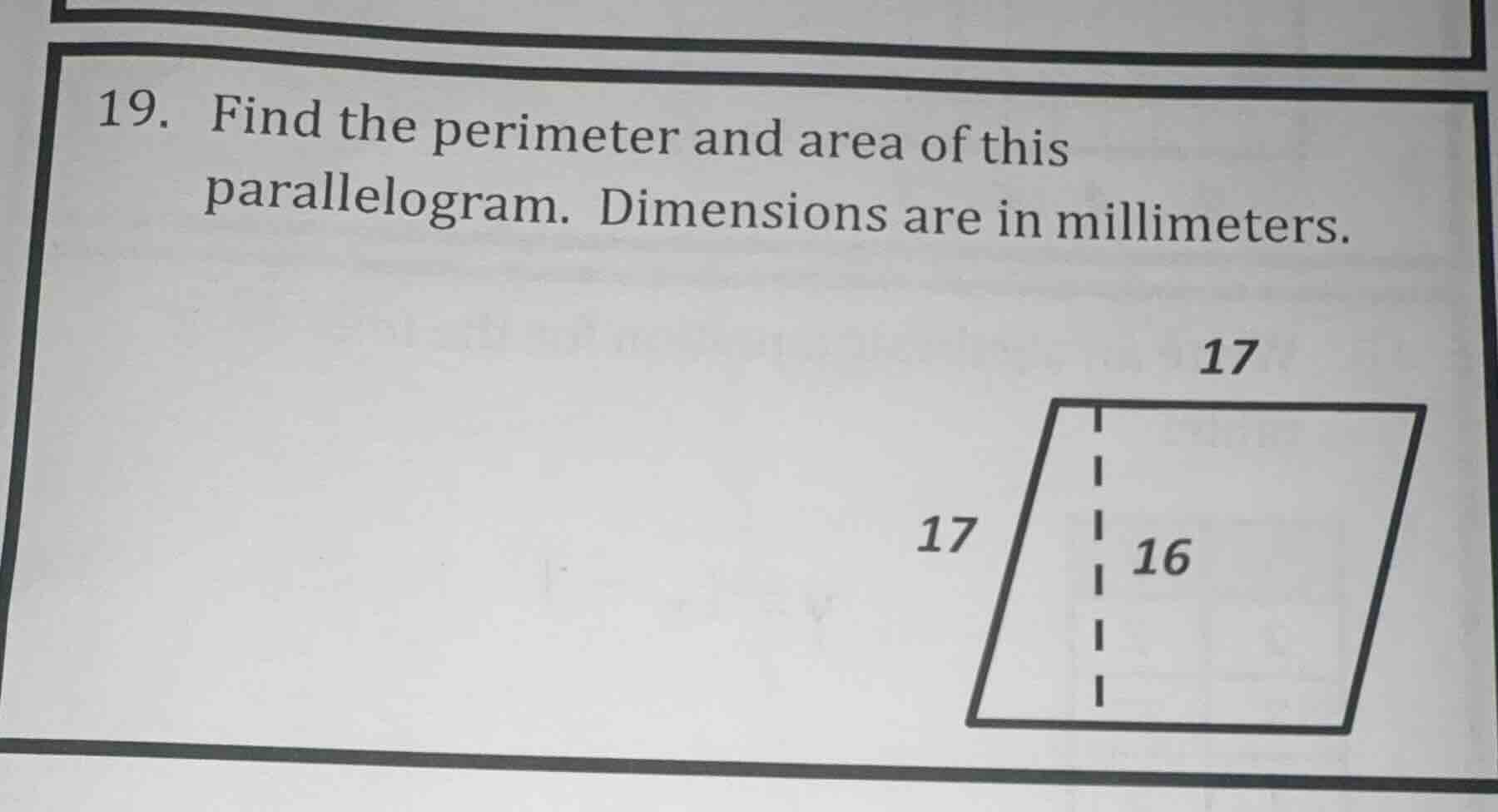
Question
- find the perimeter and area of this parallelogram. dimensions are in millimeters.
Step1: Find the perimeter of the parallelogram
In a parallelogram, opposite sides are equal. So the perimeter \( P \) is calculated as \( P = 2\times(a + b) \), where \( a \) and \( b \) are the lengths of adjacent sides. Here, \( a = 17 \) mm and \( b = 17 \) mm? Wait, no, looking at the diagram, one side is 17 (the base) and the adjacent side is also 17? Wait, no, the base is 17, the slant side is 17? Wait, no, the base is 17, the height is 16, and the adjacent side (the side of the parallelogram) is 17. Wait, actually, in a parallelogram, perimeter is \( 2\times(\text{base} + \text{side}) \). So if the base is 17 and the side (the other pair of sides) is 17? Wait, no, maybe I misread. Wait, the diagram shows one side as 17 (the slant side) and the base as 17? Wait, no, the base is 17, the height is 16, and the adjacent side (the side length) is 17. Wait, actually, let's check: in a parallelogram, opposite sides are equal. So if one side is 17 (base) and the adjacent side is 17 (the slant side), then perimeter is \( 2\times(17 + 17) = 2\times34 = 68 \) mm. Wait, but maybe the base is 17 and the other side is 17? Wait, no, maybe the base is 17, and the side (the length of the non - base side) is 17. Wait, let's confirm the formula for perimeter of a parallelogram: \( P = 2\times(\text{length of base} + \text{length of adjacent side}) \). From the diagram, the base is 17 mm, and the adjacent side (the side of the parallelogram) is 17 mm. So \( P = 2\times(17 + 17)=68 \) mm.
Step2: Find the area of the parallelogram
The formula for the area \( A \) of a parallelogram is \( A=\text{base}\times\text{height} \). The base is 17 mm and the height is 16 mm. So \( A = 17\times16 = 272 \) square millimeters.
Wait, wait, maybe I made a mistake in the perimeter. Wait, no, if the base is 17 and the adjacent side (the side length) is 17, then perimeter is \( 2\times(17 + 17)=68 \) mm. And area is \( 17\times16 = 272 \) \( \text{mm}^2 \).
Wait, let's re - check:
Perimeter of parallelogram: \( P = 2\times(a + b) \), where \( a \) and \( b \) are the lengths of two adjacent sides. From the diagram, one side (base) is 17, the other adjacent side (the side of the parallelogram) is 17. So \( P = 2\times(17 + 17)=68 \) mm.
Area of parallelogram: \( A=\text{base}\times\text{height} \). Base = 17 mm, height = 16 mm. So \( A = 17\times16 = 272 \) \( \text{mm}^2 \).

Snap & solve any problem in the app
Get step-by-step solutions on Sovi AI
Photo-based solutions with guided steps
Explore more problems and detailed explanations
Perimeter: \( 68 \) millimeters, Area: \( 272 \) square millimeters