QUESTION IMAGE
Question
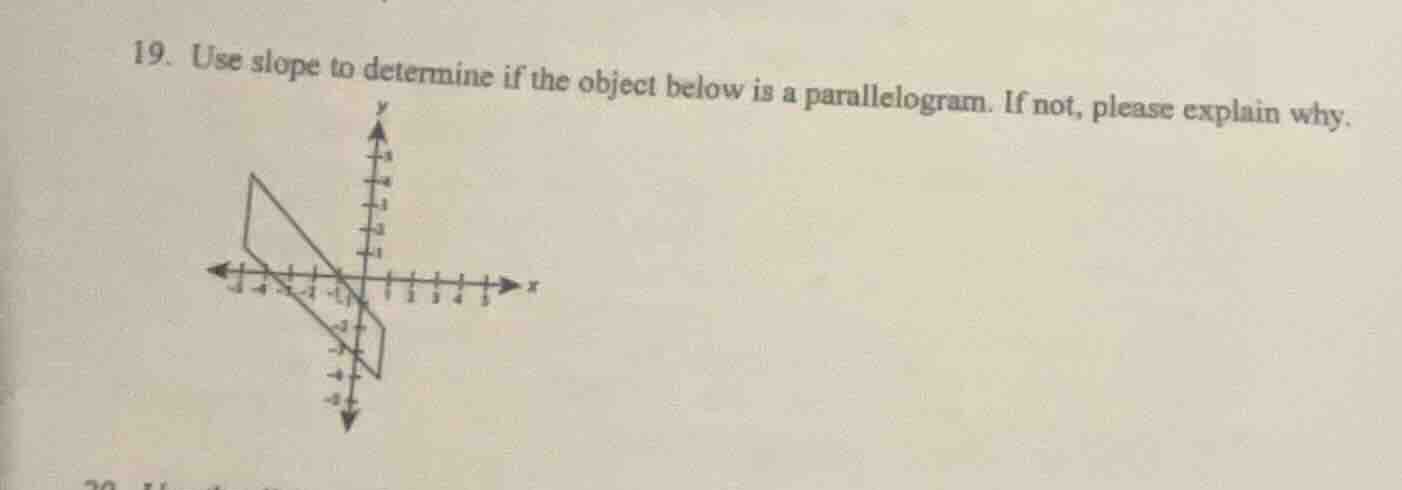
- use slope to determine if the object below is a parallelogram. if not, please explain why.
First, identify the 4 vertices of the quadrilateral from the graph: let's define them as $A(-4, 2)$, $B(-1, 0)$, $C(1, -4)$, $D(-2, -2)$.
Step1: Calculate slope of AB
Slope formula: $m=\frac{y_2-y_1}{x_2-x_1}$
$\text{Slope of } AB = \frac{0-2}{-1-(-4)} = \frac{-2}{3}$
Step2: Calculate slope of CD
$\text{Slope of } CD = \frac{-2-(-4)}{-2-1} = \frac{2}{-3} = -\frac{2}{3}$
Step3: Calculate slope of BC
$\text{Slope of } BC = \frac{-4-0}{1-(-1)} = \frac{-4}{2} = -2$
Step4: Calculate slope of DA
$\text{Slope of } DA = \frac{2-(-2)}{-4-(-2)} = \frac{4}{-2} = -2$
Step5: Compare slopes for parallelism
A quadrilateral is a parallelogram if both pairs of opposite sides are parallel (equal slopes). Here, $\text{Slope of } AB = \text{Slope of } CD$, and $\text{Slope of } BC = \text{Slope of } DA$.

Snap & solve any problem in the app
Get step-by-step solutions on Sovi AI
Photo-based solutions with guided steps
Explore more problems and detailed explanations
The object is a parallelogram, because both pairs of its opposite sides have equal slopes, meaning they are parallel.