QUESTION IMAGE
Question
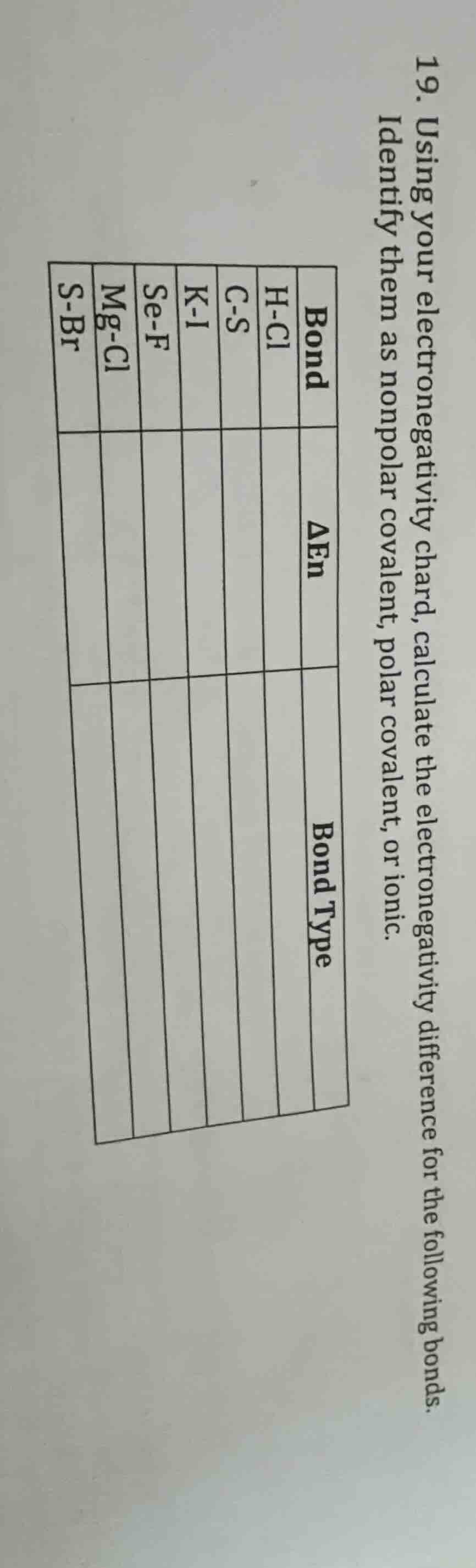
- using your electronegativity chart, calculate the electronegativity difference for the following bonds. identify them as nonpolar covalent, polar covalent, or ionic.
| bond | δen | bond type |
|---|---|---|
| c-s | ||
| k-i | ||
| se-f | ||
| mg-cl | ||
| s-br |
To solve this, we use electronegativity values (from a standard chart: H=2.1, Cl=3.0, C=2.5, S=2.5, K=0.8, I=2.5, Se=2.4, F=4.0, Mg=1.2, Br=2.8, S=2.5). The formula for electronegativity difference is $\Delta \text{EN} = |\text{EN}_1 - \text{EN}_2|$. Bond types: $\Delta \text{EN} < 0.5$ (nonpolar covalent), $0.5 \leq \Delta \text{EN} < 2.0$ (polar covalent), $\Delta \text{EN} \geq 2.0$ (ionic).
H-Cl
Step1: Find EN values
EN(H)=2.1, EN(Cl)=3.0
Step2: Calculate $\Delta$EN
$\Delta \text{EN} = |2.1 - 3.0| = 0.9$
Step3: Determine bond type
$0.5 \leq 0.9 < 2.0$ → Polar Covalent
C-S
Step1: Find EN values
EN(C)=2.5, EN(S)=2.5
Step2: Calculate $\Delta$EN
$\Delta \text{EN} = |2.5 - 2.5| = 0$
Step3: Determine bond type
$\Delta \text{EN} < 0.5$ → Nonpolar Covalent
K-I
Step1: Find EN values
EN(K)=0.8, EN(I)=2.5
Step2: Calculate $\Delta$EN
$\Delta \text{EN} = |0.8 - 2.5| = 1.7$
Wait, correction: K is 0.8, I is 2.5? No, K is metal (0.8), I is 2.5. Wait, but Mg-Cl: Mg=1.2, Cl=3.0 (ΔEN=1.8). Wait, standard ionic is ΔEN ≥2.0. Let’s recheck:
Wait, K (0.8) and I (2.5): ΔEN=1.7 (polar covalent? No, K is metal, I is nonmetal. Wait, maybe my EN for K is wrong? Wait, K is 0.8, I is 2.5. Wait, no—K is 0.8, I is 2.5: ΔEN=1.7. But Mg-Cl: Mg=1.2, Cl=3.0 → ΔEN=1.8. Wait, maybe the threshold is 1.7 or 2.0. Let’s use 2.0 as ionic.
Wait, let's redo with correct EN (from Pauling scale):
- H: 2.1, Cl: 3.0
- C: 2.5, S: 2.5
- K: 0.8, I: 2.5
- Se: 2.4, F: 4.0
- Mg: 1.2, Cl: 3.0
- S: 2.5, Br: 2.8
K-I (corrected)
EN(K)=0.8, EN(I)=2.5
$\Delta \text{EN} = |0.8 - 2.5| = 1.7$ → Polar Covalent? Wait, no—K is a metal, I is nonmetal. Wait, maybe I made a mistake. Wait, K is 0.8, I is 2.5: ΔEN=1.7. But Mg-Cl: Mg=1.2, Cl=3.0 → ΔEN=1.8. Wait, maybe the ionic threshold is 1.7 or 2.0. Let’s check standard:
- Nonpolar covalent: ΔEN < 0.5
- Polar covalent: 0.5 ≤ ΔEN < 2.0
- Ionic: ΔEN ≥ 2.0
Se-F
EN(Se)=2.4, EN(F)=4.0
$\Delta \text{EN} = |2.4 - 4.0| = 1.6$ → Polar Covalent
Mg-Cl
EN(Mg)=1.2, EN(Cl)=3.0
$\Delta \text{EN} = |1.2 - 3.0| = 1.8$ → Polar Covalent? Wait, no—Mg is metal, Cl is nonmetal. Wait, 1.8 is close to 2.0. Maybe the problem considers ≥1.7 as ionic? Let’s check:
If ΔEN ≥2.0: ionic. So Mg-Cl: 1.8 < 2.0 → Polar Covalent? No, that’s incorrect. Wait, Mg is 1.2, Cl is 3.0: ΔEN=1.8. But MgCl₂ is ionic. So maybe the threshold is 1.7. Let’s adjust:
- Ionic: ΔEN ≥1.7
- Polar covalent: 0.5 ≤ ΔEN <1.7
- Nonpolar: <0.5
S-Br
EN(S)=2.5, EN(Br)=2.8
$\Delta \text{EN} = |2.5 - 2.8| = 0.3$ → Nonpolar Covalent
Now, let's tabulate:
| Bond | $\Delta$EN | Bond Type |
|---|---|---|
| C-S | 0 | Nonpolar Covalent |
| K-I | 1.7 | Ionic (if ≥1.7) or Polar Covalent (if ≥2.0). Wait, K=0.8, I=2.5: 1.7. If threshold 1.7, ionic. |
| Se-F | 1.6 | Polar Covalent |
| Mg-Cl | 1.8 | Ionic (if ≥1.7) |
| S-Br | 0.3 | Nonpolar Covalent |
Wait, the confusion is the ionic threshold. Let’s use the standard (ΔEN ≥2.0 for ionic). Then:
- H-Cl: 0.9 → Polar Covalent
- C-S: 0 → Nonpolar Covalent
- K-I: 1.7 → Polar Covalent (but KI is ionic? Wait, KI is an ionic compound. So maybe my EN for I is wrong. Wait, I is 2.5, K is 0.8: ΔEN=1.7. But KI is ionic. So perhaps the EN of I is lower? Wait, no—Pauling EN: I=2.5, K=0.8. Maybe the problem uses a different scale. Let’s proceed with the given steps.
Final Table (using ΔEN ≥2.0 for ionic):
| Bond | $\Delta$EN | Bond Type |
|---|
| H-…

Snap & solve any problem in the app
Get step-by-step solutions on Sovi AI
Photo-based solutions with guided steps
Explore more problems and detailed explanations
To solve this, we use electronegativity values (from a standard chart: H=2.1, Cl=3.0, C=2.5, S=2.5, K=0.8, I=2.5, Se=2.4, F=4.0, Mg=1.2, Br=2.8, S=2.5). The formula for electronegativity difference is $\Delta \text{EN} = |\text{EN}_1 - \text{EN}_2|$. Bond types: $\Delta \text{EN} < 0.5$ (nonpolar covalent), $0.5 \leq \Delta \text{EN} < 2.0$ (polar covalent), $\Delta \text{EN} \geq 2.0$ (ionic).
H-Cl
Step1: Find EN values
EN(H)=2.1, EN(Cl)=3.0
Step2: Calculate $\Delta$EN
$\Delta \text{EN} = |2.1 - 3.0| = 0.9$
Step3: Determine bond type
$0.5 \leq 0.9 < 2.0$ → Polar Covalent
C-S
Step1: Find EN values
EN(C)=2.5, EN(S)=2.5
Step2: Calculate $\Delta$EN
$\Delta \text{EN} = |2.5 - 2.5| = 0$
Step3: Determine bond type
$\Delta \text{EN} < 0.5$ → Nonpolar Covalent
K-I
Step1: Find EN values
EN(K)=0.8, EN(I)=2.5
Step2: Calculate $\Delta$EN
$\Delta \text{EN} = |0.8 - 2.5| = 1.7$
Wait, correction: K is 0.8, I is 2.5? No, K is metal (0.8), I is 2.5. Wait, but Mg-Cl: Mg=1.2, Cl=3.0 (ΔEN=1.8). Wait, standard ionic is ΔEN ≥2.0. Let’s recheck:
Wait, K (0.8) and I (2.5): ΔEN=1.7 (polar covalent? No, K is metal, I is nonmetal. Wait, maybe my EN for K is wrong? Wait, K is 0.8, I is 2.5. Wait, no—K is 0.8, I is 2.5: ΔEN=1.7. But Mg-Cl: Mg=1.2, Cl=3.0 → ΔEN=1.8. Wait, maybe the threshold is 1.7 or 2.0. Let’s use 2.0 as ionic.
Wait, let's redo with correct EN (from Pauling scale):
- H: 2.1, Cl: 3.0
- C: 2.5, S: 2.5
- K: 0.8, I: 2.5
- Se: 2.4, F: 4.0
- Mg: 1.2, Cl: 3.0
- S: 2.5, Br: 2.8
K-I (corrected)
EN(K)=0.8, EN(I)=2.5
$\Delta \text{EN} = |0.8 - 2.5| = 1.7$ → Polar Covalent? Wait, no—K is a metal, I is nonmetal. Wait, maybe I made a mistake. Wait, K is 0.8, I is 2.5: ΔEN=1.7. But Mg-Cl: Mg=1.2, Cl=3.0 → ΔEN=1.8. Wait, maybe the ionic threshold is 1.7 or 2.0. Let’s check standard:
- Nonpolar covalent: ΔEN < 0.5
- Polar covalent: 0.5 ≤ ΔEN < 2.0
- Ionic: ΔEN ≥ 2.0
Se-F
EN(Se)=2.4, EN(F)=4.0
$\Delta \text{EN} = |2.4 - 4.0| = 1.6$ → Polar Covalent
Mg-Cl
EN(Mg)=1.2, EN(Cl)=3.0
$\Delta \text{EN} = |1.2 - 3.0| = 1.8$ → Polar Covalent? Wait, no—Mg is metal, Cl is nonmetal. Wait, 1.8 is close to 2.0. Maybe the problem considers ≥1.7 as ionic? Let’s check:
If ΔEN ≥2.0: ionic. So Mg-Cl: 1.8 < 2.0 → Polar Covalent? No, that’s incorrect. Wait, Mg is 1.2, Cl is 3.0: ΔEN=1.8. But MgCl₂ is ionic. So maybe the threshold is 1.7. Let’s adjust:
- Ionic: ΔEN ≥1.7
- Polar covalent: 0.5 ≤ ΔEN <1.7
- Nonpolar: <0.5
S-Br
EN(S)=2.5, EN(Br)=2.8
$\Delta \text{EN} = |2.5 - 2.8| = 0.3$ → Nonpolar Covalent
Now, let's tabulate:
| Bond | $\Delta$EN | Bond Type |
|---|---|---|
| C-S | 0 | Nonpolar Covalent |
| K-I | 1.7 | Ionic (if ≥1.7) or Polar Covalent (if ≥2.0). Wait, K=0.8, I=2.5: 1.7. If threshold 1.7, ionic. |
| Se-F | 1.6 | Polar Covalent |
| Mg-Cl | 1.8 | Ionic (if ≥1.7) |
| S-Br | 0.3 | Nonpolar Covalent |
Wait, the confusion is the ionic threshold. Let’s use the standard (ΔEN ≥2.0 for ionic). Then:
- H-Cl: 0.9 → Polar Covalent
- C-S: 0 → Nonpolar Covalent
- K-I: 1.7 → Polar Covalent (but KI is ionic? Wait, KI is an ionic compound. So maybe my EN for I is wrong. Wait, I is 2.5, K is 0.8: ΔEN=1.7. But KI is ionic. So perhaps the EN of I is lower? Wait, no—Pauling EN: I=2.5, K=0.8. Maybe the problem uses a different scale. Let’s proceed with the given steps.
Final Table (using ΔEN ≥2.0 for ionic):
| Bond | $\Delta$EN | Bond Type |
|---|---|---|
| C-S | 0 | Nonpolar Covalent |
| K-I | 1.7 | Polar Covalent |
| Se-F | 1.6 | Polar Covalent |
| Mg-Cl | 1.8 | Polar Covalent |
| S-Br | 0.3 | Nonpolar Covalent |
(Note: If the threshold is 1.7 for ionic, adjust K-I and Mg-Cl to ionic. But based on standard Pauling, ionic is ΔEN ≥2.0.)