QUESTION IMAGE
Question
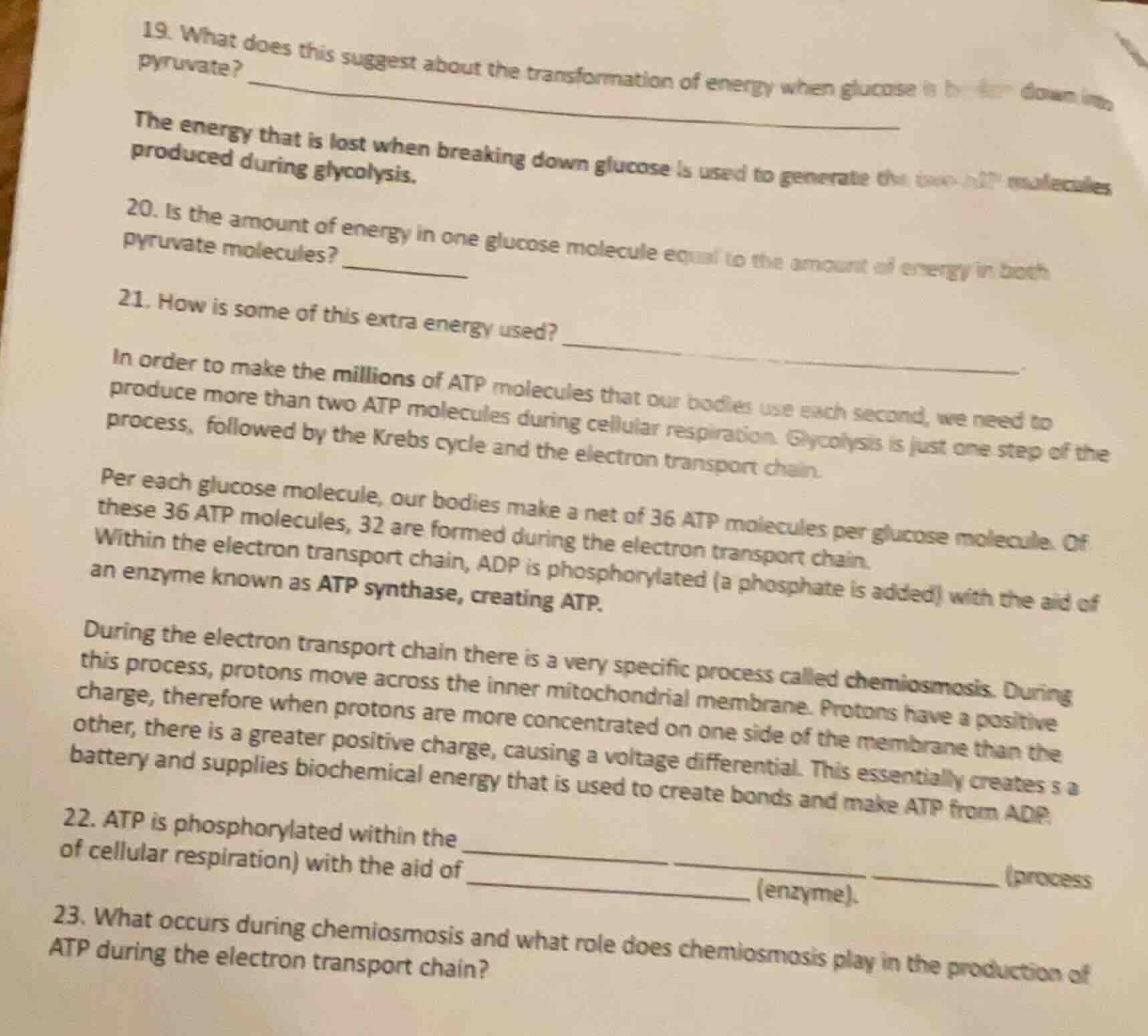
- what does this suggest about the transformation of energy when glucose is broken down into pyruvate?
the energy that is lost when breaking down glucose is used to generate the two atp molecules produced during glycolysis.
- is the amount of energy in one glucose molecule equal to the amount of energy in both pyruvate molecules?
- how is some of this extra energy used?
in order to make the millions of atp molecules that our bodies use each second, we need to produce more than two atp molecules during cellular respiration. glycolysis is just one step of the process, followed by the krebs cycle and the electron transport chain.
per each glucose molecule, our bodies make a net of 36 atp molecules per glucose molecule. of these 36 atp molecules, 32 are formed during the electron transport chain.
within the electron transport chain, adp is phosphorylated (a phosphate is added) with the aid of an enzyme known as atp synthase, creating atp.
during the electron transport chain there is a very specific process called chemiosmosis. during this process, protons move across the inner mitochondrial membrane. protons have a positive charge, therefore when protons are more concentrated on one side of the membrane than the other, there is a greater positive charge, causing a voltage differential. this essentially creates a battery and supplies biochemical energy that is used to create bonds and make atp from adp.
- atp is phosphorylated within the ________ ______ ______ (process of cellular respiration) with the aid of ________ (enzyme).
- what occurs during chemiosmosis and what role does chemiosmosis play in the production of atp during the electron transport chain?
Question 19
When glucose breaks down into pyruvate (glycolysis), energy is transformed: some is lost (as heat, for example) and some is used to make ATP. So the energy transformation involves releasing energy, with part used for ATP synthesis and part lost (e.g., as heat).
Energy in glucose vs two pyruvates: Glucose breakdown (glycolysis) loses energy (e.g., as heat, used for ATP). So glucose’s total energy (before breakdown) is more than the sum of two pyruvates’ energy, because energy was lost during the process (and used for ATP, but ATP’s energy is part of the transformed energy, but the remaining in pyruvate plus ATP plus lost energy equals glucose’s initial energy. So glucose’s energy > two pyruvates’ energy.
Extra energy (beyond what’s in pyruvates) from glucose breakdown: Used to generate ATP (during glycolysis, Krebs cycle, electron transport chain). Also, some is lost as heat (to maintain body temperature, for example) or used for other cellular processes that require energy (like active transport, biosynthesis).

Snap & solve any problem in the app
Get step-by-step solutions on Sovi AI
Photo-based solutions with guided steps
Explore more problems and detailed explanations
When glucose is broken down into pyruvate (during glycolysis), energy is transformed: some of the chemical energy in glucose is used to generate ATP, while some energy is lost (e.g., as heat), indicating that energy is neither created nor destroyed but converted between forms (chemical energy to ATP's energy and heat).