QUESTION IMAGE
Question
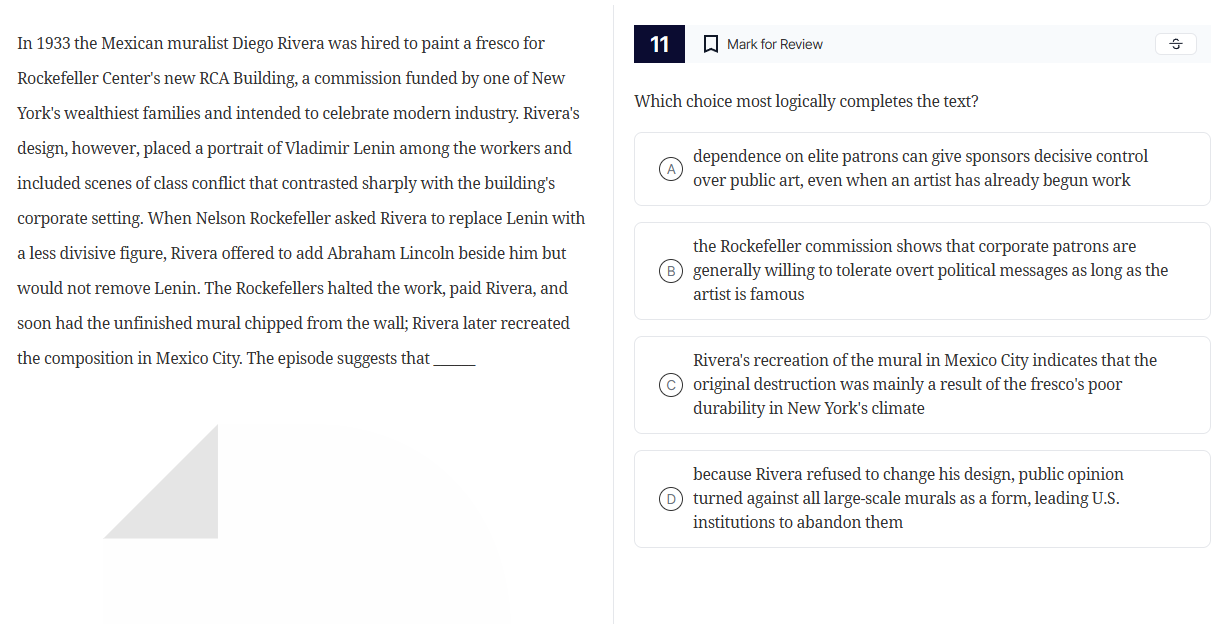
in 1933 the mexican muralist diego rivera was hired to paint a fresco for rockefeller center’s new rca building, a commission funded by one of new york’s wealthiest families and intended to celebrate modern industry. rivera’s design, however, placed a portrait of vladimir lenin among the workers and included scenes of class conflict that contrasted sharply with the building’s corporate setting. when nelson rockefeller asked rivera to replace lenin with a less divisive figure, rivera offered to add abraham lincoln beside him but would not remove lenin. the rockefellers halted the work, paid rivera, and soon had the unfinished mural chipped from the wall; rivera later recreated the composition in mexico city. the episode suggests that ______
11 □ mark for review
which choice most logically completes the text?
a ● dependence on elite patrons can give sponsors decisive control over public art, even when an artist has already begun work
b ● the rockefeller commission shows that corporate patrons are generally willing to tolerate overt political messages as long as the artist is famous
c ● rivera’s recreation of the mural in mexico city indicates that the original destruction was mainly a result of the fresco’s poor durability in new york’s climate
d ● because rivera refused to change his design, public opinion turned against all large - scale murals as a form, leading u.s. institutions to abandon them
- Option A: The episode shows Rivera was hired (began work), but the Rockefellers (elite patrons) halted work, paid him, and removed the mural when he wouldn't change the design (Lenin). This fits as it shows patrons' control over public art even after work started.
- Option B: The Rockefellers halted the work and removed the mural, so they weren't tolerant of the political message, eliminating B.
- Option C: The text says the mural was removed because of the political content (Lenin, class conflict), not durability, so C is wrong.
- Option D: There's no mention of public opinion turning against murals or U.S. institutions abandoning them, so D is incorrect.

Snap & solve any problem in the app
Get step-by-step solutions on Sovi AI
Photo-based solutions with guided steps
Explore more problems and detailed explanations
A. dependence on elite patrons can give sponsors decisive control over public art, even when an artist has already begun work