QUESTION IMAGE
Question
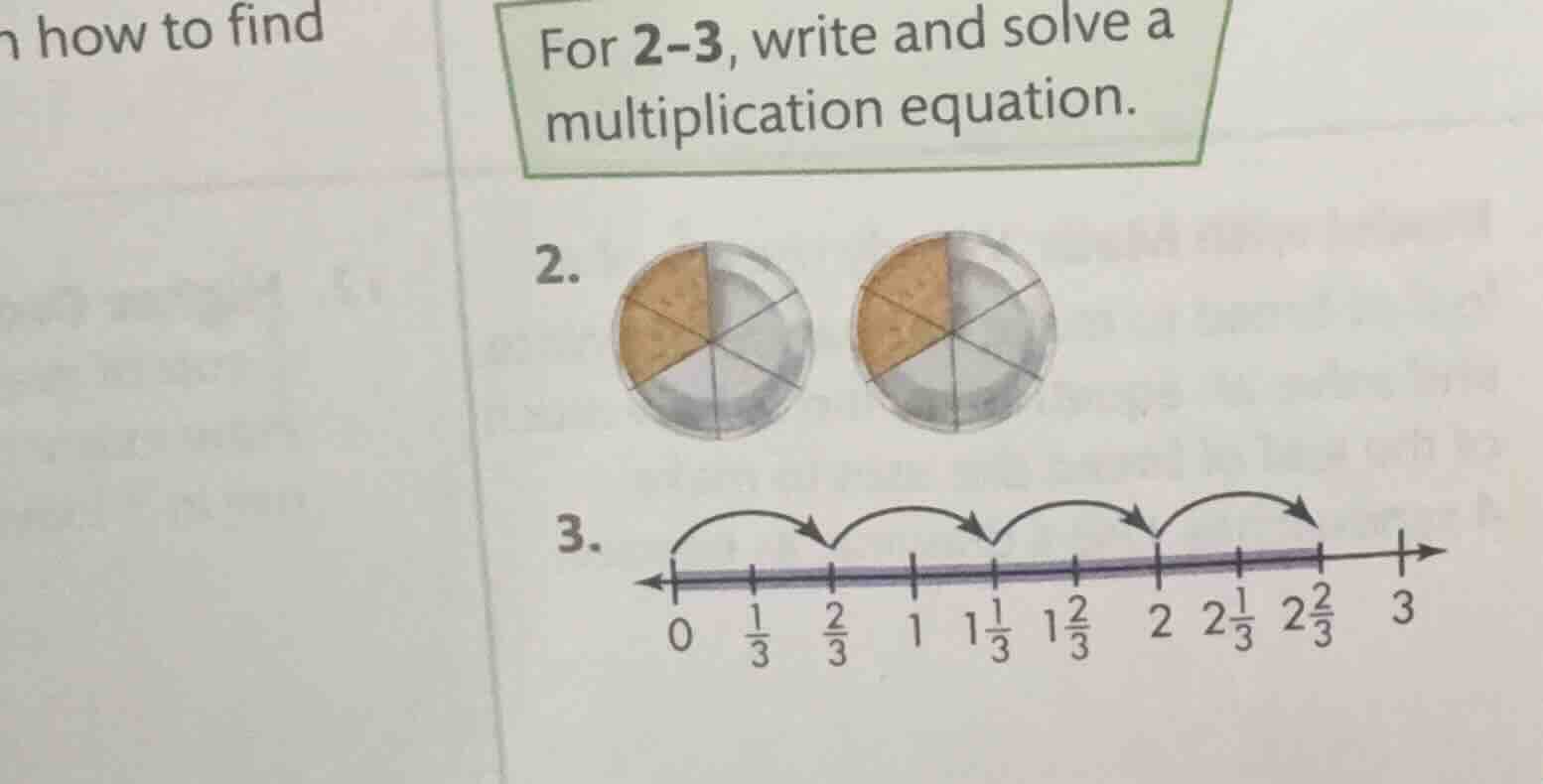
for 2-3, write and solve a multiplication equation.
2.
3.
0 1/3 2/3 1 1 1/3 1 2/3 2 2 1/3 2 2/3 3
Problem 2
Step1: Identify the fraction per circle
Each circle is divided into 6 parts, and 2 parts are shaded, so the fraction per circle is $\frac{2}{6}=\frac{1}{3}$. There are 2 circles.
Step2: Write the multiplication equation
The equation is $2\times\frac{1}{3}$ (or $\frac{1}{3}\times2$).
Step3: Solve the equation
$2\times\frac{1}{3}=\frac{2\times1}{3}=\frac{2}{3}$. Wait, no, wait, looking at the circles again, each circle has 2 out of 6? Wait, no, the shaded part is 2 out of 6? Wait, no, the circle is divided into 6? Wait, no, the first circle: the shaded part is 2? Wait, no, the circle is divided into 6 equal parts? Wait, no, the angle: wait, maybe it's divided into 6? Wait, no, the shaded part is 2? Wait, no, looking at the two circles, each has 2 shaded parts? Wait, no, maybe each circle has $\frac{2}{6}=\frac{1}{3}$? Wait, no, maybe I miscounted. Wait, the circle is divided into 6? Wait, no, the number of shaded parts: first circle, shaded parts are 2? Wait, no, the first circle: the shaded area is 2 out of 6? Wait, no, maybe it's 2 circles, each with $\frac{2}{6}=\frac{1}{3}$? Wait, no, let's re - examine. Each circle is divided into 6 equal sectors? Wait, no, the shaded part in each circle is 2 sectors? Wait, no, the first circle: the shaded part is 2? Wait, no, the two circles, each has 2 shaded sectors? Wait, no, maybe the fraction per circle is $\frac{2}{6}=\frac{1}{3}$, and there are 2 circles. So the multiplication equation is $2\times\frac{2}{6}$? Wait, no, that can't be. Wait, maybe each circle has $\frac{2}{6}=\frac{1}{3}$? No, wait, the correct way: each circle is divided into 6 parts, and 2 parts are shaded, so the fraction is $\frac{2}{6}=\frac{1}{3}$ per circle? No, wait, 2 shaded parts out of 6 is $\frac{2}{6}=\frac{1}{3}$. But there are 2 circles. So the total shaded is $2\times\frac{2}{6}$? Wait, no, I think I made a mistake. Wait, the two circles: each has 2 shaded parts (out of 6). So the fraction for one circle is $\frac{2}{6}=\frac{1}{3}$? No, 2 out of 6 is $\frac{1}{3}$? No, 2/6 reduces to 1/3. But if we have two circles, each with 2/6 shaded, then the equation is $2\times\frac{2}{6}$. Let's simplify $\frac{2}{6}=\frac{1}{3}$, so $2\times\frac{1}{3}=\frac{2}{3}$? Wait, no, that doesn't seem right. Wait, maybe the circle is divided into 6, and the shaded part is 2, so each circle has $\frac{2}{6}=\frac{1}{3}$? No, 2/6 is 1/3. But if we have two circles, the total shaded is $2\times\frac{2}{6}=\frac{4}{6}=\frac{2}{3}$. Wait, maybe that's correct.
Wait, let's start over. Each circle is divided into 6 equal parts. In each circle, 2 parts are shaded. So the fraction of shaded area in one circle is $\frac{2}{6}=\frac{1}{3}$. There are 2 circles. So the multiplication equation is $2\times\frac{2}{6}$ (or $\frac{2}{6}\times2$). Simplify $\frac{2}{6}=\frac{1}{3}$, so $2\times\frac{1}{3}=\frac{2}{3}$. Wait, but if we don't simplify the fraction first, $2\times\frac{2}{6}=\frac{4}{6}=\frac{2}{3}$.
Step1: Determine the fraction per circle
Each circle is divided into 6 equal parts, and 2 parts are shaded. So the fraction of the shaded part in one circle is $\frac{2}{6}$.
Step2: Write the multiplication equation
Since there are 2 such circles, the multiplication equation is $2\times\frac{2}{6}$ (or $\frac{2}{6}\times2$).
Step3: Simplify and solve
First, simplify $\frac{2}{6}=\frac{1}{3}$. Then $2\times\frac{1}{3}=\frac{2}{3}$. Or, $2\times\frac{2}{6}=\frac{4}{6}=\frac{2}{3}$.
Problem 3
Step1: Identify the length of each jump
Looking at the number line, each jump is of length $\frac{2}{3}$ (from 0 to $\frac{2}{3}$, $\frac{2}{3}$ to $1\frac{1}{3}$, etc.). Wait, no, from 0 to $\frac{2}{3}$ is a jump of $\frac{2}{3}$? Wait, no, the first jump is from 0 to $\frac{2}{3}$, the second from $\frac{2}{3}$ to $1\frac{1}{3}$, the third from $1\frac{1}{3}$ to $2$, and the fourth from $2$ to $2\frac{2}{3}$? Wait, no, the number of jumps: let's count the arrows. There are 4 arrows. Wait, the first arrow goes from 0 to $\frac{2}{3}$, the second from $\frac{2}{3}$ to $1\frac{1}{3}$, the third from $1\frac{1}{3}$ to $2$, and the fourth from $2$ to $2\frac{2}{3}$? Wait, no, the length of each jump: from 0 to $\frac{2}{3}$ is $\frac{2}{3}$ units. Wait, no, $\frac{2}{3}-0 = \frac{2}{3}$, $1\frac{1}{3}-\frac{2}{3}=\frac{4}{3}-\frac{2}{3}=\frac{2}{3}$, $2 - 1\frac{1}{3}=\frac{6}{3}-\frac{4}{3}=\frac{2}{3}$, $2\frac{2}{3}-2=\frac{2}{3}$. So each jump is $\frac{2}{3}$ units, and there are 4 jumps.
Step2: Write the multiplication equation
The equation is $4\times\frac{2}{3}$ (or $\frac{2}{3}\times4$).
Step3: Solve the equation
$4\times\frac{2}{3}=\frac{4\times2}{3}=\frac{8}{3}=2\frac{2}{3}$.
Problem 2 Answer:
The multiplication equation is $2\times\frac{2}{6}=\frac{2}{3}$ (or simplified as $2\times\frac{1}{3}=\frac{2}{3}$)
Problem 3 Answer:
The multiplication equation is $4\times\frac{2}{3}=\frac{8}{3}=2\frac{2}{3}$

Snap & solve any problem in the app
Get step-by-step solutions on Sovi AI
Photo-based solutions with guided steps
Explore more problems and detailed explanations
Step1: Identify the length of each jump
Looking at the number line, each jump is of length $\frac{2}{3}$ (from 0 to $\frac{2}{3}$, $\frac{2}{3}$ to $1\frac{1}{3}$, etc.). Wait, no, from 0 to $\frac{2}{3}$ is a jump of $\frac{2}{3}$? Wait, no, the first jump is from 0 to $\frac{2}{3}$, the second from $\frac{2}{3}$ to $1\frac{1}{3}$, the third from $1\frac{1}{3}$ to $2$, and the fourth from $2$ to $2\frac{2}{3}$? Wait, no, the number of jumps: let's count the arrows. There are 4 arrows. Wait, the first arrow goes from 0 to $\frac{2}{3}$, the second from $\frac{2}{3}$ to $1\frac{1}{3}$, the third from $1\frac{1}{3}$ to $2$, and the fourth from $2$ to $2\frac{2}{3}$? Wait, no, the length of each jump: from 0 to $\frac{2}{3}$ is $\frac{2}{3}$ units. Wait, no, $\frac{2}{3}-0 = \frac{2}{3}$, $1\frac{1}{3}-\frac{2}{3}=\frac{4}{3}-\frac{2}{3}=\frac{2}{3}$, $2 - 1\frac{1}{3}=\frac{6}{3}-\frac{4}{3}=\frac{2}{3}$, $2\frac{2}{3}-2=\frac{2}{3}$. So each jump is $\frac{2}{3}$ units, and there are 4 jumps.
Step2: Write the multiplication equation
The equation is $4\times\frac{2}{3}$ (or $\frac{2}{3}\times4$).
Step3: Solve the equation
$4\times\frac{2}{3}=\frac{4\times2}{3}=\frac{8}{3}=2\frac{2}{3}$.
Problem 2 Answer:
The multiplication equation is $2\times\frac{2}{6}=\frac{2}{3}$ (or simplified as $2\times\frac{1}{3}=\frac{2}{3}$)
Problem 3 Answer:
The multiplication equation is $4\times\frac{2}{3}=\frac{8}{3}=2\frac{2}{3}$