QUESTION IMAGE
Question
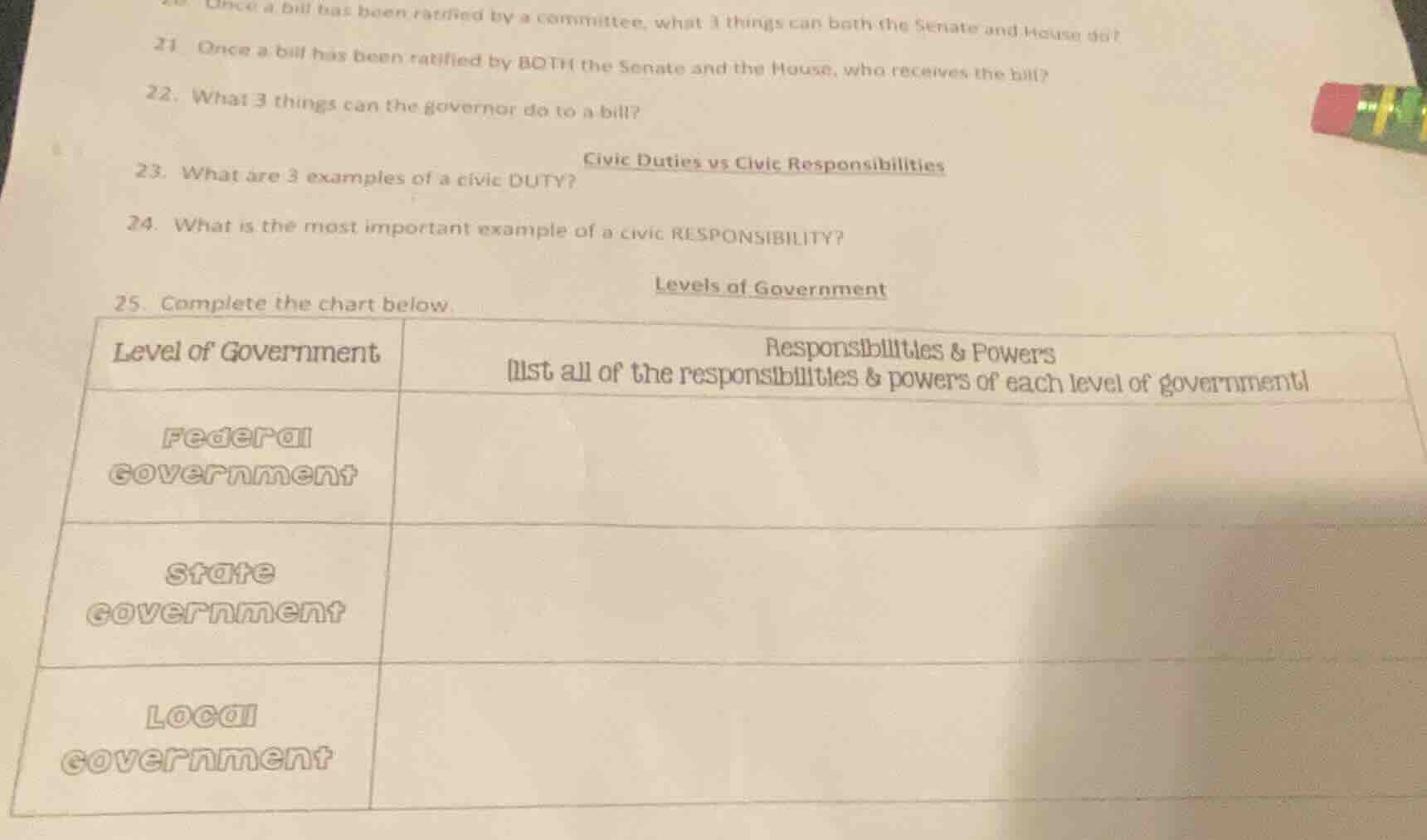
- once a bill has been ratified by a committee, what 3 things can both the senate and house do?
- once a bill has been ratified by both the senate and the house, who receives the bill?
- what 3 things can the governor do to a bill?
civic duties vs civic responsibilities
- what are 3 examples of a civic duty?
- what is the most important example of a civic responsibility?
levels of government
- complete the chart below.
level of government | responsibilities & powers
list all of the responsibilities & powers of each level of government
federal government |
state government |
local government |
Brief Explanations
- This refers to post-committee bill actions for U.S. Congress chambers.
- Addresses the next step after bicameral passage of a bill in the U.S. system.
- Covers the executive branch (state-level) bill actions in the U.S.
- Civic duties are mandatory legal obligations for citizens.
- Civic responsibilities are voluntary actions for community good, with a key impactful example.
- Breaks down core powers of the three tiers of U.S. government, based on constitutional and legal allocations.

Snap & solve any problem in the app
Get step-by-step solutions on Sovi AI
Photo-based solutions with guided steps
Explore more problems and detailed explanations
- 1. Vote to pass the bill, 2. Vote to reject the bill, 3. Amend the bill and vote on the revised version
- The President of the United States receives the bill.
- 1. Sign the bill into law, 2. Veto the bill (send it back to Congress), 3. Do nothing (pocket veto, which becomes law after 10 days if Congress is in session, or dies if Congress adjourns)
- 1. Paying taxes, 2. Serving on a jury when summoned, 3. Obeying federal, state, and local laws
- Voting in local, state, and federal elections
25.
| Level of Government | Responsibilities & Powers |
|---|---|
| State government | - Regulate intrastate commerce<br>- Establish and run public schools<br>- Manage state elections<br>- Create state-level courts<br>- Enforce state laws and maintain state law enforcement |
| Local government | - Manage local public schools (day-to-day operations)<br>- Maintain local infrastructure (roads, parks, public transit)<br>- Enforce local ordinances (e.g., zoning laws)<br>- Provide local public services (waste management, local police/fire departments) |