QUESTION IMAGE
Question
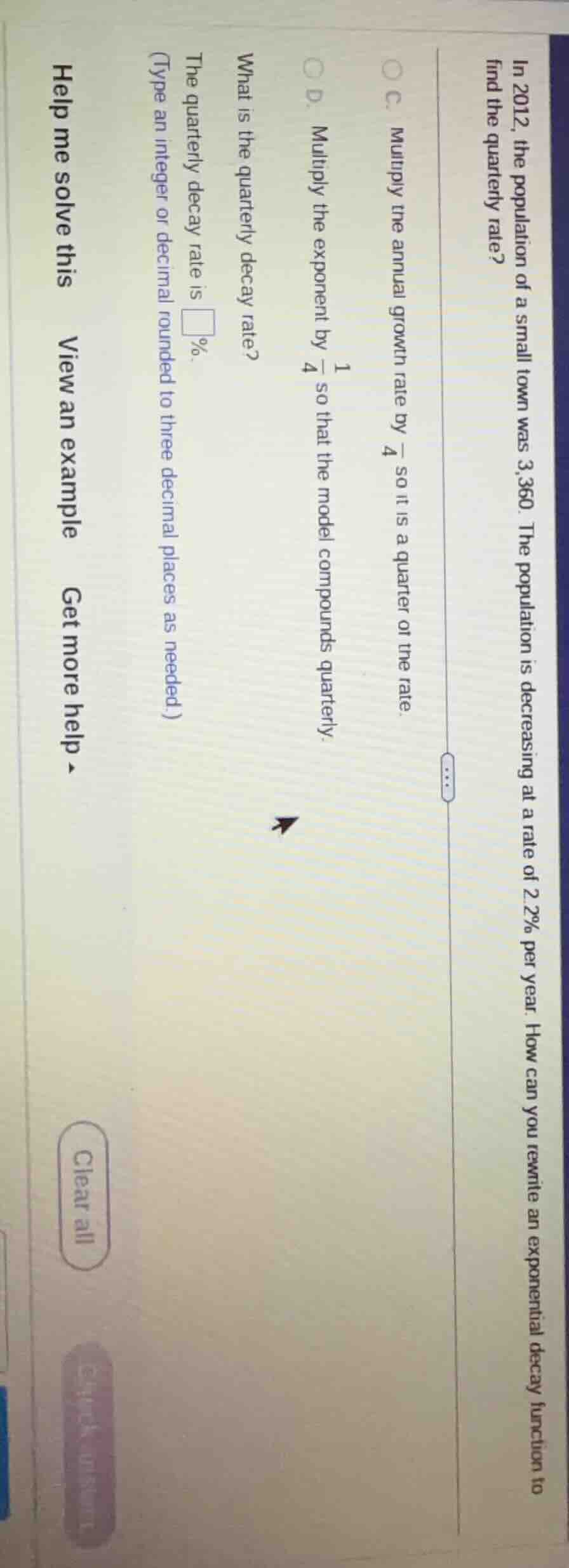
in 2012, the population of a small town was 3,360. the population is decreasing at a rate of 2.2% per year. how can you rewrite an exponential decay function to find the quarterly rate?
c. multiply the annual growth rate by $\frac{1}{4}$ so it is a quarter of the rate.
d. multiply the exponent by $\frac{1}{4}$ so that the model compounds quarterly.
what is the quarterly decay rate?
the quarterly decay rate is $square$%.
(type an integer or decimal rounded to three decimal places as needed.)
help me solve this view an example get more help
clear all
Step1: Identify correct method
To find quarterly decay rate from annual continuous decay, we use the relationship between annual and quarterly decay factors. The annual decay factor is $1 - 0.022 = 0.978$. For quarterly decay, we solve for the quarterly factor $r$ where $(1 - r)^4 = 0.978$.
Step2: Calculate quarterly decay factor
Take the 4th root of the annual decay factor:
$$1 - r = \sqrt[4]{0.978}$$
$$1 - r = 0.978^{\frac{1}{4}} \approx 0.99446$$
Step3: Find quarterly decay rate
Subtract the quarterly factor from 1, convert to percentage:
$$r = 1 - 0.99446 = 0.00554$$
$$r = 0.00554 \times 100 = 0.554\%$$

Snap & solve any problem in the app
Get step-by-step solutions on Sovi AI
Photo-based solutions with guided steps
Explore more problems and detailed explanations
Correct method option: D. Multiply the exponent by $\frac{1}{4}$ so that the model compounds quarterly.
Quarterly decay rate: $0.554\%$