QUESTION IMAGE
Question
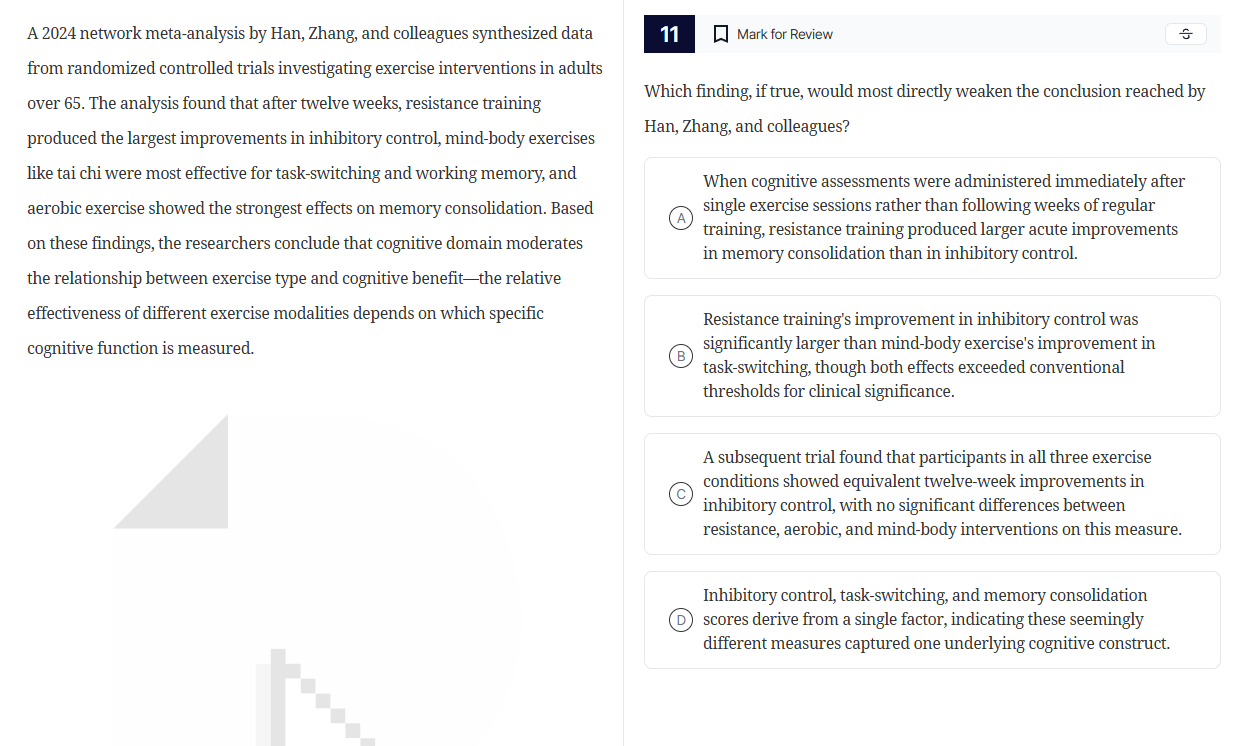
a 2024 network meta - analysis by han, zhang, and colleagues synthesized data from randomized controlled trials investigating exercise interventions in adults over 65. the analysis found that after twelve weeks, resistance training produced the largest improvements in inhibitory control, mind - body exercises like tai chi were most effective for task - switching and working memory, and aerobic exercise showed the strongest effects on memory consolidation. based on these findings, the researchers conclude that cognitive domain moderates the relationship between exercise type and cognitive benefit—the relative effectiveness of different exercise modalities depends on which specific cognitive function is measured.
11 mark for review
which finding, if true, would most directly weaken the conclusion reached by han, zhang, and colleagues?
a when cognitive assessments were administered immediately after single exercise sessions rather than following weeks of regular training, resistance training produced larger acute improvements in memory consolidation than in inhibitory control.
b resistance trainings improvement in inhibitory control was significantly larger than mind - body exercises improvement in task - switching, though both effects exceeded conventional thresholds for clinical significance.
c a subsequent trial found that participants in all three exercise conditions showed equivalent twelve - week improvements in inhibitory control, with no significant differences between resistance, aerobic, and mind - body interventions on this measure.
d inhibitory control, task - switching, and memory consolidation scores derive from a single factor, indicating these seemingly different measures captured one underlying cognitive construct.
The researchers' conclusion is that the relative effectiveness of different exercise modalities depends on the specific cognitive function measured (cognitive domain moderates the relationship). To weaken this, we need a finding that shows the exercise type's effectiveness is not dependent on the cognitive function (i.e., different exercises have similar effects on a cognitive function, or cognitive functions are not distinct).
- Option A: Talks about acute improvements (immediately after single sessions) vs. regular training, which is a different time frame and doesn't address the relationship between exercise type, cognitive domain, and effectiveness. Eliminate.
- Option B: Compares the magnitude of improvements between two exercises for different cognitive functions, which actually supports the idea that effectiveness depends on cognitive function (since different exercises are better for different functions). Eliminate.
- Option C: Shows that all three exercise conditions had equivalent improvements in inhibitory control. The original conclusion says resistance training was best for inhibitory control, but this finding shows no difference between exercise types for this cognitive function. However, it only addresses one cognitive function. Let's check D.
- Option D: States that the three cognitive measures (inhibitory control, task - switching, memory consolidation) are actually one underlying construct. If the cognitive domains are not distinct, then the idea that the relationship between exercise type and cognitive benefit is moderated by cognitive domain (which are supposed to be distinct) is weakened, as the different "cognitive domains" are not actually different. This directly attacks the premise of the conclusion (that cognitive domain moderates the relationship because different exercises are good for different domains) by showing the domains are not distinct. This is a stronger weakening than C, which only addresses one domain.

Snap & solve any problem in the app
Get step-by-step solutions on Sovi AI
Photo-based solutions with guided steps
Explore more problems and detailed explanations
D. Inhibitory control, task - switching, and memory consolidation scores derive from a single factor, indicating these seemingly different measures captured one underlying cognitive construct.