QUESTION IMAGE
Question
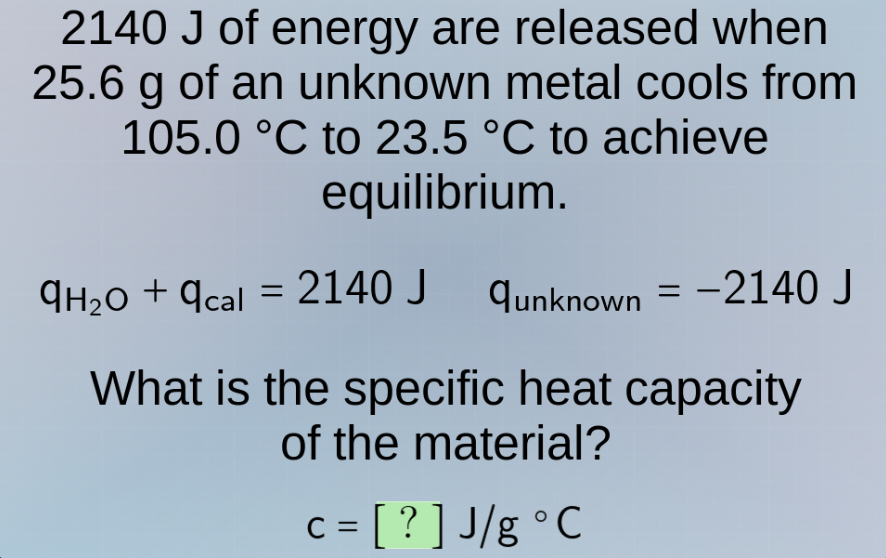
2140 j of energy are released when 25.6 g of an unknown metal cools from 105.0 °c to 23.5 °c to achieve equilibrium.
$q_{h_2o} + q_{cal} = 2140 j$ $q_{unknown} = -2140 j$
what is the specific heat capacity of the material?
$c = ? j/g °c$
Step1: Recall the formula for heat transfer
The formula for heat transfer is \( q = mc\Delta T \), where \( q \) is the heat energy, \( m \) is the mass, \( c \) is the specific heat capacity, and \( \Delta T \) is the change in temperature. For the unknown metal, we know \( q_{\text{unknown}} = -2140 \, \text{J} \), \( m = 25.6 \, \text{g} \), and we need to find \( \Delta T \) first.
Step2: Calculate the change in temperature
The initial temperature \( T_i = 105.0^\circ \text{C} \) and the final temperature \( T_f = 23.5^\circ \text{C} \). So, \( \Delta T = T_f - T_i = 23.5^\circ \text{C} - 105.0^\circ \text{C} = -81.5^\circ \text{C} \).
Step3: Rearrange the heat formula to solve for \( c \)
From \( q = mc\Delta T \), we can rearrange to solve for \( c \): \( c = \frac{q}{m\Delta T} \).
Step4: Substitute the known values into the formula
We know \( q = -2140 \, \text{J} \), \( m = 25.6 \, \text{g} \), and \( \Delta T = -81.5^\circ \text{C} \). Substituting these values in:
\[
c = \frac{-2140 \, \text{J}}{25.6 \, \text{g} \times (-81.5^\circ \text{C})}
\]
Step5: Calculate the value of \( c \)
First, calculate the denominator: \( 25.6 \times 81.5 = 25.6 \times 80 + 25.6 \times 1.5 = 2048 + 38.4 = 2086.4 \). Then, the numerator is \( -2140 \) and the denominator is \( -2086.4 \) (since both numerator and denominator have a negative sign, they cancel out). So, \( c = \frac{2140}{2086.4} \approx 1.0256 \, \text{J/g}^\circ \text{C} \). Rounding to a reasonable number of significant figures, we can check the given values: 2140 J (4 significant figures), 25.6 g (3 significant figures), 105.0 \(^\circ\)C (4 significant figures), 23.5 \(^\circ\)C (3 significant figures). So, the least number of significant figures is 3, so we can round to 1.03 \( \text{J/g}^\circ \text{C} \) or more accurately, let's do the division precisely: \( 2140 \div 2086.4 \approx 1.0256 \approx 1.03 \) (if we take three significant figures) or 1.026 (if we take more). But let's check the calculation again:
\( 25.6 \times 81.5 = 25.6 \times 81.5 \). Let's compute 25.6 80 = 2048, 25.6 1.5 = 38.4, so total 2048 + 38.4 = 2086.4. Then 2140 / 2086.4 ≈ 1.0256, which is approximately 1.03 \( \text{J/g}^\circ \text{C} \) (or more precisely, 1.026). Wait, maybe I made a mistake in the sign. Wait, \( q = mc\Delta T \), and \( \Delta T = T_f - T_i = 23.5 - 105.0 = -81.5 \). So \( q = mc\Delta T \), so \( -2140 = 25.6 \times c \times (-81.5) \). So the negatives cancel, so \( 2140 = 25.6 \times c \times 81.5 \). Then \( c = 2140 / (25.6 \times 81.5) \). Let's compute 25.6 81.5: 25 81.5 = 2037.5, 0.6 * 81.5 = 48.9, so total 2037.5 + 48.9 = 2086.4. Then 2140 / 2086.4 ≈ 1.0256, which is approximately 1.03 \( \text{J/g}^\circ \text{C} \) (or 1.026). Let's check with a calculator: 2140 ÷ 2086.4 ≈ 1.0256, so approximately 1.03 \( \text{J/g}^\circ \text{C} \) (if we take three significant figures) or 1.026. Wait, maybe the answer is approximately 1.03 \( \text{J/g}^\circ \text{C} \), but let's see:
Wait, 2140 divided by (25.6 81.5). Let's compute 25.6 81.5:
25.6 * 81.5:
First, 81.5 * 25 = 2037.5
81.5 * 0.6 = 48.9
So 2037.5 + 48.9 = 2086.4
Then 2140 / 2086.4 ≈ 1.0256, which is approximately 1.03 \( \text{J/g}^\circ \text{C} \) (rounded to three significant figures) or 1.026. Let's see, the mass is 25.6 (three sig figs), temperature change is 81.5 (three sig figs), energy is 2140 (four sig figs, but maybe it's 2140 as three sig figs if the trailing zero is not significant, but 2140 could be four if the zero is significant. Wait, 2140 J: if it's writte…

Snap & solve any problem in the app
Get step-by-step solutions on Sovi AI
Photo-based solutions with guided steps
Explore more problems and detailed explanations
\boxed{1.03} (or more precisely, \boxed{1.026} if we take more decimal places, but typically, three significant figures give 1.03)