QUESTION IMAGE
Question
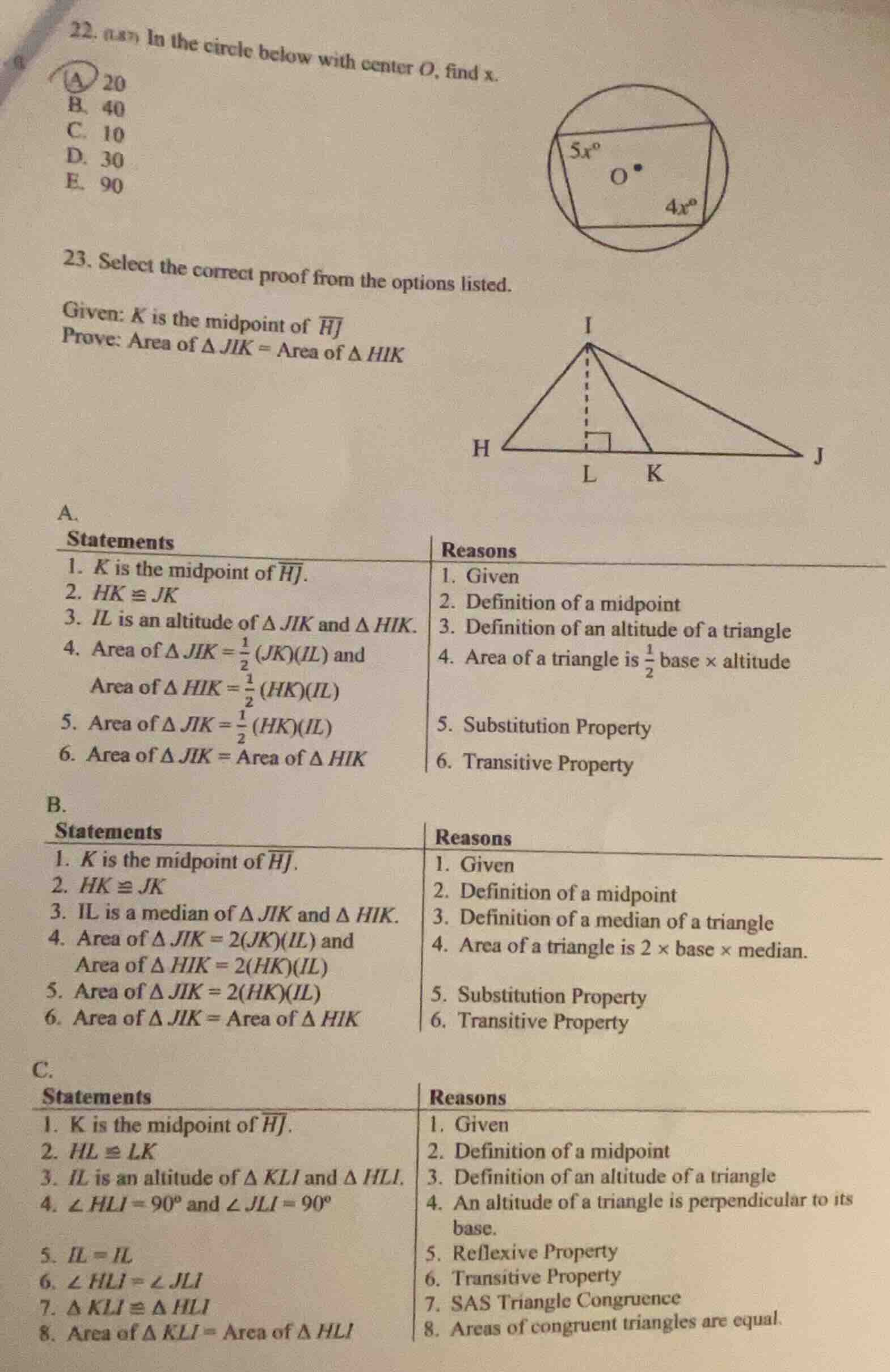
- in the circle below with center o, find x.
a 20
b. 40
c. 10
d. 30
e. 90
- select the correct proof from the options listed.
given: k is the midpoint of \\(\overline{hj}\\)
prove: area of \\(\delta jik = \\) area of \\(\delta hik\\)
a.
\\(\
$$\begin{array}{|l|l|}\\hline \\text{statements} & \\text{reasons} \\\\ \\hline 1. \\ k \\text{ is the midpoint of } \\overline{hj}. & 1. \\ \\text{given} \\\\ 2. \\ hk \\cong jk & 2. \\ \\text{definition of a midpoint} \\\\ 3. \\ il \\text{ is an altitude of } \\delta jik \\text{ and } \\delta hik. & 3. \\ \\text{definition of an altitude of a triangle} \\\\ 4. \\ \\text{area of } \\delta jik = \\frac{1}{2}(jk)(il) \\text{ and } & 4. \\ \\text{area of a triangle is } \\frac{1}{2} \\text{base} \\times \\text{altitude} \\\\ \\ \\ \\ \\ \\text{area of } \\delta hik = \\frac{1}{2}(hk)(il) & \\\\ 5. \\ \\text{area of } \\delta jik = \\frac{1}{2}(hk)(il) & 5. \\ \\text{substitution property} \\\\ 6. \\ \\text{area of } \\delta jik = \\text{area of } \\delta hik & 6. \\ \\text{transitive property} \\\\ \\hline \\end{array}$$
\\)
b.
\\(\
$$\begin{array}{|l|l|}\\hline \\text{statements} & \\text{reasons} \\\\ \\hline 1. \\ k \\text{ is the midpoint of } \\overline{hj}. & 1. \\ \\text{given} \\\\ 2. \\ hk \\cong jk & 2. \\ \\text{definition of a midpoint} \\\\ 3. \\ il \\text{ is a median of } \\delta jik \\text{ and } \\delta hik. & 3. \\ \\text{definition of a median of a triangle} \\\\ 4. \\ \\text{area of } \\delta jik = 2(jk)(il) \\text{ and } & 4. \\ \\text{area of a triangle is } 2 \\times \\text{base} \\times \\text{median}. \\\\ \\ \\ \\ \\ \\text{area of } \\delta hik = 2(hk)(il) & \\\\ 5. \\ \\text{area of } \\delta jik = 2(hk)(il) & 5. \\ \\text{substitution property} \\\\ 6. \\ \\text{area of } \\delta jik = \\text{area of } \\delta hik & 6. \\ \\text{transitive property} \\\\ \\hline \\end{array}$$
\\)
c.
\\(\
$$\begin{array}{|l|l|}\\hline \\text{statements} & \\text{reasons} \\\\ \\hline 1. \\ k \\text{ is the midpoint of } \\overline{hj}. & 1. \\ \\text{given} \\\\ 2. \\ hl \\cong lk & 2. \\ \\text{definition of a midpoint} \\\\ 3. \\ il \\text{ is an altitude of } \\delta kli \\text{ and } \\delta hli. & 3. \\ \\text{definition of an altitude of a triangle} \\\\ 4. \\ \\angle hli = 90^\\circ \\text{ and } \\angle jli = 90^\\circ & 4. \\ \\text{an altitude of a triangle is perpendicular to its} \\\\ & \\ \\ \\ \\ \\text{base.} \\\\ 5. \\ il = il & 5. \\ \\text{reflexive property} \\\\ 6. \\ \\angle hli = \\angle jli & 6. \\ \\text{transitive property} \\\\ 7. \\ \\delta kli \\cong \\delta hli & 7. \\ \\text{sas triangle congruence} \\\\ 8. \\ \\text{area of } \\delta kli = \\text{area of } \\delta hli & 8. \\ \\text{areas of congruent triangles are equal.} \\\\ \\hline \\end{array}$$
\\)
Response
Problem 22
Step1: Recall cyclic quadrilateral rule
Opposite angles sum to $180^\circ$. So $5x + 4x = 180$
Step2: Combine like terms
$9x = 180$
Step3: Solve for x
$x = \frac{180}{9} = 20$
Brief Explanations
- Option B uses an incorrect area formula (area is $\frac{1}{2} \times \text{base} \times \text{height}$, not $2 \times \text{base} \times \text{median}$) and misidentifies $IL$ as a median.
- Option C proves congruence of the wrong triangles ($\Delta KLI$ and $\Delta HLI$ instead of $\Delta JIK$ and $\Delta HIK$), so it does not address the required proof.
- Option A follows correct logic: uses the given midpoint to establish equal bases, identifies the shared altitude, applies the correct triangle area formula, substitutes equal bases, and uses transitivity to conclude equal areas.

Snap & solve any problem in the app
Get step-by-step solutions on Sovi AI
Photo-based solutions with guided steps
Explore more problems and detailed explanations
A. 20
---