QUESTION IMAGE
Question
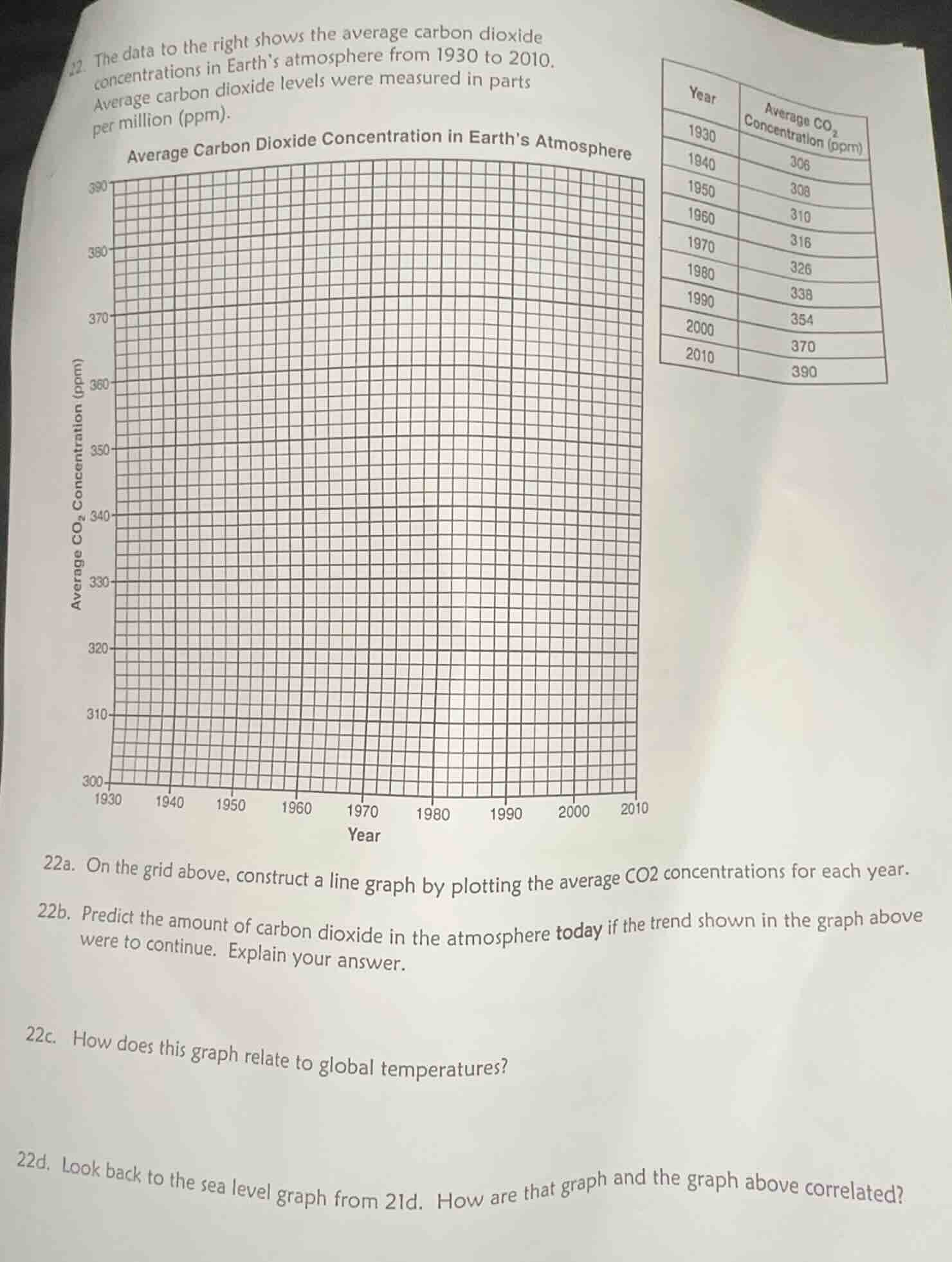
- the data to the right shows the average carbon dioxide concentrations in earth’s atmosphere from 1930 to 2010. average carbon dioxide levels were measured in parts per million (ppm).
average carbon dioxide concentration in earth’s atmosphere
(the chart and graph are omitted here as per requirements)
22a. on the grid above, construct a line graph by plotting the average co2 concentrations for each year.
22b. predict the amount of carbon dioxide in the atmosphere today if the trend shown in the graph above were to continue. explain your answer.
22c. how does this graph relate to global temperatures?
22d. look back to the sea level graph from 21d. how are that graph and the graph above correlated?
Step1: Plot data points on grid
Plot each (Year, CO₂ Concentration) pair: (1930, 306), (1940, 308), (1950, 310), (1960, 316), (1970, 326), (1980, 338), (1990, 354), (2000, 370), (2010, 390)
Step2: Connect points for line graph
Draw straight lines between consecutive plotted points.
Step3: Calculate annual growth rate
First find total change 1930-2010: $\Delta CO_2 = 390 - 306 = 84$ ppm; $\Delta Year = 2010 - 1930 = 80$ years. Annual rate: $\frac{84}{80} = 1.05$ ppm/year.
Step4: Predict 2024 (current) concentration
Years since 2010: $2024 - 2010 = 14$ years. Predicted CO₂: $390 + (1.05 \times 14) = 404.7$ ppm.

Snap & solve any problem in the app
Get step-by-step solutions on Sovi AI
Photo-based solutions with guided steps
Explore more problems and detailed explanations
22a. (Line graph constructed by plotting the listed data points and connecting them in sequence on the provided grid)
22b. ~405 ppm. The average annual increase in CO₂ between 1930 and 2010 is 1.05 ppm. From 2010 to 2024 (14 years), the total increase is ~14.7 ppm, added to 2010's 390 ppm gives ~405 ppm.
22c. CO₂ is a greenhouse gas; as atmospheric CO₂ concentrations rise (shown in the graph), global temperatures tend to increase, as CO₂ traps more heat in the atmosphere.
22d. Both graphs show an upward trend: as atmospheric CO₂ concentrations increase, global sea levels also rise (due to thermal expansion of ocean water and melting land ice caused by higher temperatures from increased CO₂).