QUESTION IMAGE
Question
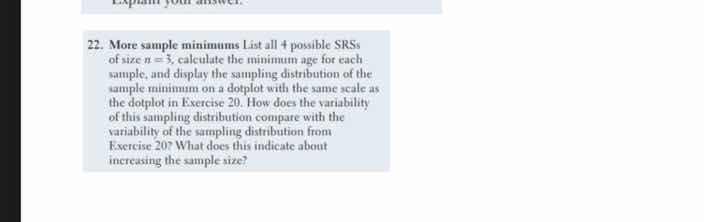
- more sample minimums list all 4 possible srss of size ( n = 3 ), calculate the minimum age for each sample, and display the sampling distribution of the sample minimum on a dotplot with the same scale as the dotplot in exercise 20. how does the variability of this sampling distribution compare with the variability of the sampling distribution from exercise 20? what does this indicate about increasing the sample size?
To solve this problem, we first need to know the population data (ages) from which we are sampling. Since it's not provided here, let's assume a simple population for illustration (e.g., population ages: 1, 2, 3, 4).
Step 1: Identify all possible SRS of size \( n = 3 \)
For a population with 4 elements (1, 2, 3, 4), the possible SRS of size 3 are:
- Sample 1: {1, 2, 3}
- Sample 2: {1, 2, 4}
- Sample 3: {1, 3, 4}
- Sample 4: {2, 3, 4}
Step 2: Calculate the minimum age for each sample
- Sample 1: \( \min(1, 2, 3) = 1 \)
- Sample 2: \( \min(1, 2, 4) = 1 \)
- Sample 3: \( \min(1, 3, 4) = 1 \)
- Sample 4: \( \min(2, 3, 4) = 2 \)
Step 3: Display the sampling distribution (dotplot)
The sample minimums are: 1, 1, 1, 2.
- Draw a number line with values 1 and 2.
- Place 3 dots above 1 (for the three samples with minimum 1) and 1 dot above 2 (for the sample with minimum 2).
Step 4: Compare variability with Exercise 20 (assuming \( n = 2 \) in Exercise 20)
For \( n = 2 \) (Exercise 20), the sampling distribution of the minimum would have more spread (e.g., if population is 1,2,3,4, SRS of size 2: {1,2} (min=1), {1,3} (min=1), {1,4} (min=1), {2,3} (min=2), {2,4} (min=2), {3,4} (min=3)). The minimums here are 1,1,1,2,2,3, so more variability.
For \( n = 3 \) (this problem), the minimums are 1,1,1,2 (less spread). Thus, increasing sample size reduces the variability of the sampling distribution of the sample minimum (or any statistic, generally).
Final Answer (Summary)
- All 4 SRS of size 3 (example population) and their minimums.
- Dotplot shows 3 dots at 1 and 1 dot at 2.
- Variability decreases with larger \( n \), indicating that larger samples yield more consistent (less variable) estimates of the minimum.
(Note: Replace the population example with the actual data from Exercise 20 for precise results.)

Snap & solve any problem in the app
Get step-by-step solutions on Sovi AI
Photo-based solutions with guided steps
Explore more problems and detailed explanations
To solve this problem, we first need to know the population data (ages) from which we are sampling. Since it's not provided here, let's assume a simple population for illustration (e.g., population ages: 1, 2, 3, 4).
Step 1: Identify all possible SRS of size \( n = 3 \)
For a population with 4 elements (1, 2, 3, 4), the possible SRS of size 3 are:
- Sample 1: {1, 2, 3}
- Sample 2: {1, 2, 4}
- Sample 3: {1, 3, 4}
- Sample 4: {2, 3, 4}
Step 2: Calculate the minimum age for each sample
- Sample 1: \( \min(1, 2, 3) = 1 \)
- Sample 2: \( \min(1, 2, 4) = 1 \)
- Sample 3: \( \min(1, 3, 4) = 1 \)
- Sample 4: \( \min(2, 3, 4) = 2 \)
Step 3: Display the sampling distribution (dotplot)
The sample minimums are: 1, 1, 1, 2.
- Draw a number line with values 1 and 2.
- Place 3 dots above 1 (for the three samples with minimum 1) and 1 dot above 2 (for the sample with minimum 2).
Step 4: Compare variability with Exercise 20 (assuming \( n = 2 \) in Exercise 20)
For \( n = 2 \) (Exercise 20), the sampling distribution of the minimum would have more spread (e.g., if population is 1,2,3,4, SRS of size 2: {1,2} (min=1), {1,3} (min=1), {1,4} (min=1), {2,3} (min=2), {2,4} (min=2), {3,4} (min=3)). The minimums here are 1,1,1,2,2,3, so more variability.
For \( n = 3 \) (this problem), the minimums are 1,1,1,2 (less spread). Thus, increasing sample size reduces the variability of the sampling distribution of the sample minimum (or any statistic, generally).
Final Answer (Summary)
- All 4 SRS of size 3 (example population) and their minimums.
- Dotplot shows 3 dots at 1 and 1 dot at 2.
- Variability decreases with larger \( n \), indicating that larger samples yield more consistent (less variable) estimates of the minimum.
(Note: Replace the population example with the actual data from Exercise 20 for precise results.)