QUESTION IMAGE
Question
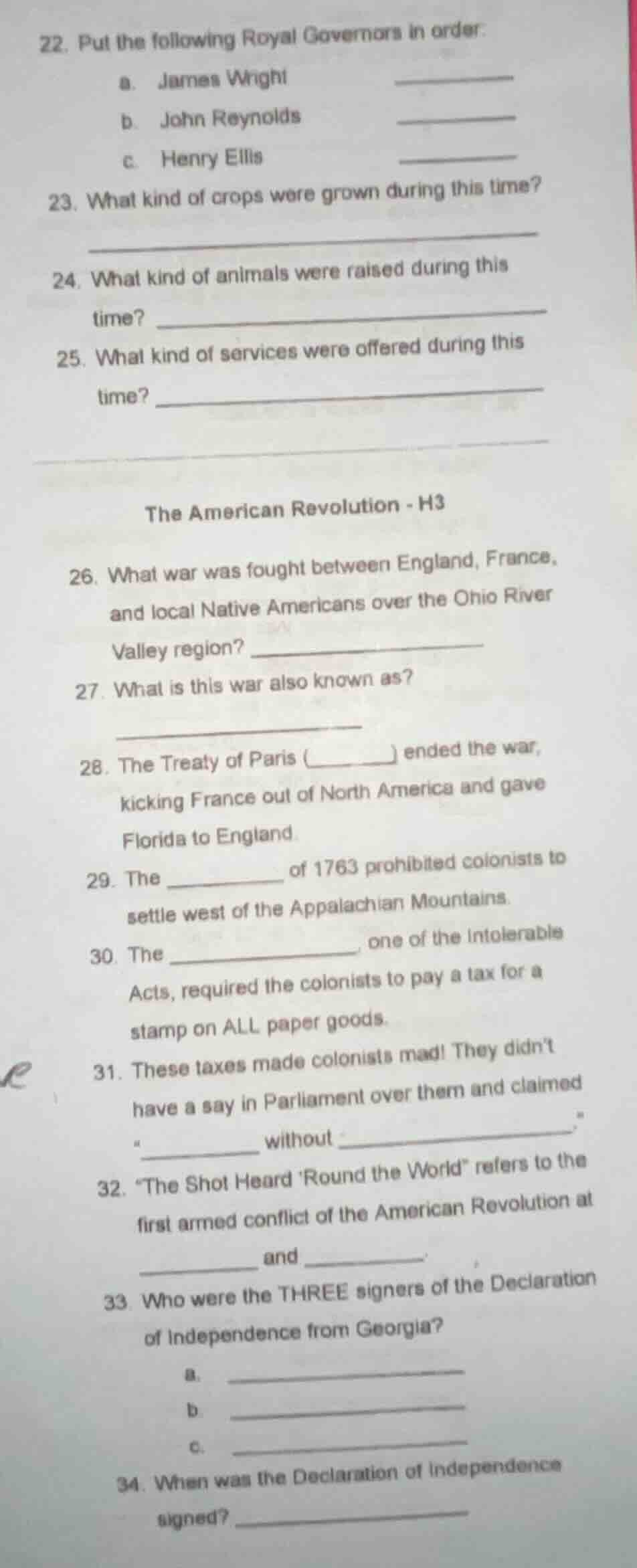
- put the following royal governors in order.
a. james wright
b. john reynolds
c. henry ellis
- what kind of crops were grown during this time?
- what kind of animals were raised during this
time?
- what kind of services were offered during this
time?
the american revolution - h3
- what war was fought between england, france,
and local native americans over the ohio river
valley region?
- what is this war also known as?
- the treaty of paris (______) ended the war,
kicking france out of north america and gave
florida to england
- the _________ of 1763 prohibited colonists to
settle west of the appalachian mountains.
- the _____________, one of the intolerable
acts, required the colonists to pay a tax for a
stamp on all paper goods.
- these taxes made colonists mad! they didnt
have a say in parliament over them and claimed
\______ without _____________.\
- \the shot heard round the world\ refers to the
first armed conflict of the american revolution at
_______ and _______.
- who were the three signers of the declaration
of independence from georgia?
a.
b
c.
- when was the declaration of independence
signed?
Question 22
The Royal Governors of Georgia in order were John Reynolds (first, 1754 - 1757), Henry Ellis (second, 1757 - 1760), and James Wright (third, 1760 - 1782). So we assign numbers based on their order of service.
During the colonial period (when these governors served), crops like rice, indigo, and later cotton (though cotton became more prominent later) were grown in Georgia, especially in the lowcountry for rice and indigo due to the climate and slave - based plantation system.
During the colonial era in Georgia, animals such as cattle, hogs (pigs), and horses were raised. Cattle were used for labor and food, hogs for food (and they could forage in the woods), and horses for transportation and labor.

Snap & solve any problem in the app
Get step-by-step solutions on Sovi AI
Photo-based solutions with guided steps
Explore more problems and detailed explanations
a. James Wright: 3
b. John Reynolds: 1
c. Henry Ellis: 2