QUESTION IMAGE
Question
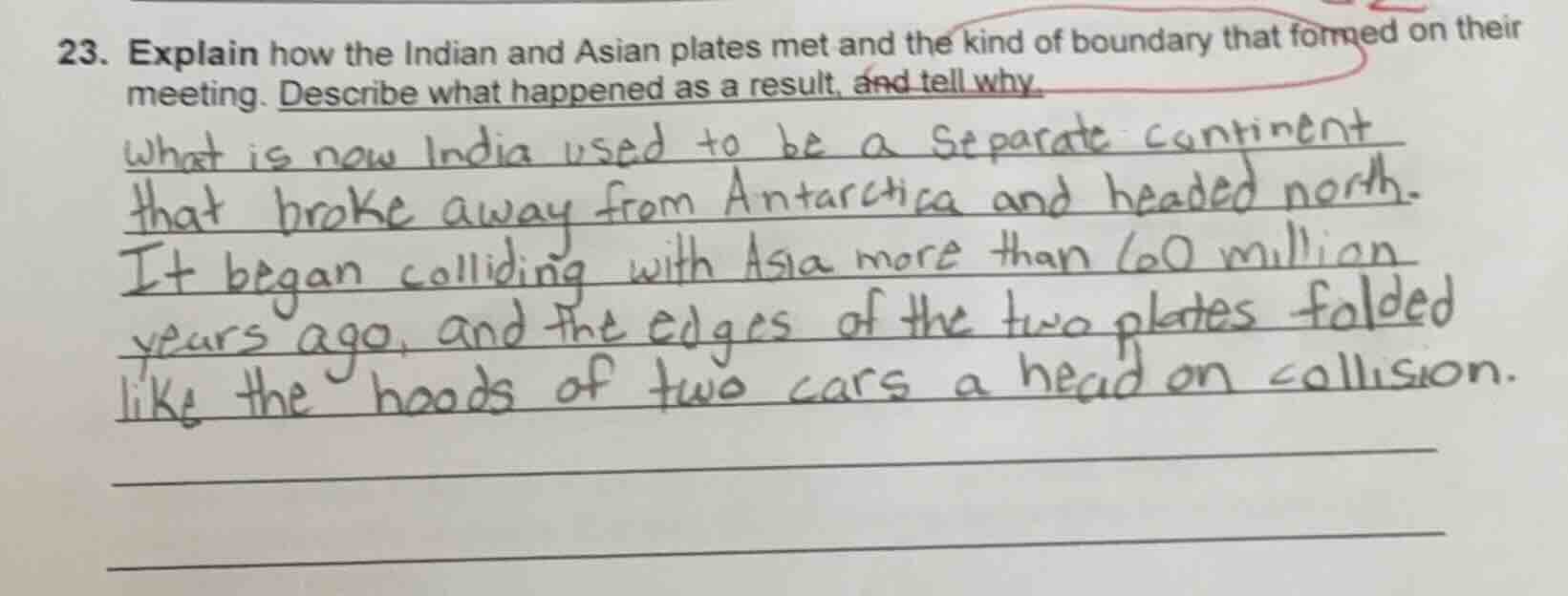
- explain how the indian and asian plates met and the kind of boundary that formed on their meeting. describe what happened as a result, and tell why.
what is now india used to be a separate continent
that broke away from antarctica and headed north.
it began colliding with asia more than 600 million
years ago, and the edges of the two plates folded
like the hoods of two cars a head on collision.
Brief Explanations
- Plate Movement: The Indian plate (once part of a landmass that broke from Antarctica) moved northward due to tectonic forces.
- Boundary Type: When it met the Eurasian (Asian) plate, a convergent plate boundary formed (both are continental plates here).
- Result: The collision caused the crustal material to crumple, fold, and uplift, forming the Himalayan mountain range and the Tibetan Plateau. This happens because continental crust is less dense, so instead of subducting, it compresses and deforms, creating large mountain systems over millions of years.

Snap & solve any problem in the app
Get step-by-step solutions on Sovi AI
Photo-based solutions with guided steps
Explore more problems and detailed explanations
- Plate Meeting: The Indian plate (a continental plate) moved northward (after rifting from Antarctica) and collided with the Eurasian (Asian) continental plate.
- Boundary Type: A convergent continental - continental plate boundary formed (since both plates are continental, neither subducts easily).
- Result: The collision caused intense compression, folding, and uplift of the crust. This formed the Himalayan mountain range (the world’s highest mountains, e.g., Mount Everest) and the Tibetan Plateau (the “roof of the world”). Over time, the continuous collision still causes the Himalayas to rise (e.g., at a rate of ~5 mm/year) as the plates keep pushing against each other.
- Why: Continental crust is relatively low - density (compared to oceanic crust). When two continental plates converge, they cannot subduct (sink) into the mantle easily. Instead, the crustal rocks are forced together, leading to folding, faulting, and uplift as the energy from the plate motion is released through mountain - building (orogenesis).