QUESTION IMAGE
Question
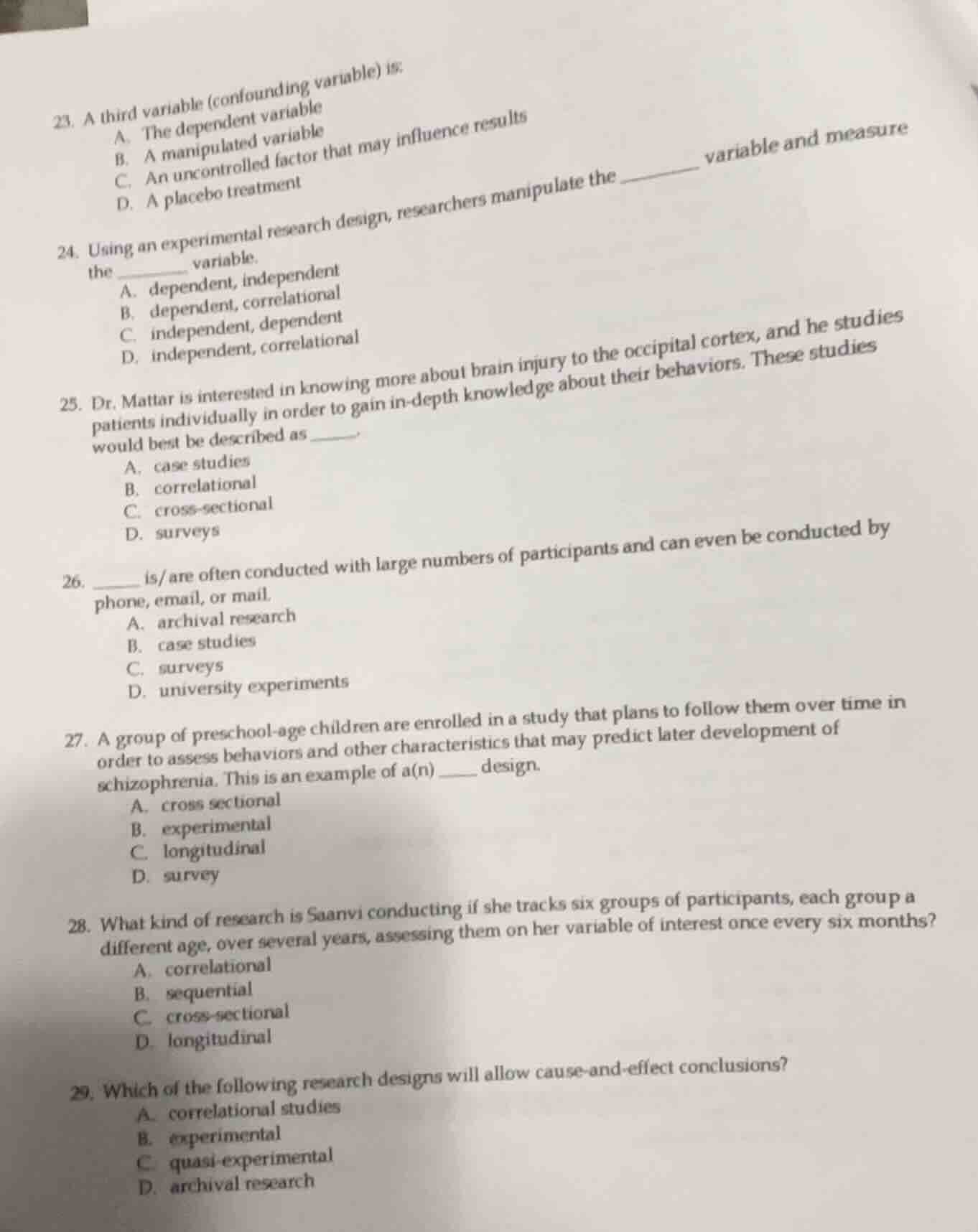
- a third variable (confounding variable) is:
a. the dependent variable
b. a manipulated variable
c. an uncontrolled factor that may influence results
d. a placebo treatment
- using an experimental research design, researchers manipulate the ____ variable and measure the ____ variable.
a. dependent, independent
b. dependent, correlational
c. independent, dependent
d. independent, correlational
- dr. mattar is interested in knowing more about brain injury to the occipital cortex, and he studies patients individually in order to gain in - depth knowledge about their behaviors. these studies would best be described as ______.
a. case studies
b. correlational
c. cross - sectional
d. surveys
- ______ is/are often conducted with large numbers of participants and can even be conducted by phone, email, or mail.
a. archival research
b. case studies
c. surveys
d. university experiments
- a group of preschool - age children are enrolled in a study that plans to follow them over time in order to assess behaviors and other characteristics that may predict later development of schizophrenia. this is an example of a(n) ______ design.
a. cross sectional
b. experimental
c. longitudinal
d. survey
- what kind of research is saanvi conducting if she tracks six groups of participants, each group a different age, over several years, assessing them on her variable of interest once every six months?
a. correlational
b. sequential
c. cross - sectional
d. longitudinal
- which of the following research designs will allow cause - and - effect conclusions?
a. correlational studies
b. experimental
c. quasi - experimental
d. archival research
Brief Explanations
- A confounding variable is an uncontrolled factor that skews results by affecting both independent and dependent variables.
- In experimental design, researchers intentionally change the independent variable and observe/measure the resulting changes in the dependent variable.
- Case studies involve in-depth, individual analysis of participants to understand specific conditions or behaviors.
- Surveys are a research method that can easily reach large participant groups via phone, email, mail, or other remote methods.
- Longitudinal designs follow the same group of participants over an extended period to track changes or predict outcomes.
- Sequential research combines cross-sectional (multiple age groups) and longitudinal (long-term tracking) elements by following different age groups over time.
- Only experimental designs, with controlled manipulation of variables and random assignment, can establish definitive cause-and-effect relationships.

Snap & solve any problem in the app
Get step-by-step solutions on Sovi AI
Photo-based solutions with guided steps
Explore more problems and detailed explanations
- C. An uncontrolled factor that may influence results
- C. independent, dependent
- A. case studies
- C. surveys
- C. longitudinal
- B. sequential
- B. experimental