QUESTION IMAGE
Question
24.
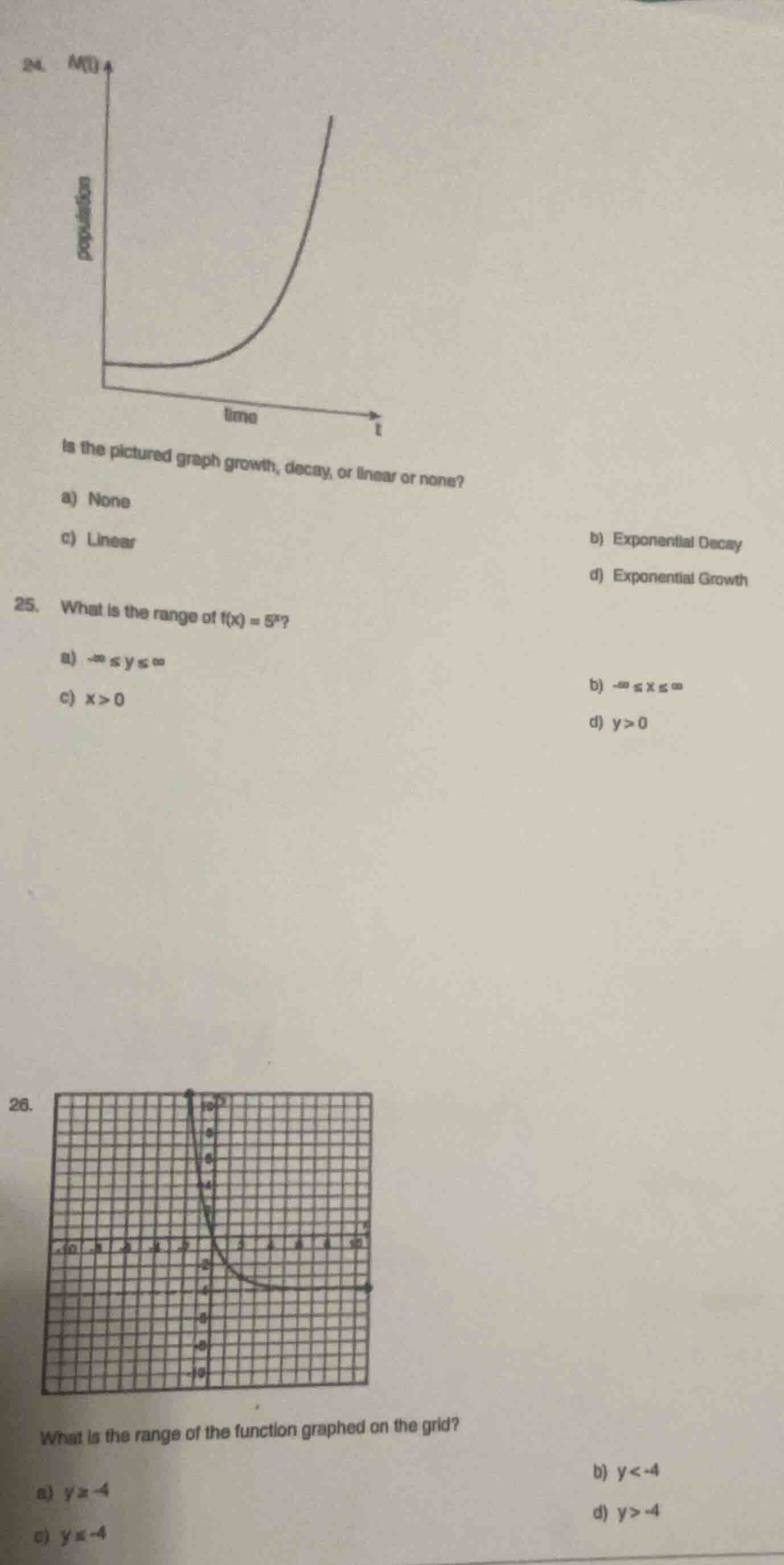
is the pictured graph growth, decay, or linear or none?
a) none
b) exponential decay
c) linear
d) exponential growth
- what is the range of ( f(x) = 5^x )?
a) ( -infty leq y leq infty )
b) ( -infty leq x leq infty )
c) ( x > 0 )
d) ( y > 0 )
26.
what is the range of the function graphed on the grid?
a) ( y geq -4 )
b) ( y < -4 )
c) ( y leq -4 )
d) ( y > -4 )
Question 24
The graph shows a curve that starts low and increases rapidly over time, which is characteristic of exponential growth (as opposed to decay, which decreases, or linear, which is a straight line).
For the function \( f(x) = 5^x \), we analyze the range (set of \( y \)-values). The base \( 5>1 \), so as \( x \to -\infty \), \( 5^x \to 0 \) (but never reaches 0), and as \( x \to \infty \), \( 5^x \to \infty \). Thus, \( y>0 \).
Looking at the graphed function, the lowest \( y \)-value (from the grid) is \( -4 \), and the graph extends upwards from there (or stays at/below? Wait, no—wait, the graph's lowest point is \( y = -4 \), and it goes up? Wait, no, looking at the grid, the curve seems to approach \( y = -4 \) from above? Wait, no, the options: a) \( y \geq -4 \), b) \( y < -4 \), c) \( y \leq -4 \), d) \( y > -4 \). Wait, the graph's \( y \)-values: if the curve is above \( y = -4 \) (since it's approaching \( y = -4 \) from above, or the lowest point is \( y = -4 \) and it goes up). Wait, the correct range: if the graph's \( y \)-values are greater than or equal to \( -4 \)? Wait, no, looking at the grid, the function's graph has \( y \)-values starting from \( -4 \) and going up? Wait, no, the options: a) \( y \geq -4 \), d) \( y > -4 \). Wait, maybe the graph has a horizontal asymptote at \( y = -4 \), and the function is above that (so \( y > -4 \))? Wait, no, let's recheck. The graph: the curve is above \( y = -4 \), so the range is \( y > -4 \)? Wait, no, the options: a) \( y \geq -4 \), d) \( y > -4 \). Wait, maybe the graph touches \( y = -4 \)? No, the grid: the lowest point is \( y = -4 \), but is it included? Wait, the options: a) \( y \geq -4 \), d) \( y > -4 \). Wait, the correct answer is d) \( y > -4 \) if the asymptote is \( y = -4 \) (so it approaches but never reaches), or a) if it includes \( -4 \). Wait, the graph's grid: looking at the curve, it seems to approach \( y = -4 \) from above, so \( y > -4 \).

Snap & solve any problem in the app
Get step-by-step solutions on Sovi AI
Photo-based solutions with guided steps
Explore more problems and detailed explanations
d) Exponential Growth