QUESTION IMAGE
Question
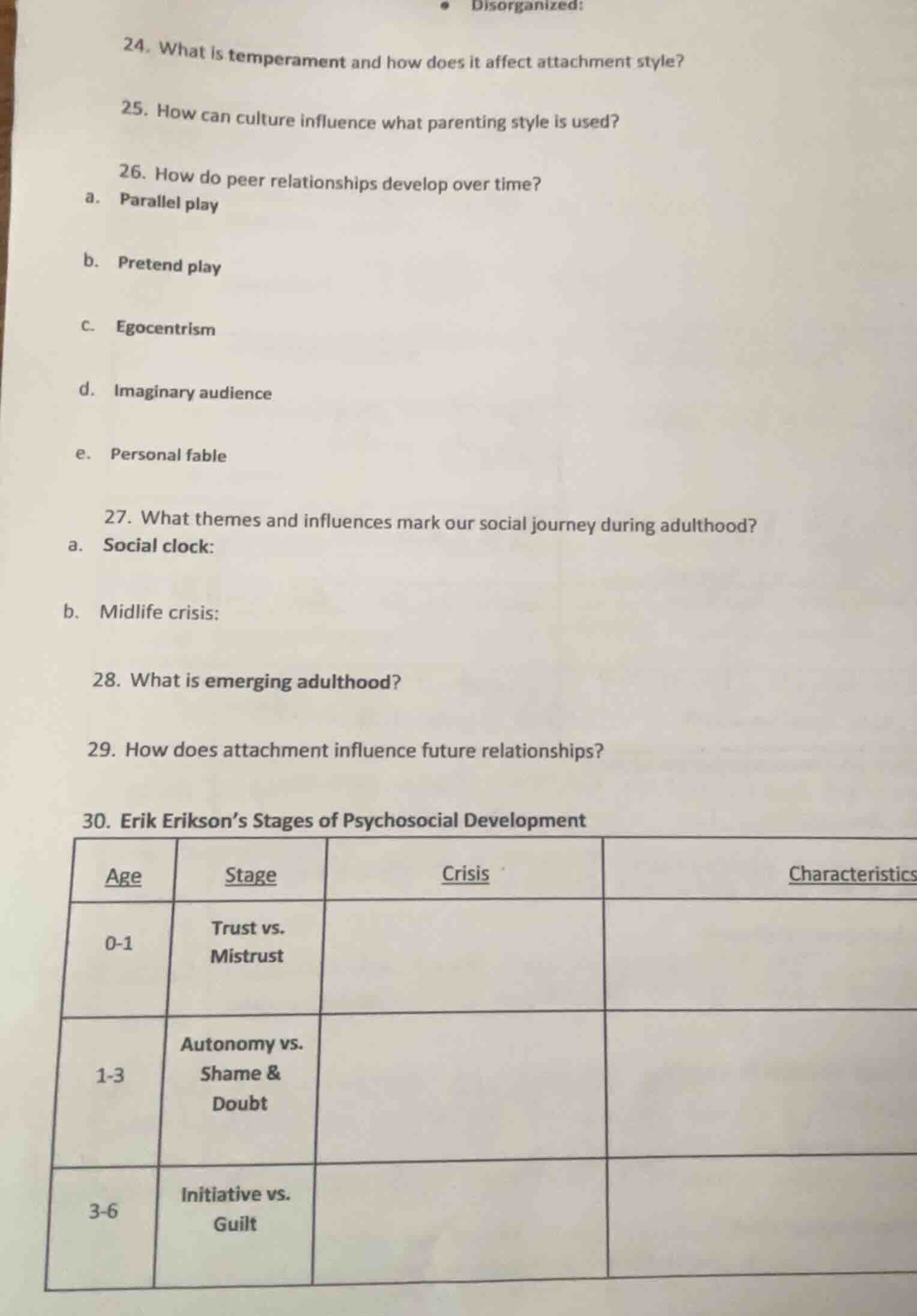
- what is temperament and how does it affect attachment style?
- how can culture influence what parenting style is used?
- how do peer relationships develop over time?
a. parallel play
b. pretend play
c. egocentrism
d. imaginary audience
e. personal fable
- what themes and influences mark our social journey during adulthood?
a. social clock:
b. midlife crisis:
- what is emerging adulthood?
- how does attachment influence future relationships?
- erik erikson’s stages of psychosocial development
| age | stage | crisis | characteristics |
| 0 - 1 | trust vs. mistrust | ||
| 1 - 3 | autonomy vs. shame & doubt | ||
| 3 - 6 | initiative vs. guilt |
Question 24
Temperament refers to innate, biologically-based behavioral tendencies (like reactivity, self-regulation) present from infancy. It shapes attachment style by interacting with caregiver responses: for example, a highly reactive infant may develop an anxious attachment if caregivers are inconsistent, or secure attachment if caregivers are responsive. Easy-going infants may more readily form secure attachments with supportive caregivers.
Question 25
Cultural values, norms, and priorities guide parenting styles. Collectivist cultures often emphasize interdependence, leading to more directive, communal parenting (e.g., authoritarian or authoritative styles focused on family harmony). Individualist cultures prioritize independence, leading to more permissive or authoritative styles that foster personal autonomy. Cultural views on child roles, discipline, and family structure also play a role.
Question 26
Peer relationships develop through distinct play/social stages:
a. Parallel play: Toddlerhood (ages 2-3), children play near each other but not together, a foundational early peer interaction.
b. Pretend play: Preschool years (ages 3-5), children collaborate in imaginative scenarios, building social skills like turn-taking.
c. Egocentrism: A preoperational cognitive state (Piaget) where children cannot take others' perspectives, limiting early peer understanding.
d. Imaginary audience: Adolescent cognitive phenomenon where teens feel constantly watched, shaping peer approval-seeking behavior.
e. Personal fable: Adolescent belief in being unique/invulnerable, influencing risk-taking with peers.
Question 27
a. Social clock: The culturally expected timeline for major life events (e.g., marriage, career, parenthood). It influences social choices, self-esteem, and social integration when individuals meet or deviate from these norms.
b. Midlife crisis: A period of self-reflection (often 40s-50s) triggered by unmet life goals, aging, or major losses. It can shift social priorities, like rekindling old relationships or ending unfulfilling ones.
Other key themes: Career advancement, caregiving for both children and aging parents, maintaining long-term romantic relationships, and adjusting to empty nest transitions.
Question 28
Emerging adulthood is a developmental stage (roughly ages 18-29) between adolescence and full adulthood, primarily in industrialized societies. It is marked by identity exploration, instability in relationships, education, and work, self-focus, feeling "in-between" adolescence and adulthood, and possibilities for change.
Question 29
Early attachment styles (secure, anxious-ambivalent, avoidant, disorganized) create internal working models of relationships. Securely attached individuals tend to form trusting, long-term adult relationships. Anxious-ambivalent people may be clingy or fear abandonment. Avoidant individuals often struggle with emotional intimacy. Disorganized attachment can lead to chaotic, unstable adult relationships.
Question 30
| Age | Stage | Crisis | Characteristics |
|---|---|---|---|
| 1-3 | Autonomy vs. Shame & Doubt | Autonomy vs. Shame & Doubt | Toddlers seek independence (e.g., toilet training); support fosters self-reliance, while criticism leads to shame and self-doubt. |
| 3-6 | Initiative vs. Guilt | Initiative vs. G… |

Snap & solve any problem in the app
Get step-by-step solutions on Sovi AI
Photo-based solutions with guided steps
Explore more problems and detailed explanations
24.
Temperament is innate, biologically rooted behavioral tendencies (e.g., reactivity, self-control) present from birth. It interacts with caregiver responsiveness to shape attachment style: responsive caregivers can help even highly reactive infants form secure attachments, while inconsistent care paired with difficult temperament may lead to insecure (anxious or avoidant) attachment.
25.
Cultural values (collectivism vs. individualism), norms around family roles, and societal expectations drive parenting styles. For example, collectivist cultures may favor directive, family-focused parenting, while individualist cultures prioritize autonomy-focused styles. Cultural views on discipline and child development also influence caregiver choices.
26.
a. Parallel play: Toddlerhood (2-3 years) foundational peer interaction, playing near others without collaboration.
b. Pretend play: Preschool (3-5 years) collaborative imaginative play building social skills.
c. Egocentrism: Preoperational cognitive state limiting peer perspective-taking.
d. Imaginary audience: Adolescent focus on peer approval due to feeling watched.
e. Personal fable: Adolescent belief in uniqueness shaping peer risk-taking.
27.
a. Social clock: Cultural life event timelines guiding social choices and self-esteem.
b. Midlife crisis: Self-reflection period shifting social priorities.
Additional themes: Career growth, caregiving for family, long-term relationship maintenance, and empty nest adjustment.
28.
Emerging adulthood is a developmental stage (18-29, industrialized societies) between adolescence and full adulthood, defined by identity exploration, instability, self-focus, feeling "in-between," and transformative possibility.
29.
Early attachment creates internal relationship models: secure attachment fosters trusting adult relationships; anxious attachment leads to clinginess/abandonment fears; avoidant attachment causes intimacy struggles; disorganized attachment links to chaotic adult relationships.
30.
| Age | Stage | Crisis | Characteristics |
|---|---|---|---|
| 1-3 | Autonomy vs. Shame & Doubt | Autonomy vs. Shame & Doubt | Support builds self-reliance; criticism leads to shame/doubt. |
| 3-6 | Initiative vs. Guilt | Initiative vs. Guilt | Encouragement fosters purpose; criticism creates guilt over initiative. |