QUESTION IMAGE
Question
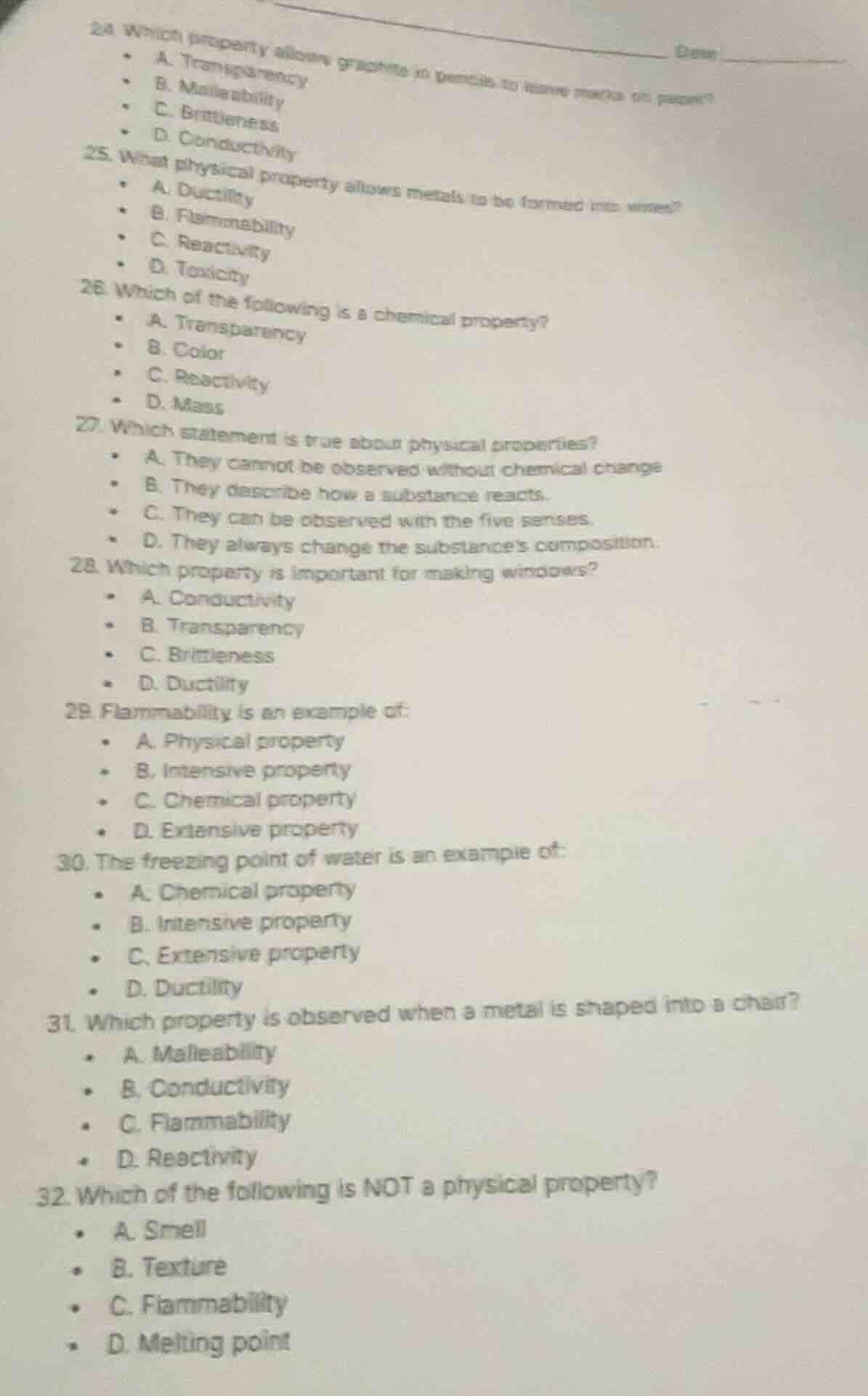
- which property allows graphite in pencils to leave marks on paper?
- a. transparency
- b. malleability
- c. brittleness
- d. conductivity
- what physical property allows metals to be formed into wires?
- a. ductility
- b. flammability
- c. reactivity
- d. toxicity
- which of the following is a chemical property?
- a. transparency
- b. color
- c. reactivity
- d. mass
- which statement is true about physical properties?
- a. they cannot be observed without chemical changes
- b. they describe how a substance reacts.
- c. they can be observed with the five senses.
- d. they always change the substances composition.
- which property is important for making windows?
- a. conductivity
- b. transparency
- c. brittleness
- d. ductility
- flammability is an example of:
- a. physical property
- b. intensive property
- c. chemical property
- d. extensive property
- the freezing point of water is an example of:
- a. chemical property
- b. intensive property
- c. extensive property
- d. ductility
- which property is observed when a metal is shaped into a chair?
- a. malleability
- b. conductivity
- c. flammability
- d. reactivity
- which of the following is not a physical property?
- a. smell
- b. texture
- c. flammability
- d. melting point
Brief Explanations
- Graphite leaves marks because it breaks into small layers easily, which is brittleness.
- Metals formed into wires rely on ductility, the ability to be drawn into thin wires.
- Reactivity describes how a substance changes chemically, so it is a chemical property.
- Physical properties can be observed using sight, touch, smell, taste, or sound without altering the substance's composition.
- Windows need to let light pass through, which is transparency.
- Flammability involves a substance undergoing a chemical reaction (burning), so it is a chemical property.
- The freezing point of water does not depend on the amount of water, so it is an intensive property.
- Shaping metal into a chair involves hammering or bending it into a new shape, which is malleability.
- Flammability requires a chemical change to observe, so it is not a physical property.

Snap & solve any problem in the app
Get step-by-step solutions on Sovi AI
Photo-based solutions with guided steps
Explore more problems and detailed explanations
- C. Brittleness
- A. Ductility
- C. Reactivity
- C. They can be observed with the five senses.
- B. Transparency
- C. Chemical property
- B. Intensive property
- A. Malleability
- C. Flammability