QUESTION IMAGE
Question
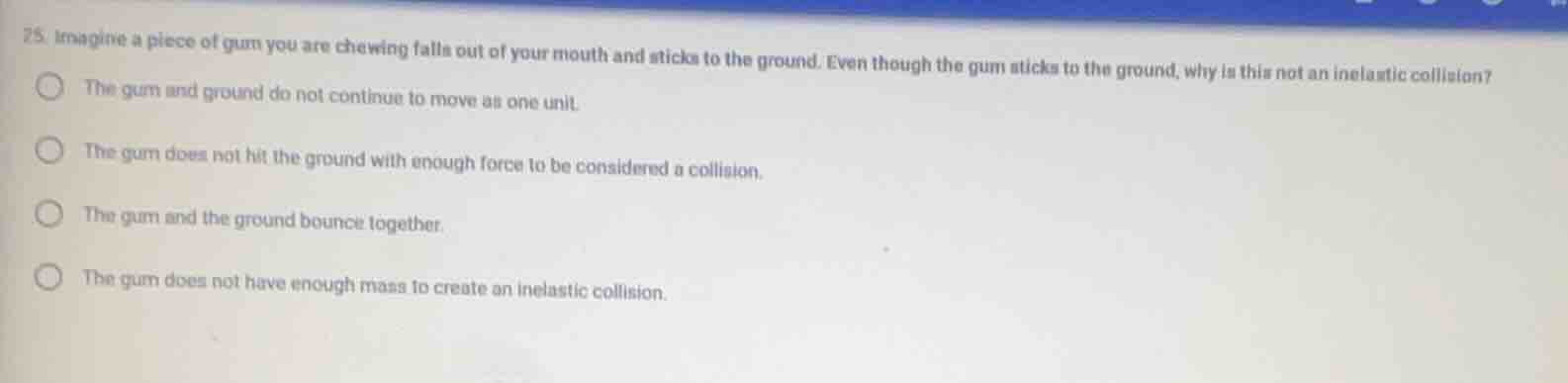
- imagine a piece of gum you are chewing falls out of your mouth and sticks to the ground. even though the gum sticks to the ground, why is this not an inelastic collision?
the gum and ground do not continue to move as one unit.
the gum does not hit the ground with enough force to be considered a collision.
the gum and the ground bounce together.
the gum does not have enough mass to create an inelastic collision.
Step1: Define inelastic collision
An inelastic collision is defined as a collision where the colliding objects stick together and move as a single unit after the collision, with momentum conserved but kinetic energy not conserved.
Step2: Analyze the gum-ground interaction
The Earth (ground) is an extremely massive object. When the gum sticks to it, the Earth does not move with the gum (the combined system does not move as one unit in any measurable or meaningful way, as the Earth's inertia prevents any detectable motion from the gum's impact).
Step3: Match to correct option
This matches the first option, as the key requirement for an inelastic collision (moving as one unit) is not met here.

Snap & solve any problem in the app
Get step-by-step solutions on Sovi AI
Photo-based solutions with guided steps
Explore more problems and detailed explanations
A. The gum and ground do not continue to move as one unit.