QUESTION IMAGE
Question
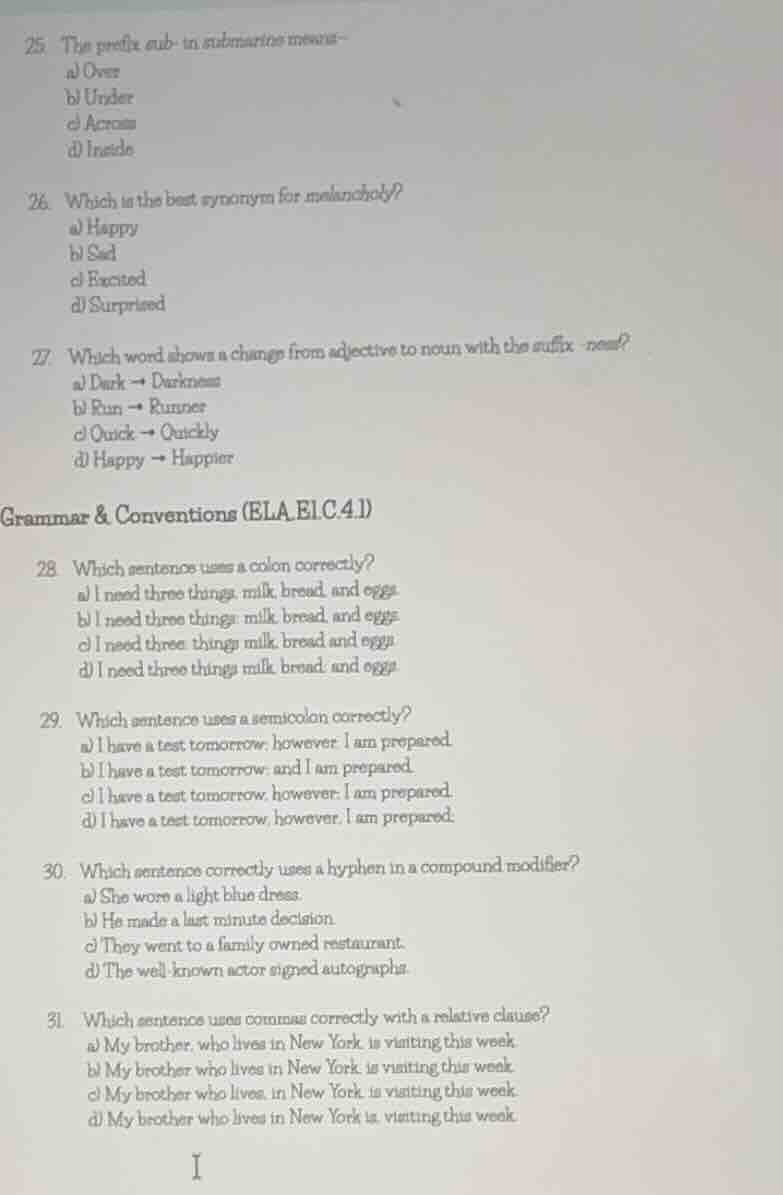
- the prefix sub- in submarine means-a) overb) underc) acrossd) inside26. which is the best synonym for melancholy?a) happyb) sadc) excitedd) surprised27. which word shows a change from adjective to noun with the suffix -ness?a) dark → darknessb) run → runnerc) quick → quicklyd) happy → happiergrammar & conventions (ela.ei.c.4.1)28. which sentence uses a colon correctly?a) i need three things milk, bread, and eggs.b) i need three things: milk, bread, and eggs.c) i need three things milk, bread and eggs.d) i need three things milk bread, and eggs.29. which sentence uses a semicolon correctly?a) i have a test tomorrow, however, i am prepared.b) i have a test tomorrow; and i am prepared.c) i have a test tomorrow, however; i am prepared.d) i have a test tomorrow; however, i am prepared.30. which sentence correctly uses a hyphen in a compound modifier?a) she wore a light blue dress.b) he made a last minute decision.c) they went to a family owned restaurant.d) the well-known actor signed autographs.31. which sentence uses commas correctly with a relative clause?a) my brother, who lives in new york, is visiting this week.b) my brother who lives in new york is visiting this week.c) my brother who lives, in new york, is visiting this week.d) my brother who lives in new york is, visiting this week.
Brief Explanations
- The word "submarine" breaks down to "sub-" (under) + "marine" (related to the sea), so the prefix means under.
- "Melancholy" is defined as a feeling of persistent sadness, so its best synonym is sad.
- "Dark" is an adjective, and adding "-ness" creates "Darkness", a noun. The other options either use the wrong suffix or change word type incorrectly.
- A colon is used to introduce a list after an independent clause. The correct format places a colon right after the introductory clause, no extra space before it, and lists items clearly.
- A semicolon joins two independent clauses or separates clauses with a conjunctive adverb like "however". It should come before the conjunctive adverb, with a comma after it.
- A compound modifier (two words describing a noun) needs a hyphen when it comes before the noun. "Well-known" correctly hyphenates the modifier before "actor".
- A non-restrictive relative clause (providing extra, non-essential info) needs commas around it. The clause "who lives in New York" is extra info about "My brother", so commas enclose it and separate it from the main clause.

Snap & solve any problem in the app
Get step-by-step solutions on Sovi AI
Photo-based solutions with guided steps
Explore more problems and detailed explanations
- b) Under
- b) Sad
- a) Dark → Darkness
- b) I need three things: milk, bread, and eggs.
- c) I have a test tomorrow; however, I am prepared.
- d) The well-known actor signed autographs.
- a) My brother, who lives in New York, is visiting this week.