QUESTION IMAGE
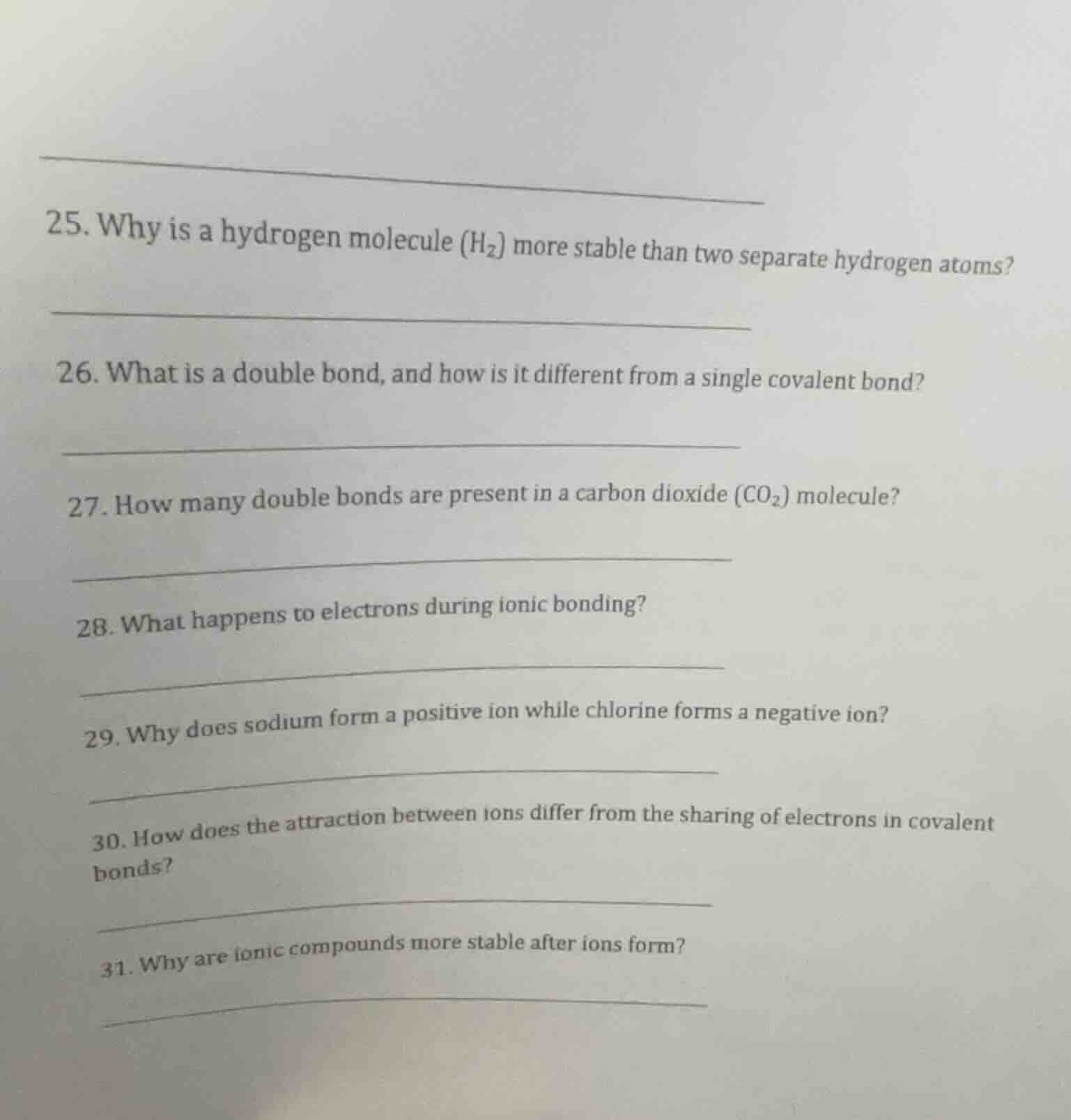
Question
- why is a hydrogen molecule (h₂) more stable than two separate hydrogen atoms?
- what is a double bond, and how is it different from a single covalent bond?
- how many double bonds are present in a carbon dioxide (co₂) molecule?
- what happens to electrons during ionic bonding?
- why does sodium form a positive ion while chlorine forms a negative ion?
- how does the attraction between ions differ from the sharing of electrons in covalent bonds?
- why are ionic compounds more stable after ions form?
Question 25
A hydrogen atom has 1 valence electron and needs 1 more to fill its outer shell (duet rule). In $\ce{H_2}$, the two H atoms share their electrons, forming a covalent bond. This sharing gives each atom a stable electron configuration (like helium, 2 electrons in the outer shell), lowering the overall energy of the system compared to two separate atoms with unpaired electrons seeking stability.
A double bond is a covalent bond where two atoms share two pairs of electrons (4 total electrons). A single covalent bond involves sharing one pair (2 electrons). Differences: 1. Electron pairs: double has 2, single has 1. 2. Bond length: double bonds are shorter. 3. Bond energy: double bonds have higher energy (harder to break) than single bonds. 4. Reactivity: double bonds are more reactive (due to extra electron density) than single bonds in many cases.
Step1: Determine the Lewis structure of $\ce{CO_2}$
Carbon (C) has 4 valence electrons, and each oxygen (O) has 6. The total valence electrons are $4 + 2\times6 = 16$. Carbon is the central atom. We arrange the atoms as O - C - O.
Step2: Form bonds and lone pairs
We start by forming single bonds: O - C - O (2 bonds, 4 electrons used). Remaining electrons: $16 - 4 = 12$. We place 6 electrons (3 pairs) on each O, but this would give O atoms 7 electrons (not stable, needs 8). So we convert lone pairs to double bonds. Each O needs 2 more electrons, so we form two double bonds (O = C = O). Now, each O has 8 electrons (2 from double bond, 6 from lone pairs), and C has 8 (4 from two double bonds).
Step3: Count double bonds
In the Lewis structure O = C = O, there are two double bonds.

Snap & solve any problem in the app
Get step-by-step solutions on Sovi AI
Photo-based solutions with guided steps
Explore more problems and detailed explanations
A hydrogen molecule ($\ce{H_2}$) is more stable because the two H atoms share electrons to form a covalent bond, giving each atom a stable electron configuration (duet of electrons), which lowers the system's energy compared to two separate H atoms with unpaired electrons.