QUESTION IMAGE
Question
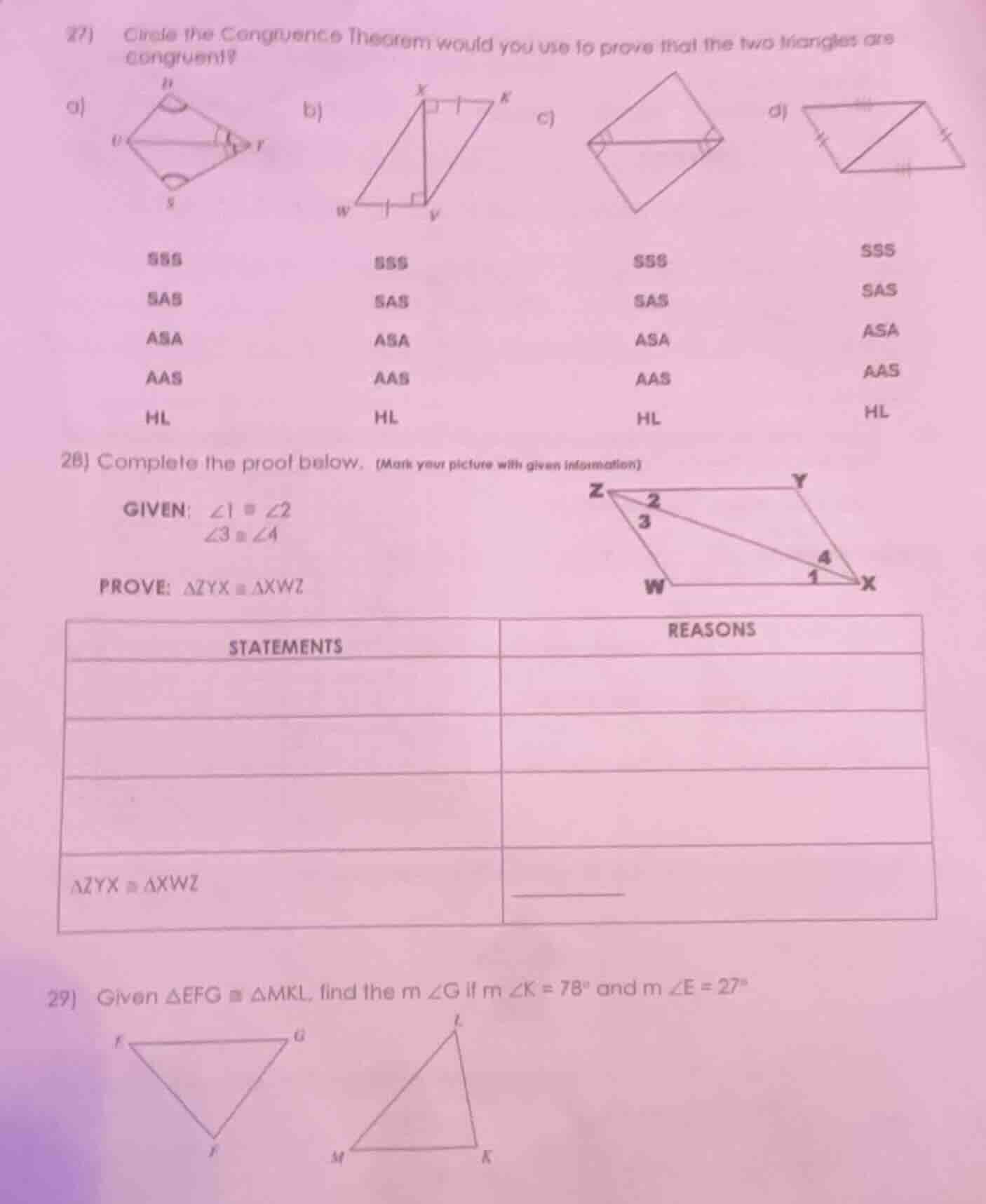
- circle the congruence theorem would you use to prove that the two triangles are congruent?
a)
b)
c)
d)
- complete the proof below. (mark your picture with given information)
given: ( angle 1 cong angle 2 )
( angle 3 cong angle 4 )
prove: ( \triangle zyx cong \triangle xwz )
- given ( \triangle efg cong \triangle mkl ), find the ( mangle g ) if ( mangle k = 78^circ ) and ( mangle e = 27^circ )
27) (Let's analyze each part: )
a)
- Observe the triangles: We have two angles and the included side? Wait, looking at the diagram (angles at \( B \) and \( S \), and side \( CR \) maybe? Wait, actually, if we have two angles and the included side? No, maybe ASA? Wait, no, let's think again. Wait, the diagram shows two angles (at \( B \) and \( S \)) and a side? Wait, maybe AAS? Wait, no, let's check the markings. Wait, the problem is to circle the congruence theorem. Let's assume the triangles have two angles and a side, or maybe ASA? Wait, maybe the correct theorem is ASA? Wait, no, maybe AAS? Wait, perhaps the first one (a) has ASA? Wait, maybe I need to re-examine. Alternatively, maybe the answer for a) is ASA? Wait, no, let's think of the congruence theorems: SSS (all three sides), SAS (two sides and included angle), ASA (two angles and included side), AAS (two angles and non-included side), HL (right triangles, hypotenuse and leg).
b)
- The diagram has right angles at \( V \) (for \( WV \) and \( KV \))? Wait, \( W \) and \( K \) have right angles? So it's a right triangle, and we have a leg and hypotenuse? Wait, HL? Or maybe SAS? Wait, the markings show a leg ( \( WV \) and \( KV \) maybe) and the hypotenuse? Wait, HL?
c)
- The diagram has two right angles, and a side? Maybe HL? Or SAS? Wait, the triangles are right triangles, so HL?
d)
- The diagram has all three sides marked, so SSS.
But since the user might need a general approach, let's take part 29 first as it's a calculation.
29)
Step1: Recall congruent triangles properties
Since \(\triangle EFG \cong \triangle MKL\), corresponding angles are equal. So \( \angle E = \angle M = 27^\circ \), \( \angle F = \angle K = 78^\circ \), and \( \angle G = \angle L \).
Step2: Use triangle angle sum
The sum of angles in a triangle is \( 180^\circ \). So for \(\triangle EFG\), \( m\angle E + m\angle F + m\angle G = 180^\circ \).
Step3: Substitute known values
We know \( m\angle E = 27^\circ \), \( m\angle F = m\angle K = 78^\circ \) (since \( \angle F \cong \angle K \)). So:
\( 27^\circ + 78^\circ + m\angle G = 180^\circ \)
Step4: Solve for \( m\angle G \)
First, calculate \( 27 + 78 = 105 \). Then:
\( m\angle G = 180^\circ - 105^\circ = 75^\circ \)
Step1: Identify given angles
Given \( \angle 1 \cong \angle 2 \) and \( \angle 3 \cong \angle 4 \). Also, the side \( ZX \) is common to both \(\triangle ZYX\) and \(\triangle XWZ\) (reflexive property).
Step2: List statements and reasons
- Statement 1: \( \angle 1 \cong \angle 2 \)
Reason 1: Given
- Statement 2: \( \angle 3 \cong \angle 4 \)
Reason 2: Given
- Statement 3: \( ZX \cong XZ \)
Reason 3: Reflexive property of congruence (common side)
- Statement 4: \( \triangle ZYX \cong \triangle XWZ \)
Reason 4: ASA (since \( \angle 1 \) and \( \angle 3 \) with included side \( ZX \), or \( \angle 2 \) and \( \angle 4 \) with included side \( ZX \))
But for the proof table:
| STATEMENTS | REASONS |
|---|---|
| \( \angle 3 \cong \angle 4 \) | Given |
| \( ZX \cong XZ \) | Reflexive Property of Congruence |
| \( \triangle ZYX \cong \triangle XWZ \) | ASA (Angle-Side-Angle) Congruence Theorem |
27) (Examples for each part: )
a)
If the triangles have two angles and the included side, then ASA. So circle ASA.
b)
If it's a right triangle with hypotenuse and leg, circle HL.
c)
Right triangles, so HL. Circle HL.
d)
All three sides marked, so SSS. Circle SSS.
But since the user might need specific answers, let's summarize:
For 27) (assuming typical markings):
a) ASA (or AAS, but let's say ASA)
b) HL
c) HL
d) SSS
For 28) The reason for \( \triangle ZYX \cong \triangle XWZ \) is ASA (using \( \angle 1 \cong \angle 2 \), \( ZX \cong XZ \), \( \angle 3 \cong \angle 4 \)).
For 29) The measure of \( \angle G \) is \( 75^\circ \).

Snap & solve any problem in the app
Get step-by-step solutions on Sovi AI
Photo-based solutions with guided steps
Explore more problems and detailed explanations
\( 75^\circ \)