QUESTION IMAGE
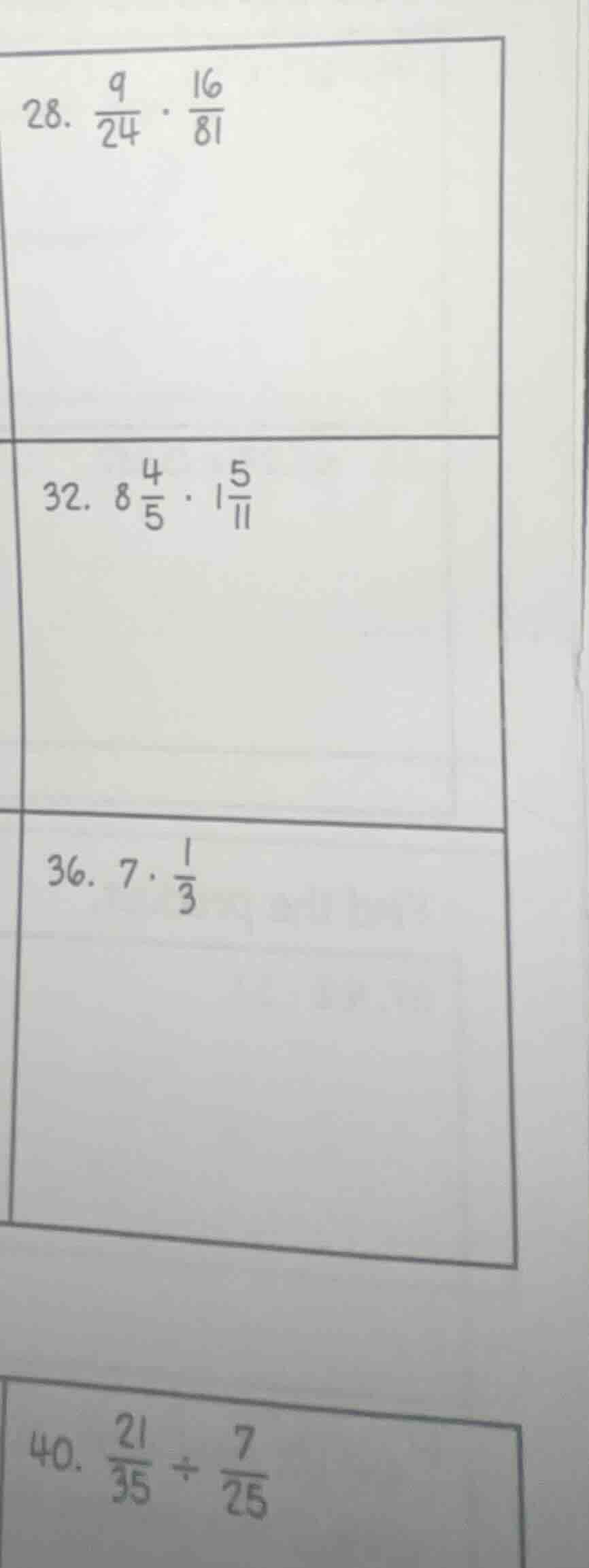
Question
- \\(\frac{9}{24} cdot \frac{16}{81}\\)
- \\(8\frac{4}{5} cdot 1\frac{5}{11}\\)
- \\(7 cdot \frac{1}{3}\\)
- \\(\frac{21}{35} div \frac{7}{25}\\)
Problem 28: $\boldsymbol{\frac{9}{24} \cdot \frac{16}{81}}$
Step1: Simplify fractions before multiplying.
We can simplify $\frac{9}{24}$ by dividing numerator and denominator by 3: $\frac{9\div3}{24\div3}=\frac{3}{8}$. Also, simplify $\frac{16}{81}$ (no common factors with 3 or 8, but we can cross - simplify 9 and 81, 16 and 24). 9 and 81 have a common factor of 9: $\frac{9\div9}{81\div9}=\frac{1}{9}$. 16 and 24 have a common factor of 8: $\frac{16\div8}{24\div8}=\frac{2}{3}$. Now the expression becomes $\frac{1}{3}\cdot\frac{2}{9}$ (wait, actually, original cross - simplification: 9 and 81: 9 is in numerator of first fraction, 81 in denominator of second. 9/81 = 1/9. 16 and 24: 16 in numerator of second, 24 in denominator of first. 16/24 = 2/3. So now we have $\frac{1}{3}\cdot\frac{2}{9}$? Wait, no, original fractions: $\frac{9}{24}\times\frac{16}{81}=\frac{9\times16}{24\times81}$. Let's factor numerator and denominator: 9 = 3×3, 16 = 2×2×2×2, 24 = 2×2×2×3, 81 = 3×3×3×3. So numerator: 3×3×2×2×2×2. Denominator: 2×2×2×3×3×3×3. Cancel out common factors: 3×3 (from numerator and denominator), 2×2×2 (from numerator and denominator). We are left with $\frac{2\times2}{3\times3\times3}=\frac{4}{27}$? Wait, no, let's do it step by step. $\frac{9}{24}\times\frac{16}{81}=\frac{9\times16}{24\times81}$. Divide numerator and denominator by 9: $\frac{1\times16}{24\times9}$. Then divide numerator and denominator by 8: $\frac{1\times2}{3\times9}=\frac{2}{27}$? Wait, I made a mistake earlier. Let's do it correctly. $\frac{9}{24}\times\frac{16}{81}=\frac{9\times16}{24\times81}$. 9 and 81: GCD(9,81)=9. So 9÷9 = 1, 81÷9 = 9. 16 and 24: GCD(16,24)=8. 16÷8 = 2, 24÷8 = 3. So now we have $\frac{1\times2}{3\times9}=\frac{2}{27}$. Wait, no, 9/24 ×16/81 = (9×16)/(24×81). Let's divide numerator and denominator by 9: (1×16)/(24×9). Then divide numerator and denominator by 8: (1×2)/(3×9)=2/27. Wait, but 9×16 = 144, 24×81 = 1944. 144/1944 = divide numerator and denominator by 72: 2/27. Yes, that's correct.
Step2: Multiply the simplified fractions.
After cross - simplifying, we have $\frac{1}{3}\times\frac{2}{9}$? No, better way: $\frac{9}{24}\times\frac{16}{81}=\frac{9\times16}{24\times81}=\frac{144}{1944}$. Now divide numerator and denominator by 72: 144÷72 = 2, 1944÷72 = 27. So $\frac{2}{27}$.
Step1: Convert mixed numbers to improper fractions.
To convert $8\frac{4}{5}$ to an improper fraction: $8\times5 + 4=40 + 4 = 44$, so $8\frac{4}{5}=\frac{44}{5}$. To convert $1\frac{5}{11}$ to an improper fraction: $1\times11+5 = 16$, so $1\frac{5}{11}=\frac{16}{11}$.
Step2: Multiply the improper fractions.
$\frac{44}{5}\times\frac{16}{11}$. Now, simplify before multiplying. 44 and 11 have a common factor of 11: $\frac{44\div11}{11\div11}=\frac{4}{1}$. So now the expression becomes $\frac{4}{5}\times16=\frac{4\times16}{5}=\frac{64}{5}=12\frac{4}{5}$.
Step1: Recall the rule for multiplying an integer by a fraction.
When multiplying an integer $a$ by a fraction $\frac{b}{c}$, we use the rule $a\times\frac{b}{c}=\frac{a\times b}{c}$. Here, $a = 7$, $b = 1$, $c = 3$.
Step2: Apply the rule.
$7\times\frac{1}{3}=\frac{7\times1}{3}=\frac{7}{3}=2\frac{1}{3}$.

Snap & solve any problem in the app
Get step-by-step solutions on Sovi AI
Photo-based solutions with guided steps
Explore more problems and detailed explanations
$\frac{2}{27}$