QUESTION IMAGE
Question
28 mark for review
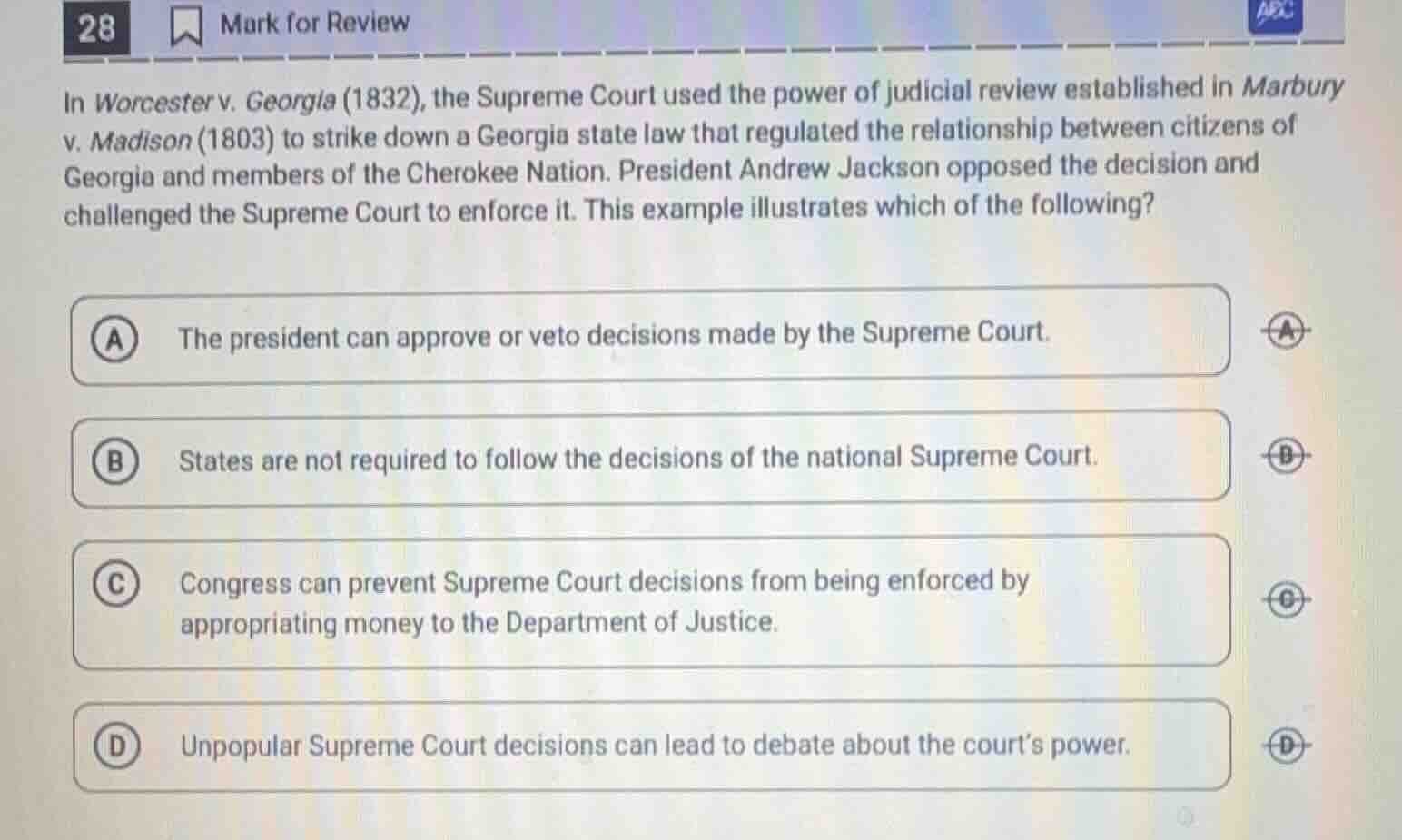
in worcester v. georgia (1832), the supreme court used the power of judicial review established in marbury v. madison (1803) to strike down a georgia state law that regulated the relationship between citizens of georgia and members of the cherokee nation. president andrew jackson opposed the decision and challenged the supreme court to enforce it. this example illustrates which of the following?
a the president can approve or veto decisions made by the supreme court.
b states are not required to follow the decisions of the national supreme court.
c congress can prevent supreme court decisions from being enforced by appropriating money to the department of justice.
d unpopular supreme court decisions can lead to debate about the court’s power.
- Option A is incorrect: The president has no constitutional power to approve or veto Supreme Court decisions; the veto applies to congressional legislation.
- Option B is incorrect: Under the Supremacy Clause, states are required to follow federal Supreme Court rulings, even if they disagree.
- Option C is incorrect: The scenario does not involve Congress or funding for the Department of Justice; it centers on the president's reaction.
- Option D is correct: President Jackson's opposition to the Worcester v. Georgia ruling, and his challenge to the Court's ability to enforce it, shows that an unpopular Supreme Court decision can spark debate over the court's authority and enforceability of its rulings.

Snap & solve any problem in the app
Get step-by-step solutions on Sovi AI
Photo-based solutions with guided steps
Explore more problems and detailed explanations
D. Unpopular Supreme Court decisions can lead to debate about the court’s power.