QUESTION IMAGE
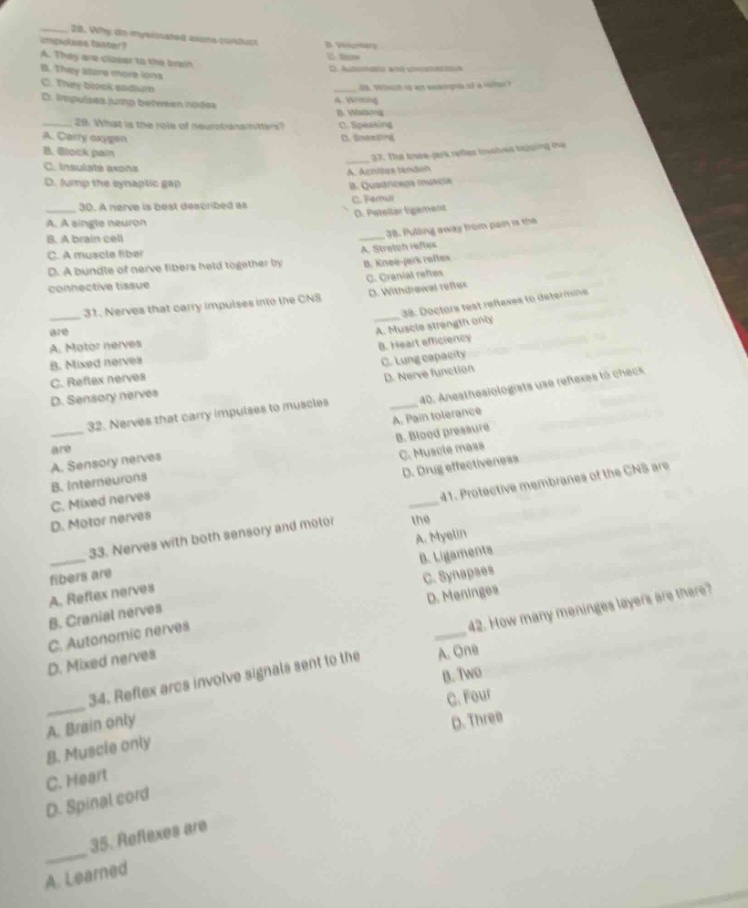
Question
- why do myelinated axons conduct impulses faster?
a. they are closer to the brain
b. they store more ions
c. they block sodium
d. impulses jump between nodes
- what is the role of neurotransmitters?
a. carry oxygen
b. block pain
c. insulate axons
d. jump the synaptic gap
- a nerve is best described as
a. a single neuron
b. a brain cell
c. a muscle fiber
d. a bundle of nerve fibers held together by connective tissue
- nerves that carry impulses into the cns are
a. motor nerves
b. mixed nerves
c. reflex nerves
d. sensory nerves
- nerves that carry impulses to muscles are
a. sensory nerves
b. interneurons
c. mixed nerves
d. motor nerves
- nerves with both sensory and motor fibers are
a. reflex nerves
b. cranial nerves
c. autonomic nerves
d. mixed nerves
- reflex arcs involve signals sent to the
a. brain only
b. muscle only
c. heart
d. spinal cord
- reflexes are
a. learned
b. voluntary
c. slow and uncoordinated
d. automatic and unconscious
- which is an example of a reflex?
a. yawning
b. walking
c. sneezing
d. sneezing
- the knee - jerk reflex involves tapping the
a. achilles tendon
b. quadriceps muscle
c. femur
d. patellar ligament
- pulling away from pain is the
a. stretch reflex
b. knee - jerk reflex
c. cranial reflex
d. withdrawal reflex
- doctors test reflexes to determine
a. muscle strength only
b. heart efficiency
c. lung capacity
d. nerve function
- anesthesiologists use reflexes to check
a. pain tolerance
b. blood pressure
c. muscle mass
d. drug effectiveness
- protective membranes of the cns are the
a. myelin
b. ligaments
c. synapses
d. meninges
- how many meninges layers are there?
a. one
b. two
c. four
d. three
trigger action.
- Mixed nerves contain both sensory (input) and motor (output) fibers to handle two-way signals.
- Most reflex arcs send signals to the spinal cord first for rapid, involuntary response, bypassing the brain initially.
- Reflexes are involuntary, automatic responses to stimuli, requiring no conscious thought.
- Sneezing is an autonomic reflex triggered by irritants in the nasal passages; the others are voluntary actions.
- The knee-jerk reflex tests stretch of the quadriceps tendon, which connects to the patellar ligament (patellar reflex).
- Pulling away from pain is a withdrawal reflex, a protective response to harmful stimuli.
- Reflex tests assess the integrity of nerve pathways, so they primarily check nerve function.
- Anesthesiologists use reflexes to monitor how well anesthesia (drugs) is suppressing neural activity.
- The meninges are the three protective membranes surrounding the CNS (brain and spinal cord).
- The three meningeal layers are the dura mater, arachnoid mater, and pia mater.

Snap & solve any problem in the app
Get step-by-step solutions on Sovi AI
Photo-based solutions with guided steps
Explore more problems and detailed explanations
trigger action.
- Mixed nerves contain both sensory (input) and motor (output) fibers to handle two-way signals.
- Most reflex arcs send signals to the spinal cord first for rapid, involuntary response, bypassing the brain initially.
- Reflexes are involuntary, automatic responses to stimuli, requiring no conscious thought.
- Sneezing is an autonomic reflex triggered by irritants in the nasal passages; the others are voluntary actions.
- The knee-jerk reflex tests stretch of the quadriceps tendon, which connects to the patellar ligament (patellar reflex).
- Pulling away from pain is a withdrawal reflex, a protective response to harmful stimuli.
- Reflex tests assess the integrity of nerve pathways, so they primarily check nerve function.
- Anesthesiologists use reflexes to monitor how well anesthesia (drugs) is suppressing neural activity.
- The meninges are the three protective membranes surrounding the CNS (brain and spinal cord).
- The three meningeal layers are the dura mater, arachnoid mater, and pia mater.