QUESTION IMAGE
Question
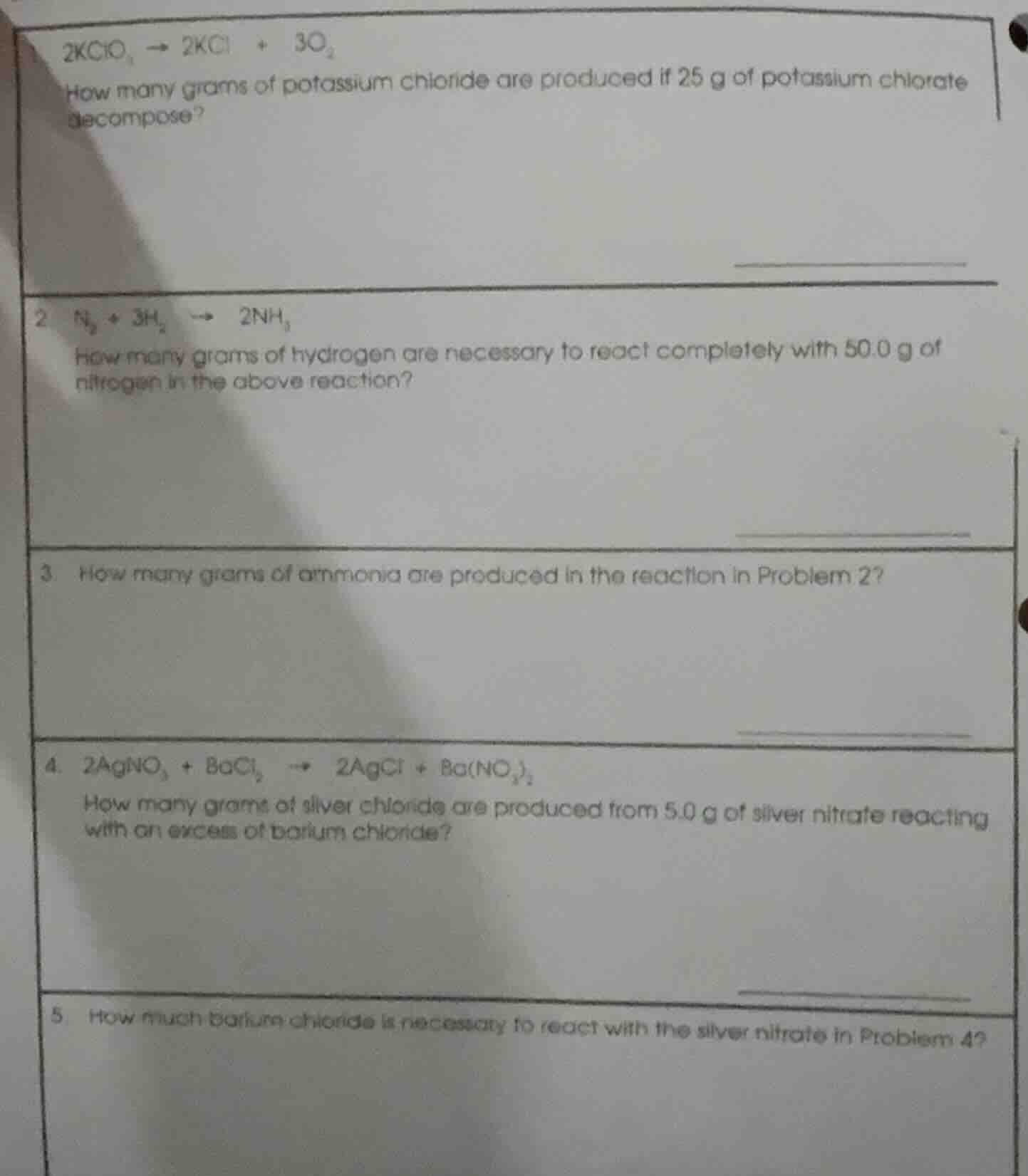
$2kclo_3 \
ightarrow 2kcl + 3o_2$
how many grams of potassium chloride are produced if 25 g of potassium chlorate decompose?
- $n_2 + 3h_2 \
ightarrow 2nh_3$
how many grams of hydrogen are necessary to react completely with 50.0 g of nitrogen in the above reaction?
- how many grams of ammonia are produced in the reaction in problem 2?
- $2agno_3 + bacl_2 \
ightarrow 2agcl + ba(no_3)_2$
how many grams of silver chloride are produced from 5.0 g of silver nitrate reacting with an excess of barium chloride?
- how much barium chloride is necessary to react with the silver nitrate in problem 4?
---
Problem 1
Step1: Calculate molar masses
Molar mass of $\text{KClO}_3$: $39.10 + 35.45 + 3\times16.00 = 122.55\ \text{g/mol}$
Molar mass of $\text{KCl}$: $39.10 + 35.45 = 74.55\ \text{g/mol}$
Step2: Moles of $\text{KClO}_3$ used
$\text{Moles of KClO}_3 = \frac{25\ \text{g}}{122.55\ \text{g/mol}} \approx 0.204\ \text{mol}$
Step3: Mole ratio (1:1)
From reaction $2\text{KClO}_3
ightarrow 2\text{KCl} + 3\text{O}_2$, mole ratio $\text{KClO}_3:\text{KCl}=1:1$, so $\text{Moles of KCl}=0.204\ \text{mol}$
Step4: Mass of $\text{KCl}$ produced
$\text{Mass of KCl} = 0.204\ \text{mol} \times 74.55\ \text{g/mol} \approx 15.2\ \text{g}$
---
Problem 2
Step1: Calculate molar masses
Molar mass of $\text{N}_2$: $2\times14.01 = 28.02\ \text{g/mol}$
Molar mass of $\text{H}_2$: $2\times1.008 = 2.016\ \text{g/mol}$
Step2: Moles of $\text{N}_2$ used
$\text{Moles of N}_2 = \frac{50.0\ \text{g}}{28.02\ \text{g/mol}} \approx 1.784\ \text{mol}$
Step3: Mole ratio ($\text{N}_2:\text{H}_2=1:3$)
$\text{Moles of H}_2 = 1.784\ \text{mol} \times 3 = 5.352\ \text{mol}$
Step4: Mass of $\text{H}_2$ needed
$\text{Mass of H}_2 = 5.352\ \text{mol} \times 2.016\ \text{g/mol} \approx 10.8\ \text{g}$
---
Problem 3
Step1: Molar mass of $\text{NH}_3$
Molar mass of $\text{NH}_3$: $14.01 + 3\times1.008 = 17.034\ \text{g/mol}$
Step2: Mole ratio ($\text{N}_2:\text{NH}_3=1:2$)
From Problem 2, $\text{Moles of N}_2=1.784\ \text{mol}$, so $\text{Moles of NH}_3=1.784\ \text{mol} \times 2 = 3.568\ \text{mol}$
Step3: Mass of $\text{NH}_3$ produced
$\text{Mass of NH}_3 = 3.568\ \text{mol} \times 17.034\ \text{g/mol} \approx 60.8\ \text{g}$
---
Problem 4
Step1: Calculate molar masses
Molar mass of $\text{AgNO}_3$: $107.87 + 14.01 + 3\times16.00 = 169.88\ \text{g/mol}$
Molar mass of $\text{AgCl}$: $107.87 + 35.45 = 143.32\ \text{g/mol}$
Step2: Moles of $\text{AgNO}_3$ used
$\text{Moles of AgNO}_3 = \frac{5.0\ \text{g}}{169.88\ \text{g/mol}} \approx 0.0294\ \text{mol}$
Step3: Mole ratio (1:1)
From reaction $2\text{AgNO}_3 + \text{BaCl}_2
ightarrow 2\text{AgCl} + \text{Ba(NO}_3\text{)}_2$, mole ratio $\text{AgNO}_3:\text{AgCl}=1:1$, so $\text{Moles of AgCl}=0.0294\ \text{mol}$
Step4: Mass of $\text{AgCl}$ produced
$\text{Mass of AgCl} = 0.0294\ \text{mol} \times 143.32\ \text{g/mol} \approx 4.2\ \text{g}$
---
Problem 5
Step1: Molar mass of $\text{BaCl}_2$
Molar mass of $\text{BaCl}_2$: $137.33 + 2\times35.45 = 208.23\ \text{g/mol}$
Step2: Mole ratio ($\text{AgNO}_3:\text{BaCl}_2=2:1$)
From Problem 4, $\text{Moles of AgNO}_3=0.0294\ \text{mol}$, so $\text{Moles of BaCl}_2 = \frac{0.0294\ \text{mol}}{2} = 0.0147\ \text{mol}$
Step3: Mass of $\text{BaCl}_2$ needed
$\text{Mass of BaCl}_2 = 0.0147\ \text{mol} \times 208.23\ \text{g/mol} \approx 3.06\ \text{g}$

Snap & solve any problem in the app
Get step-by-step solutions on Sovi AI
Photo-based solutions with guided steps
Explore more problems and detailed explanations
- $\approx 15.2$ grams of potassium chloride
- $\approx 10.8$ grams of hydrogen
- $\approx 60.8$ grams of ammonia
- $\approx 4.2$ grams of silver chloride
- $\approx 3.1$ grams of barium chloride