QUESTION IMAGE
Question
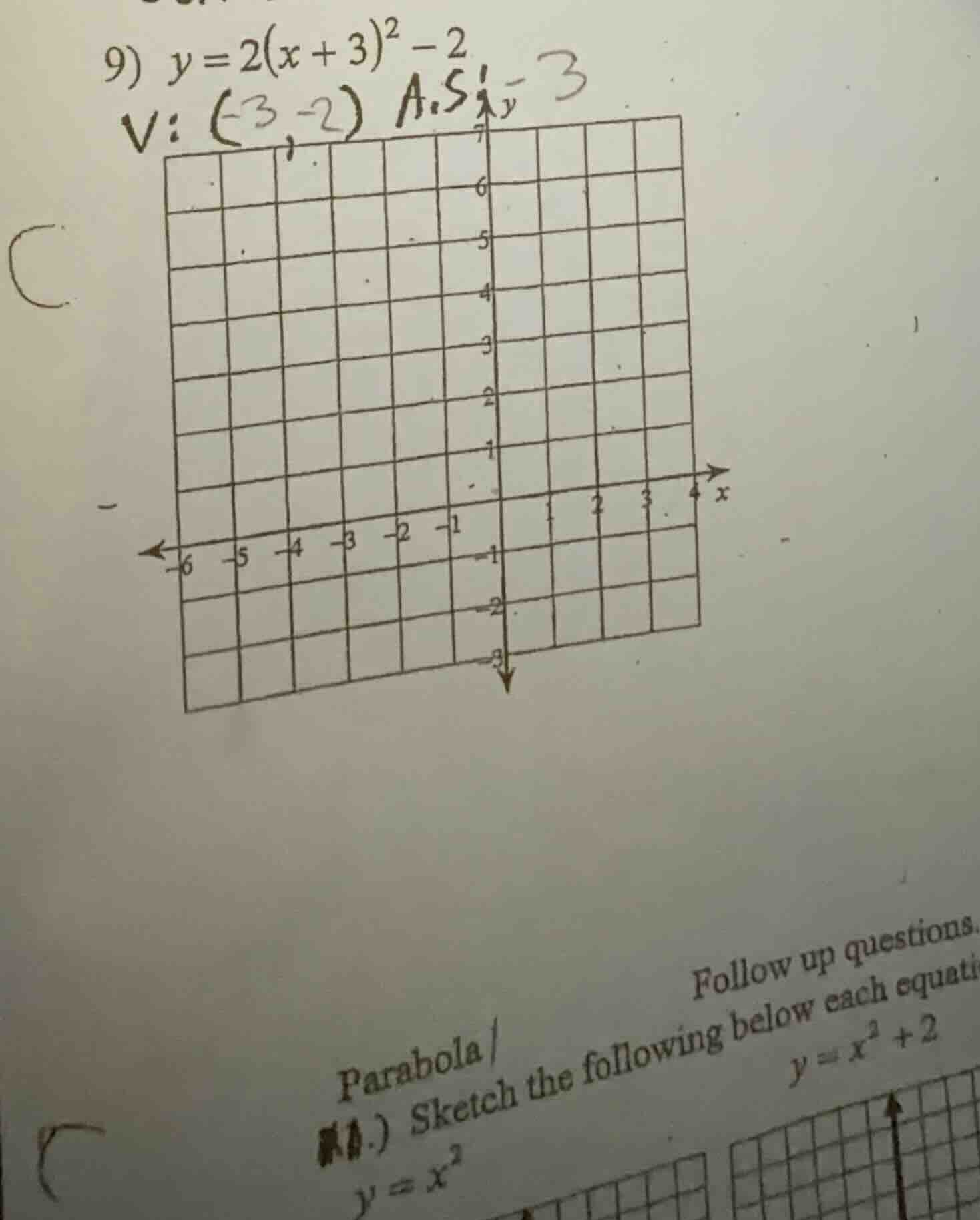
- $y = 2(x + 3)^2 - 2$
v: $(-3, -2)$ a.s: -3
follow up questions.
parabola /
11.) sketch the following below each equati
$y = x^2$
$y = x^2 + 2$
To analyze the parabola \( y = 2(x + 3)^2 - 2 \) and sketch it (or confirm its vertex and axis of symmetry):
Step 1: Identify the Vertex Form
The vertex form of a parabola is \( y = a(x - h)^2 + k \), where \((h, k)\) is the vertex, and \( x = h \) is the axis of symmetry.
For \( y = 2(x + 3)^2 - 2 \), rewrite \( (x + 3) \) as \( (x - (-3)) \). Thus:
- \( h = -3 \) (from \( x - (-3) \))
- \( k = -2 \) (the constant term)
Step 2: Determine the Vertex
The vertex \((h, k)\) is \( (-3, -2) \), as found from the vertex form.
Step 3: Determine the Axis of Symmetry
The axis of symmetry for a parabola in vertex form is \( x = h \). Here, \( h = -3 \), so the axis of symmetry is \( x = -3 \).
Step 4: Sketching the Parabola (Brief)
- Vertex: Plot \( (-3, -2) \) on the grid.
- Direction: Since \( a = 2 > 0 \), the parabola opens upward.
- Key Points: Use the axis of symmetry (\( x = -3 \)) to find symmetric points. For example:
- When \( x = -2 \) (1 unit right of the vertex), \( y = 2(-2 + 3)^2 - 2 = 2(1)^2 - 2 = 0 \), so the point is \( (-2, 0) \).
- When \( x = -4 \) (1 unit left of the vertex), \( y = 2(-4 + 3)^2 - 2 = 2(-1)^2 - 2 = 0 \), so the point is \( (-4, 0) \).
Final Answer (for Vertex and Axis of Symmetry)
- Vertex: \( \boldsymbol{(-3, -2)} \)
- Axis of Symmetry: \( \boldsymbol{x = -3} \)
(If the task was to sketch, the graph would have the vertex at \((-3, -2)\), open upward, and pass through \((-4, 0)\) and \((-2, 0)\), with symmetry about \( x = -3 \).)

Snap & solve any problem in the app
Get step-by-step solutions on Sovi AI
Photo-based solutions with guided steps
Explore more problems and detailed explanations
To analyze the parabola \( y = 2(x + 3)^2 - 2 \) and sketch it (or confirm its vertex and axis of symmetry):
Step 1: Identify the Vertex Form
The vertex form of a parabola is \( y = a(x - h)^2 + k \), where \((h, k)\) is the vertex, and \( x = h \) is the axis of symmetry.
For \( y = 2(x + 3)^2 - 2 \), rewrite \( (x + 3) \) as \( (x - (-3)) \). Thus:
- \( h = -3 \) (from \( x - (-3) \))
- \( k = -2 \) (the constant term)
Step 2: Determine the Vertex
The vertex \((h, k)\) is \( (-3, -2) \), as found from the vertex form.
Step 3: Determine the Axis of Symmetry
The axis of symmetry for a parabola in vertex form is \( x = h \). Here, \( h = -3 \), so the axis of symmetry is \( x = -3 \).
Step 4: Sketching the Parabola (Brief)
- Vertex: Plot \( (-3, -2) \) on the grid.
- Direction: Since \( a = 2 > 0 \), the parabola opens upward.
- Key Points: Use the axis of symmetry (\( x = -3 \)) to find symmetric points. For example:
- When \( x = -2 \) (1 unit right of the vertex), \( y = 2(-2 + 3)^2 - 2 = 2(1)^2 - 2 = 0 \), so the point is \( (-2, 0) \).
- When \( x = -4 \) (1 unit left of the vertex), \( y = 2(-4 + 3)^2 - 2 = 2(-1)^2 - 2 = 0 \), so the point is \( (-4, 0) \).
Final Answer (for Vertex and Axis of Symmetry)
- Vertex: \( \boldsymbol{(-3, -2)} \)
- Axis of Symmetry: \( \boldsymbol{x = -3} \)
(If the task was to sketch, the graph would have the vertex at \((-3, -2)\), open upward, and pass through \((-4, 0)\) and \((-2, 0)\), with symmetry about \( x = -3 \).)