QUESTION IMAGE
Question
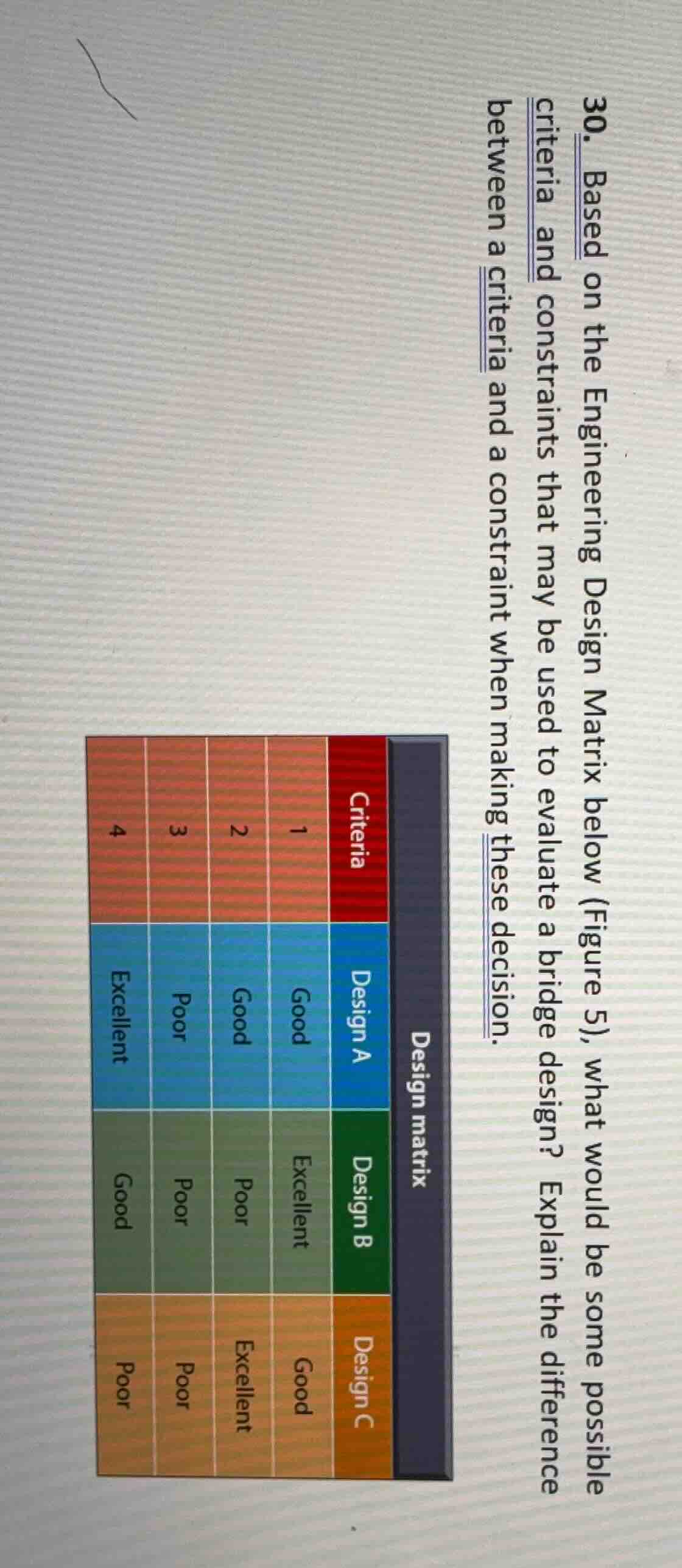
- based on the engineering design matrix below (figure 5), what would be some possible criteria and constraints that may be used to evaluate a bridge design? explain the difference between a criteria and a constraint when making these decision.
design matrix
criteria
design a
design b
design c
1
good
excellent
good
2
good
poor
excellent
3
poor
poor
poor
4
excellent
good
poor
Brief Explanations
- Criteria: These are measurable, comparative factors used to rank the quality of each bridge design (e.g., how well Design A performs on structural integrity vs. Design B). They help score and compare options.
- Constraints: These are fixed, non-negotiable limits that all valid designs must satisfy (e.g., staying under a set budget or meeting legal safety codes). A design that violates a constraint is immediately disqualified, regardless of its performance against criteria.
- For the given matrix, criteria align with the 4 evaluation columns, where each design is rated (Good/Excellent/Poor) against these standards, while constraints are the mandatory rules that define which designs are even eligible for this evaluation.

Snap & solve any problem in the app
Get step-by-step solutions on Sovi AI
Photo-based solutions with guided steps
Explore more problems and detailed explanations
Possible Criteria:
- Structural Integrity
- Cost Efficiency
- Construction Time
- Environmental Impact
Possible Constraints:
- Maximum Allowable Budget
- Legal Building Code Requirements
- Project Deadline
- Load-Bearing Capacity Limits
Difference:
Criteria are evaluative standards to compare design quality; constraints are non-negotiable limits that designs must meet to be viable.