QUESTION IMAGE
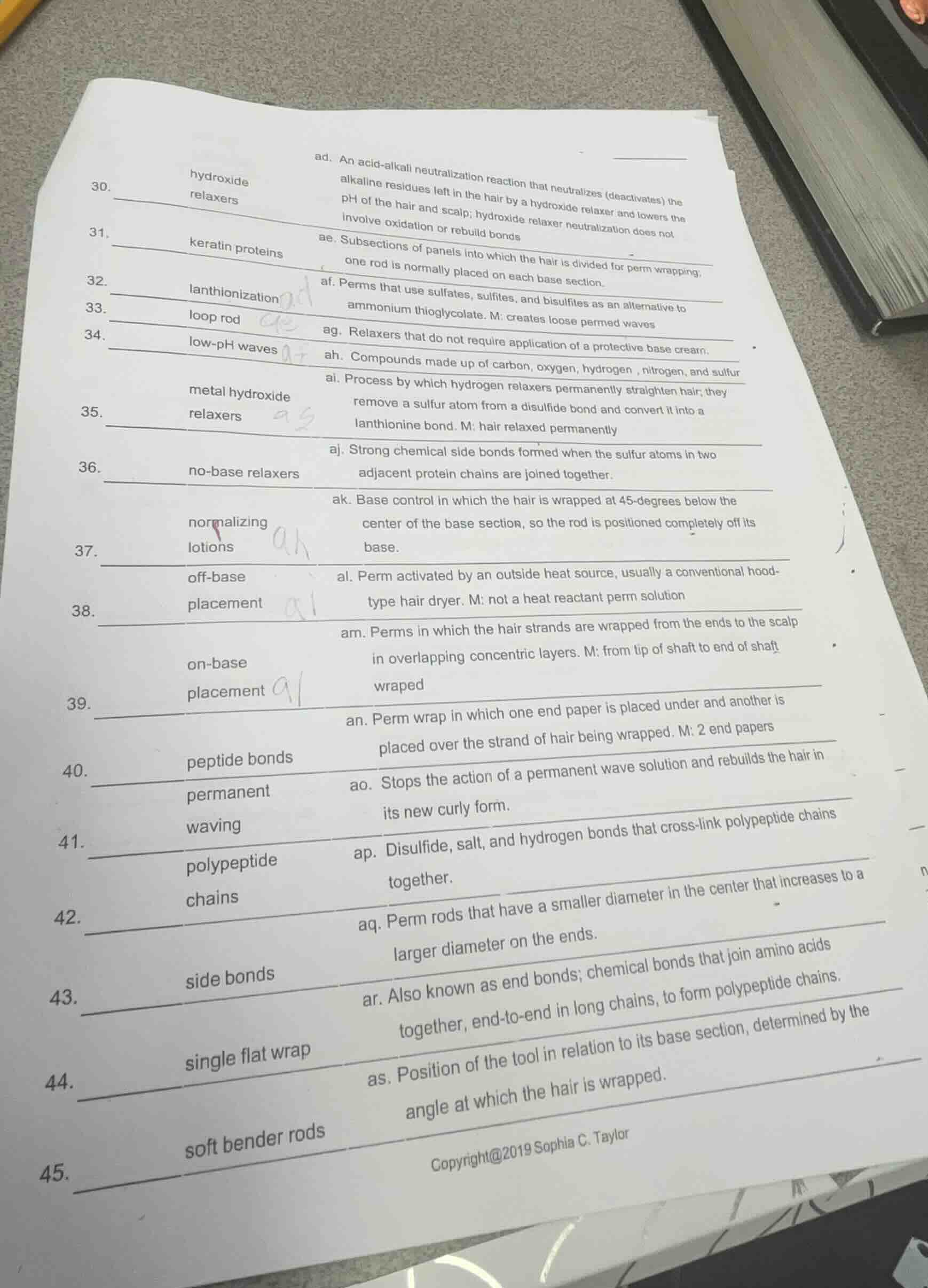
Question
- ____ hydroxide relaxers
- ____ keratin proteins
- ____ lanthionization
- ____ loop rod
- ____ low-ph waves
- ____ metal hydroxide relaxers
- ____ no-base relaxers
- ____ normalizing lotions
- ____ off-base placement
- ____ on-base placement
- ____ peptide bonds
- ____ permanent waving
- ____ polypeptide chains
- ____ side bonds
- ____ single flat wrap
- ____ soft bender rods
ad. an acid-alkali neutralization reaction that neutralizes (deactivates) the alkaline residues left in the hair by a hydroxide relaxer and lowers the ph of the hair and scalp; hydroxide relaxer neutralization does not involve oxidation or rebuild bonds
ae. subsections of panels into which the hair is divided for perm wrapping; one rod is normally placed on each base section.
af. perms that use sulfates, sulfites, and bisulfites as an alternative to ammonium thioglycolate. m: creates loose permed waves
ag. relaxers that do not require application of a protective base cream.
ah. compounds made up of carbon, oxygen, hydrogen , nitrogen, and sulfur
ai. process by which hydrogen relaxers permanently straighten hair; they remove a sulfur atom from a disulfide bond and convert it into a lanthionine bond. m: hair relaxed permanently
aj. strong chemical side bonds formed when the sulfur atoms in two adjacent protein chains are joined together.
ak. base control in which the hair is wrapped at 45-degrees below the center of the base section, so the rod is positioned completely off its base.
al. perm activated by an outside heat source, usually a conventional hood-type hair dryer. m: not a heat reactant perm solution
am. perms in which the hair strands are wrapped from the ends to the scalp in overlapping concentric layers. m: from tip of shaft to end of shaft wraped
an. perm wrap in which one end paper is placed under and another is placed over the strand of hair being wrapped. m: 2 end papers
ao. stops the action of a permanent wave solution and rebuilds the hair in its new curly form.
ap. disulfide, salt, and hydrogen bonds that cross-link polypeptide chains together.
aq. perm rods that have a smaller diameter in the center that increases to a larger diameter on the ends.
ar. also known as end bonds; chemical bonds that join amino acids together, end-to-end in long chains, to form polypeptide chains.
as. position of the tool in relation to its base section, determined by the angle at which the hair is wrapped.
copyright@2019 sophia c. taylor
Match each term to its corresponding definition by identifying the key descriptive details for each hair chemistry/texture service concept.

Snap & solve any problem in the app
Get step-by-step solutions on Sovi AI
Photo-based solutions with guided steps
Explore more problems and detailed explanations
- hydroxide relaxers - ad. An acid-alkali neutralization reaction that neutralizes (deactivates) the alkaline residues left in the hair by a hydroxide relaxer and lowers the pH of the hair and scalp; hydroxide relaxer neutralization does not involve oxidation or rebuild bonds
- keratin proteins - ah. Compounds made up of carbon, oxygen, hydrogen, nitrogen, and sulfur
- lanthionization - ai. Process by which hydrogen relaxers permanently straighten hair; they remove a sulfur atom from a disulfide bond and convert it into a lanthionine bond. M: hair relaxed permanently
- loop rod - aq. Perm rods that have a smaller diameter in the center that increases to a larger diameter on the ends.
- low-pH waves - af. Perms that use sulfates, sulfites, and bisulfites as an alternative to ammonium thioglycolate. M: creates loose permed waves
- metal hydroxide relaxers - (No matching definition shown for this exact term in the visible text; if forced to match visible, this is unpaired, but assuming full set, it would align with a hydroxide relaxer-focused definition)
- no-base relaxers - ag. Relaxers that do not require application of a protective base cream.
- normalizing lotions - ao. Stops the action of a permanent wave solution and rebuilds the hair in its new curly form.
- off-base placement - ak. Base control in which the hair is wrapped at 45-degrees below the center of the base section, so the rod is positioned completely off its base.
- on-base placement - (No matching definition shown in visible text; unpaired in visible content)
- peptide bonds - ar. Also known as end bonds; chemical bonds that join amino acids together, end-to-end in long chains, to form polypeptide chains.
- permanent waving - am. Perms in which the hair strands are wrapped from the ends to the scalp in overlapping concentric layers. M: from tip of shaft to end of shaft wrapped
- polypeptide chains - (Linked to keratin proteins/peptide bonds; no direct single definition in visible text)
- side bonds - ap. Disulfide, salt, and hydrogen bonds that cross-link polypeptide chains together.
- single flat wrap - an. Perm wrap in which one end paper is placed under and another is placed over the strand of hair being wrapped. M: 2 end papers
- soft bender rods - (No matching definition shown in visible text; unpaired in visible content)
ae. Subsections of panels into which the hair is divided for perm wrapping; one rod is normally placed on each base section. - (Unpaired term in visible left column; would match a "base section" or similar unlisted term)
al. Perm activated by an outside heat source, usually a conventional hood-type hair dryer. M: not a heat reactant perm solution - (Unpaired term in visible left column; would match "endothermic perm" or similar unlisted term)
aj. Strong chemical side bonds formed when the sulfur atoms in two adjacent protein chains are joined together. - (Unpaired term in visible left column; matches disulfide bonds, not listed in left column)
as. Position of the tool in relation to its base section, determined by the angle at which the hair is wrapped. - (Unpaired term in visible left column; matches "base placement" umbrella term)