QUESTION IMAGE
Question
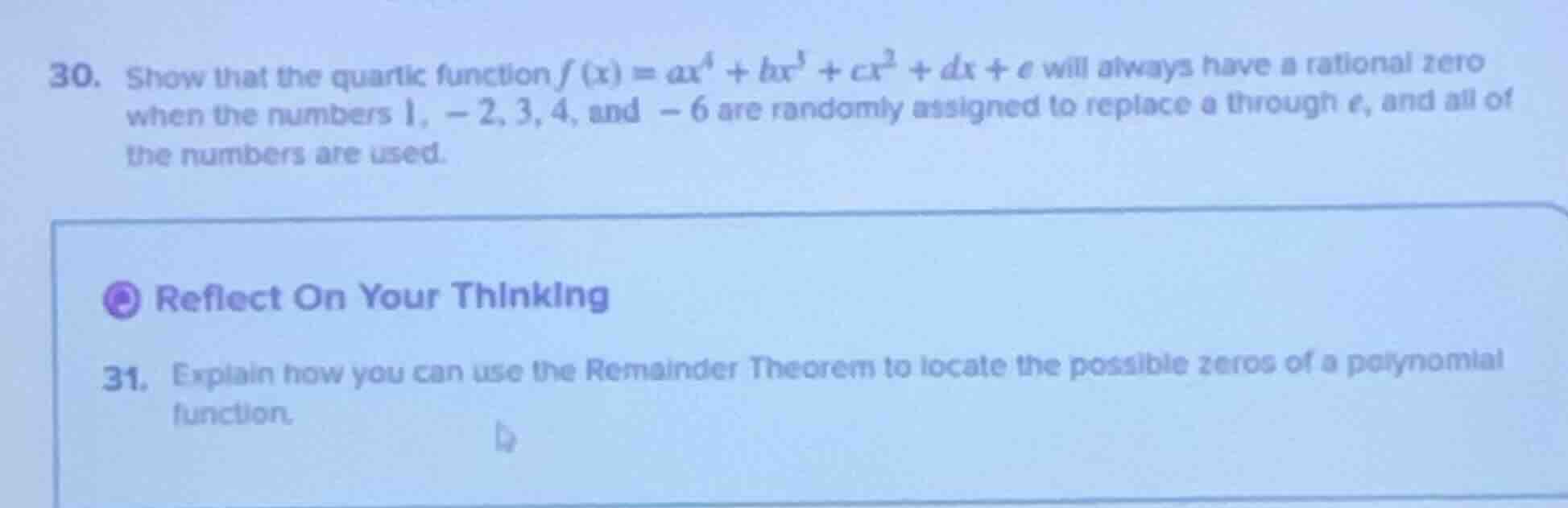
- show that the quartic function $f(x)=ax^4 + bx^3 + cx^2 + dx + e$ will always have a rational zero when the numbers $1, -2, 3, 4,$ and $-6$ are randomly assigned to replace $a$ through $e$, and all of the numbers are used.
reflect on your thinking
- explain how you can use the remainder theorem to locate the possible zeros of a polynomial function.
Question 30
Step 1: Recall Rational Root Theorem
The Rational Root Theorem states that any possible rational zero of a polynomial \( f(x) = a_nx^n + a_{n - 1}x^{n - 1}+\cdots+a_1x + a_0\) is of the form \(\frac{p}{q}\), where \(p\) is a factor of the constant term \(a_0\) and \(q\) is a factor of the leading coefficient \(a_n\). For our quartic function \(f(x)=ax^{4}+bx^{3}+cx^{2}+dx + e\), the possible rational zeros are \(\frac{\text{factors of } e}{\text{factors of } a}\).
Step 2: Analyze the sum of coefficients or specific values
Let's consider \(x = 1\). Then \(f(1)=a(1)^{4}+b(1)^{3}+c(1)^{2}+d(1)+e=a + b + c + d+e\). The numbers assigned to \(a,b,c,d,e\) are \(1,- 2,3,4,-6\). Let's calculate the sum: \(1+( - 2)+3 + 4+( - 6)=(1 + 3+4)+(-2-6)=8 - 8 = 0\).
Step 3: Conclude the rational zero
Since \(f(1)=0\) (because the sum of the coefficients \(a + b + c + d+e = 0\) when we substitute \(x = 1\) into the polynomial), \(x = 1\) is a zero of the polynomial \(f(x)\) for any assignment of the numbers \(1,-2,3,4,-6\) to \(a,b,c,d,e\) (as long as all numbers are used). And \(1\) is a rational number (since it can be written as \(\frac{1}{1}\)). So the quartic function will always have a rational zero (specifically \(x = 1\)).
The Remainder Theorem states that if a polynomial \(f(x)\) is divided by \((x - k)\), the remainder is \(f(k)\). A zero of a polynomial \(f(x)\) is a value \(k\) such that \(f(k)=0\). To locate possible zeros:
- First, use the Rational Root Theorem to find all possible rational candidates for zeros (values of \(k\)) in the form \(\frac{p}{q}\) (where \(p\) divides the constant term and \(q\) divides the leading coefficient).
- Then, for each candidate \(k\), evaluate \(f(k)\) (using the Remainder Theorem, which is equivalent to finding the remainder when \(f(x)\) is divided by \((x - k)\)).
- If \(f(k)=0\), then \(k\) is a zero of the polynomial. By testing these candidate values, we can identify the actual zeros (or narrow down the possible zeros) of the polynomial function.

Snap & solve any problem in the app
Get step-by-step solutions on Sovi AI
Photo-based solutions with guided steps
Explore more problems and detailed explanations
The quartic function \(f(x)\) always has \(x = 1\) as a rational zero because \(f(1)=a + b + c + d+e\) and the sum of \(1,-2,3,4,-6\) is \(0\), so \(f(1) = 0\).