QUESTION IMAGE
Question
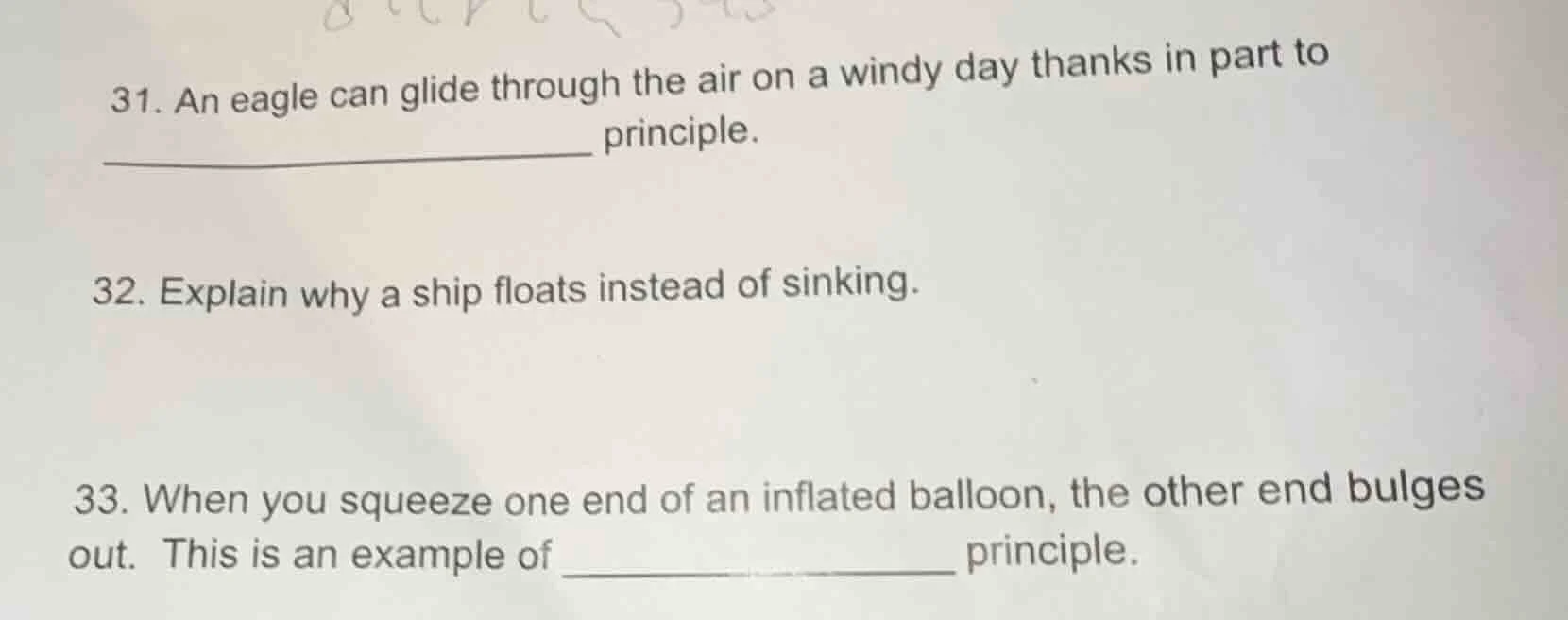
- an eagle can glide through the air on a windy day thanks in part to
____________________ principle.
- explain why a ship floats instead of sinking.
- when you squeeze one end of an inflated balloon, the other end bulges
out. this is an example of _______________ principle.
Question 31
The eagle glides using the Bernoulli's principle. Bernoulli's principle states that as the speed of a fluid (air, in this case) increases, the pressure within the fluid decreases. The eagle's wings are shaped such that air flows faster over the top surface than the bottom surface. This creates a pressure difference (lower pressure above, higher pressure below), generating an upward lift force that allows the eagle to glide.
A ship floats due to Archimedes' principle. The principle states that the buoyant force (upward force) exerted on an object submerged in a fluid is equal to the weight of the fluid displaced by the object. A ship is hollow and has a large volume. When it is in water, it displaces a volume of water whose weight is equal to the weight of the ship (including its cargo). The buoyant force from the displaced water is equal to the ship's weight, so it balances the downward gravitational force, allowing the ship to float. If the weight of the displaced water (buoyant force) is greater than or equal to the ship's weight, it floats; if not, it would sink.
When squeezing one end of an inflated balloon, the other end bulges due to Pascal's principle. Pascal's principle states that a pressure change applied to an enclosed fluid is transmitted undiminished to every portion of the fluid and the walls of the containing vessel. The air inside the balloon is an enclosed fluid. When pressure is applied at one end (by squeezing), this pressure is transmitted equally throughout the air inside the balloon. To balance this pressure, the other end bulges out as the pressure forces the rubber to expand at that point.

Snap & solve any problem in the app
Get step-by-step solutions on Sovi AI
Photo-based solutions with guided steps
Explore more problems and detailed explanations
Bernoulli's