QUESTION IMAGE
Question
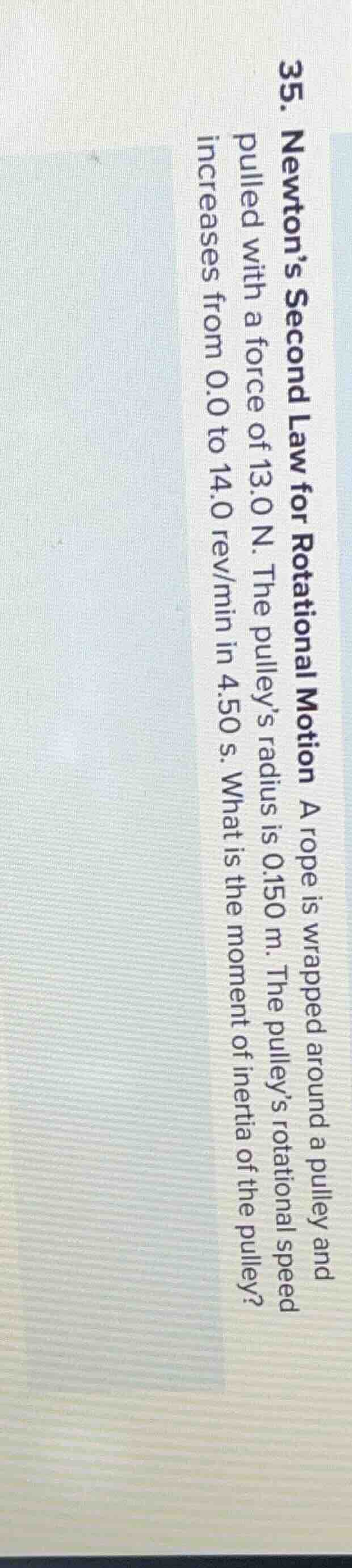
- newton’s second law for rotational motion a rope is wrapped around a pulley and pulled with a force of 13.0 n. the pulley’s radius is 0.150 m. the pulley’s rotational speed increases from 0.0 to 14.0 rev/min in 4.50 s. what is the moment of inertia of the pulley?
Step1: Convert rotational speed to angular velocity
First, convert the final rotational speed from rev/min to rad/s. The initial angular velocity \(\omega_0 = 0\) rad/s. The final rotational speed \(n = 14.0\) rev/min.
To convert to rad/s: \( \omega = 2\pi n / 60 \)
\( \omega = 2\pi \times 14.0 / 60 \approx 1.466\) rad/s
Step2: Calculate angular acceleration
Use the formula for angular acceleration \(\alpha = (\omega - \omega_0)/t\), where \(t = 4.50\) s.
\( \alpha = (1.466 - 0)/4.50 \approx 0.3258\) rad/s²
Step3: Calculate torque
Torque \(\tau = rF\), where \(r = 0.150\) m and \(F = 13.0\) N.
\( \tau = 0.150 \times 13.0 = 1.95\) N·m
Step4: Relate torque, angular acceleration, and moment of inertia
Use the rotational version of Newton's second law: \(\tau = I\alpha\), so \(I = \tau / \alpha\)
\( I = 1.95 / 0.3258 \approx 5.98\) kg·m²

Snap & solve any problem in the app
Get step-by-step solutions on Sovi AI
Photo-based solutions with guided steps
Explore more problems and detailed explanations
The moment of inertia of the pulley is approximately \(\boldsymbol{6.0}\) kg·m² (or more precisely \(\boldsymbol{5.98}\) kg·m²)