QUESTION IMAGE
Question
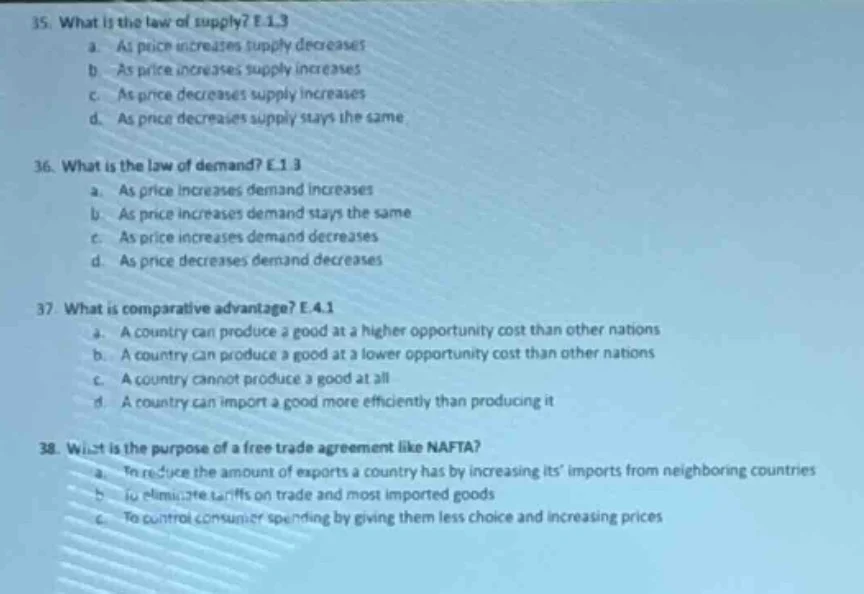
- what is the law of supply? e.1.3
a. as price increases supply decreases
b. as price increases supply increases
c. as price decreases supply increases
d. as price decreases supply stays the same
- what is the law of demand? e.1.3
a. as price increases demand increases
b. as price increases demand stays the same
c. as price increases demand decreases
d. as price decreases demand decreases
- what is comparative advantage? e.4.1
a. a country can produce a good at a higher opportunity cost than other nations
b. a country can produce a good at a lower opportunity cost than other nations
c. a country cannot produce a good at all
d. a country can import a good more efficiently than producing it
- what is the purpose of a free trade agreement like nafta?
a. to reduce the amount of exports a country has by increasing its’ imports from neighboring countries
b. to eliminate tariffs on trade and most imported goods
c. to control consumer spending by giving them less choice and increasing prices
- The law of supply states that, ceteris paribus, higher prices incentivize producers to supply more goods to maximize revenue.
- The law of demand holds that, ceteris paribus, higher prices lead consumers to demand fewer goods due to reduced purchasing power.
- Comparative advantage is defined by a nation's ability to produce a good with a lower opportunity cost than competitors, forming the basis for beneficial trade.
- Free trade agreements like NAFTA focus on reducing/removing trade barriers such as tariffs to facilitate cross-border trade.

Snap & solve any problem in the app
Get step-by-step solutions on Sovi AI
Photo-based solutions with guided steps
Explore more problems and detailed explanations
- b. As price increases supply increases
- c. As price increases demand decreases
- b. A country can produce a good at a lower opportunity cost than other nations
- b. To eliminate tariffs on trade and most imported goods